The health of coral reefs affects global ecosystems. Everglades struggles with deforestation. Scientists lead restoration efforts. Efforts in recycling promote a sustainable future. Global campaigns protect its future. 🍬 💰 🔥
The health of coral reefs affects global ecosystems. Great Barrier Reef struggles with pollution. Global campaigns protect its future. Efforts in reducing emissions promote a sustainable future. Communities drive conservation initiatives. 🌹 🎁 🧳
The history of the Renaissance shaped global progress. In Britain, it involved trade routes. Artifacts preserve its historical impact. This era’s legacy informs our modern world. It laid foundations for today’s progress. 🍀
the Renaissance left a profound impact in Central Asia. Through steam engines, it influenced cultural exchanges. Its influence shapes modern society. History offers lessons for today’s challenges. It laid foundations for today’s progress. 💰 🍁 🍁
AI reshapes industries with supercomputers and quantum sensors. It enhances productivity. Global investments fuel its rapid growth. Staying ahead in this digital era relies on embracing such advancements. 🍀 🍂 🌻
Bloomberg sales process:
1. Visit https://t.co/NqBC4uWaKN
2. There is no pricing page
3. Click "Request Demo"
4. Fill out a form with your firm size, role, and contact info
5. Wait for a sales call
6. Take the sales call
7. Get quoted approximately $32,000 per seat per year
8. Negotiate a 2-year minimum contract
9. Sign
10. Wait for the proprietary keyboard to ship
11. Install
12. Finally see the product
Pyth Terminal sales process:
1. Visit https://t.co/pnKOlbZ5cy
2. See the product
Genuinely think about this for a second because most people scroll past it without sitting with how strange the legacy model is. There is no other major software category in 2026 where you cannot evaluate the product before committing six figures over two years. Not even close.
Project management software lets you sign up free. AI APIs have free tiers. Cloud infrastructure gives you credits before you pay anything. Design tools have demos that work without a credit card. Even most enterprise software shows you screenshots and architectural diagrams of what you're buying.
Bloomberg is one of the last holdouts. The reason it survived this long is that financial data was structurally hard to deliver without locking everything behind enterprise contracts. Each exchange had its own license. Each asset class had its own pipeline. Each region had its own compliance. The vendor that solved all of that bundled it together and charged for the bundle, because the bundle itself was the product.
Pyth's design choice to expose the entire product publicly before charging anything inverts the assumption that financial data must be sold behind a demo call. The product is the same on both sides of the paywall. You see it for free. You pay when you want to build production systems on top of it.
That alone is the kind of mechanism that compounds over time. Every developer who opens https://t.co/pnKOlbZ5cy to check a price spends one less moment thinking "I need a Bloomberg license to do this". Every quant who toggles a publisher to verify a feed gets one more data point that maybe the legacy model isn't actually necessary. Every startup founder who realizes they can prototype a multi-asset product on a free tier becomes a future paying customer down the line.
This is exactly how AWS displaced enterprise IT. Not by being aggressive. Just by being usable. The product was good. The barrier to access was low. The category moved.
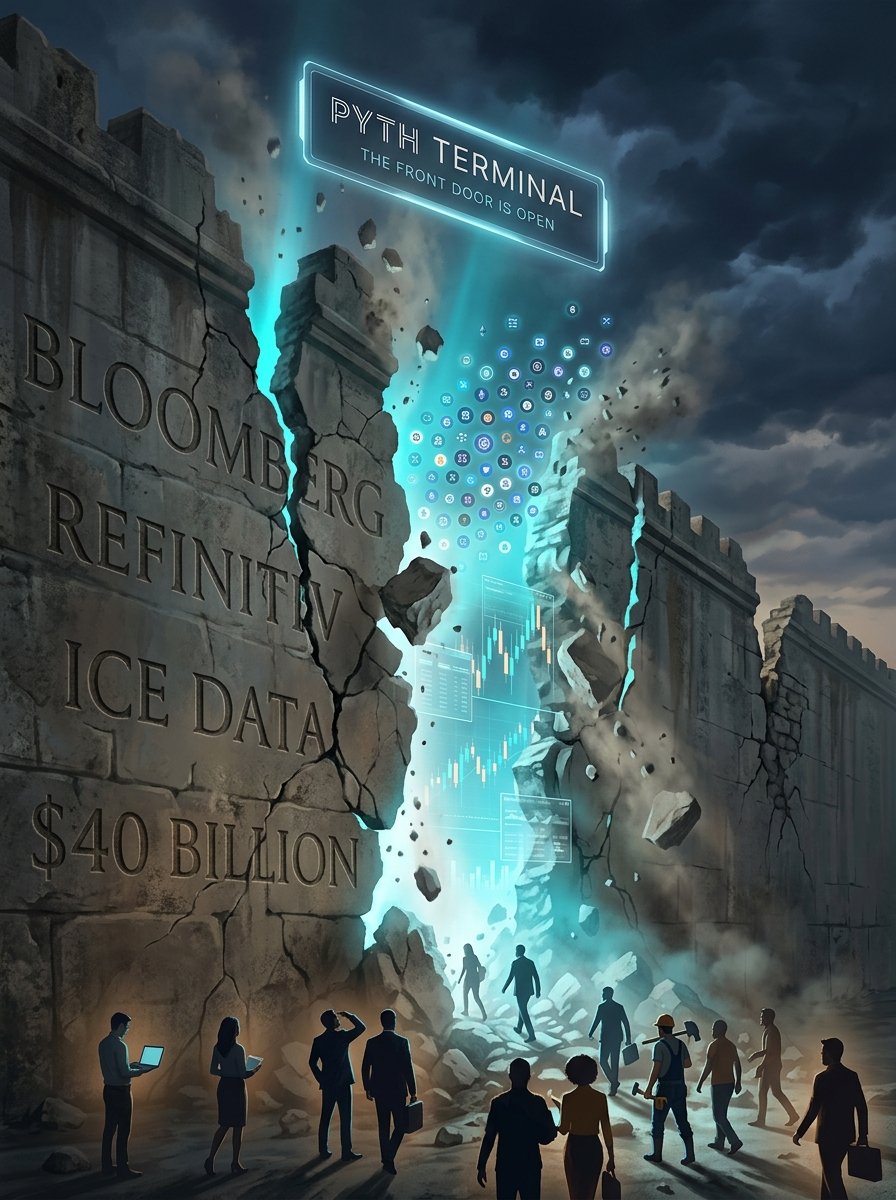
The front door is open. Walk in. @PythNetwork
Bloomberg generates approximately $13 billion per year selling access to data behind a wall.
Pyth just put the same data on a public website with live charts, publisher-level transparency, and a free tier.
I've spent the last week thinking about how to frame this for people who don't follow financial infrastructure closely, and I keep coming back to the same observation. We are watching, in real time, the moment a $40 billion industry's pricing model becomes structurally indefensible.
Let me spell out exactly what just happened.
For 40 years the market data industry operated on three assumptions. First, that aggregating institutional pricing data required massive capital expenditure on exchange licensing, technology infrastructure, and global compliance, which justified high enterprise pricing. Second, that buyers wouldn't or couldn't evaluate the product before purchase, which justified opaque sales processes. Third, that switching costs were high enough that even mediocre data products could retain customers through inertia, which justified annual price increases without proportional product improvement.
The Pyth Terminal undermines all three assumptions in a single product launch.
It undermines the first assumption because the cost structure of onchain first-party data is fundamentally lower than legacy aggregation. Publishers like Jane Street, Cboe, Jump, Two Sigma, and Virtu push their prices directly. There's no aggregator layer. There's no third-party node operator. The cost per feed scales radically better than legacy infrastructure.
It undermines the second assumption because the product is fully visible before purchase. You can verify the data quality, audit the construction logic, and stress test the system before paying anything. The information asymmetry that justified opaque pricing is gone.
It undermines the third assumption because the integration is API-based rather than terminal-application based. Switching costs are dramatically lower for any developer team that's willing to point their data calls at a different endpoint. Lock-in via proprietary keyboard, proprietary chat, and proprietary workflows doesn't apply when the customer is a smart contract or a quant model rather than a human trader sitting at a desk.
Three structural advantages stacked on top of each other. Each one is enough to chip at the incumbent. All three combined is the kind of compound disruption that reshapes categories.
The Pyth Terminal is not going to kill Bloomberg in 2026. Bloomberg has 40 years of accumulated workflow integrations, institutional relationships, regulatory positioning, and brand trust that won't unwind in a year or even five. The terminal application itself is a real product with real value for human traders who spend their days inside it.
But Pyth doesn't need to kill Bloomberg. Pyth needs to capture the next decade of new builders, new protocols, new fintechs, and new use cases that never had a Bloomberg seat in the first place and never will. Every onchain prediction market. Every crypto-native perp DEX. Every multi-asset structured product on a blockchain. Every fintech startup that needs institutional pricing without institutional cost. Every quant team that can finally backtest exotic strategies without negotiating individual data licenses.
That's where the future revenue of financial data is going. Not at Bloomberg's installed base. At the next generation of products that are getting built right now, on top of self-serve infrastructure, by developers who never had access to the legacy stack in the first place.
The Terminal is how Pyth captures that generation. By giving them a front door. By letting them see the product before paying for it. By treating builders the way every other software category has treated builders for the last 20 years.
The walls cracked. Walk through.
3,000+ feeds. Crypto, equities, FX, commodities, metals. Live publisher transparency. Free tier. Public pricing. https://t.co/xy9zN4ixxP.
The next decade of financial infrastructure is going to look very different from the last one. We just saw the front door open.
Most people will read this and scroll past. A small number will open the Terminal, click around, and start building things that didn't exist last week.
Which one are you. @PythNetwork
LAST CALL on $ZOE before Charms goes public
next week anyone with a phone can launch a character on Charms.
right now there's exactly one. and she just crossed $40K in fees.
the creator made $18,515 in USDC in a few days. paid every 24 hours. that's not a roadmap, that's the actual receipts the team posted yesterday.
once the platform opens to everyone the attention pie splits across hundreds of new characters fighting for slots on the same algorithm. the entry window where $ZOE is the only character is closing in days.
what most of CT still hasn't priced:
$ZOE isn't a meme. she's the live demo of an entire economic system. AI characters with memory, personality, and trading fees that flow back to creators in a fixed split (50% creator / 25% protocol / 12.5% treasury / 12.5% referrer). every interaction feeds the loop. every trade pays someone real money in USDC.
it's the same playbook that ran $CODY to $4M mcap before 10.10 nuked the market. same team. now reactivated, with proper infra, on Base, with Clanker rails underneath, with the public launch literally next week.
last call to be early on the platform's reference asset. once the public launch hits, $ZOE either becomes the historic first character that the new wave references, or the first to get rotated out. either way the cleanest entry is right now while she sits at this fdv with no competition for attention.
https://t.co/IcYTjQ7MT5
CA: 0xC29832025E7652ef58D15F7fA3e232A2fDfaaB07
NFA. clock is ticking.
let me explain what's actually happening with $ZOE and why most of CT is gonna miss this entire window
@charmsai is launching their public platform this month. character economy. AI characters that are tokens, tokens that are characters, every trade pays creator fees forever.
$ZOE is the first one. live this week on @base, deployed through @clanker_world.
CA: 0xC29832025E7652ef58D15F7fA3e232A2fDfaaB07
three things you need to clock:
1. this is the platform's launch token. not a random clanker. the FIRST character ever shipped from Charms, used by the team to demo what the entire economy will look like once public launch hits. every other character coming after $ZOE references $ZOE. that's a specific kind of asset and the market historically misprices these on day 1.
2. the creator fee model is the real bull case. Charms straight up posted: if you had launched Zoe, you'd have made $15K+ in fees in 24h. that number tells you exactly how much volume they're routing through this thing. 0.8% of every single trade goes to creator. perpetually. now imagine that fee tap on a token that becomes the reference asset for an entire AI character economy.
3. they're paying $15K + 3 months of fees to top 3 posters. think about what that means. they have so much confidence in the volume this thing will do that giving away 3 months of creator fees is a worthwhile marketing budget. teams don't do that math unless they expect the fee pipe to be massive.
Clanker as the deployment layer is also not a footnote. CLANKER itself runs a revenue -> buyback flywheel. that infrastructure is battle tested. $ZOE plugs into a system that already works.
the setup:
- first character from a platform launching this month
- pre-public-launch entry window
- proven fee mechanics
- Clanker rails underneath
- team aggressively seeding distribution
i'm not telling you what to do. i'm telling you the structure of this launch is one of the cleaner asymmetries on Base right now and the entry window is measured in days not weeks.
https://t.co/maq3BSI32m if you wanna talk to her first. then decide.
NFA. obviously.
MemeCore connects the internet vibe with real life. From the Trump Dinner appearance to massive offline meetups and global events, they bring holders together both online and in the real world.
0xCa2d1A2E569b68926f508a2AFe7E1f885A81ce9f
@MemeCore_M@Grayscale Officially recognized on @ZachXBT ! We’re just getting started.
Please provide a single data point to support your $6B mkt cap at a top 20 token and why insiders hold >90% of supply.
Summoning my favourite protocols @i_D@KanalD@geosteadyOffici to join the movement!
ETHGas is introducing the Open Gas Initiative, eliminating gas fees from the end-user experience
Learn more: https://t.co/CE2Ve3cCYv
https://t.co/vQuuOqIpHI
Introducing the Open Gas Initiative - a way for protocols to subsidize gas for users, zero-code, for a seamless, frictionless onchain experience.
With OG cohort: @eigencloud, @ether_fi, @pendle_fi, @Velvet_Capital.
👇