My wife mentioned a nice private school over dinner this week
She said the campus was beautiful
I asked what's the tuition
She said we should look at it as an investment in him not a cost
I made a note
She said don't make a note
I said I always make notes
She said this isn't a deal
I said everything is a deal
She closed her eyes
She said we'd discuss it Saturday
I agreed
Saturday 7:02am
She came downstairs in her Saturday robe
Coffee in hand
I had my cargo shorts on
The dining room had been cleared
The projector was on
The analyst was at the head of the table
Quarter zip on, three iced coffees, a legal pad, and two laptops
He had been there since 6:44am
I texted him at 11:14pm Friday
The text said dining room 6:45am bring the model
He sent a thumbs up
My wife stopped in the doorway
She said what is this
I said you said you wanted to discuss it
She said this is not a discussion
I did not respond
She sat down anyway
The analyst stood
He said good morning ma'am
She did not respond
He sat back down
A printed deck in front of each seat
A fourth copy in case
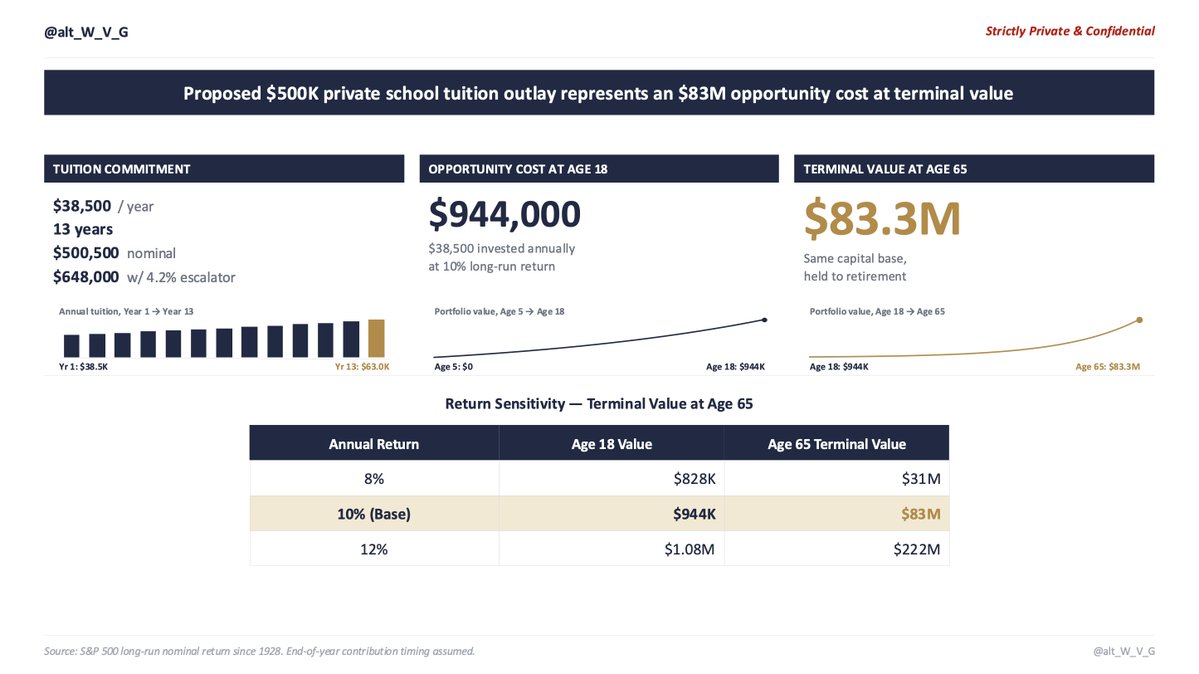
Slide 1 Tuition Schedule
$38,500 per year
Thirteen years
$500,500 nominal
Before escalators
The school has raised tuition 4.2% per year for a decade
With escalators $648,000
My wife said okay
I said I'm not done
Slide 2 Opportunity Cost
Even before escalators
$38,500 invested annually
10% nominal return
S&P long-run average since 1928
By his eighteenth birthday $944,000
My wife said we can afford it
I said I know that's not the slide
Slide 3 Terminal Value at Age 65
$83 million
She was quiet
The analyst slid the sensitivity tables across the table
8% return $31 million
10% return $83 million
12% return $222 million
She did not look
She said this isn't about money
I said it's always about money
She said no it isn't
I said then what is it about
She did not answer
She said you can't put a dollar value on his teachers his classmates his environment
I said I can the analyst already did slide 6
He flipped to slide 6
She did not look
She said the school is the best in the city
I said best is a feeling
She said it produces the best students
I said the students were already the best before they got there
She said our son deserves it
I said our son deserves $83 million
My son walked in
He is five
Dinosaur pajamas
He looked at the projector
He looked at the open deck on the table
He looked at slide 3
He said are we modeling pre-tax or after-tax
The analyst opened a new tab
My wife looked at the ceiling
He said what's the discount rate
The analyst set down his pen
She closed her eyes
He said is this the same return assumption from the 529 conversation
The analyst stopped typing
He looked at me
I did not say anything
She stood up
Sat back down
He said dad can I help
I said yes
He pulled up a chair
The analyst handed him a printout
He started reading
My wife watched him read
She watched him for a long time
She said his name
He looked up
She said do you like school
He said the work is too easy and the kids don't ask questions
She did not respond
She looked at the ceiling
She walked out of the room
The analyst started packing up
He said should I follow up Monday sir
I said no follow up needed
He'll be fine
Sent from my iPhone
Smartphones are not the explanation for the recent decline in fertility. Instead, they are an accelerator of deeper forces already at work.
Let’s start with the facts. Fertility is falling almost everywhere: in rich, middle-income, and poor countries; in secular and religious countries; and in countries with high and low levels of gender equality.
The decline accelerated around 2014. So, no country-specific explanation will work unless you are willing to believe that 200 distinct country-specific explanations arrived at roughly the same time.
Smartphones look like the obvious candidate: the first iPhone was released in 2007, and global adoption has been astonishingly fast.
Economists understand the first major decline in fertility in advanced economies, from 6 or 7 children per woman throughout most of human history to about 1.8, that occurred between the early 1800s and roughly 1970, well before smartphones. The main drivers were a sharp fall in child mortality (effective fertility was rarely above 3 and often close to 2) and the shift from a low-skill, rural agrarian economy to a high-skill, urban industrial one. We have quantitative models that fit these facts well.
Country-specific factors mattered too, of course. Proximity to low-fertility neighbors accelerated Hungary’s decline, while fragmented landowning structures accelerated France’s. But these were second-order mechanisms.
This is also why most economists long considered Paul Ehrlich’s doom scenarios implausible. We forecast that fertility in middle- and low-income economies would follow the same path as in the rich, probably faster, because reductions in child mortality reached India or Africa at lower income levels (medical technology is nearly universal, and most gains come from handwashing and cheap antibiotics, not Mayo Clinic-level care). Much of what we see in Africa or parts of Latin America today is still that old story.
But in the 1980s, a new pattern appeared. Japan and Italy fell below 1.8, the level we had thought was the new floor. By 1990, Japan was at 1.54 and Italy at 1.36.
This second fertility decline began in Japan and Italy earlier than elsewhere, driven by country-specific factors, but the underlying dynamics were widespread: secularization, an education arms race, expensive housing, the dissolution of old social networks, and the shift to a service economy in which women’s bargaining power within the household is higher. The U.S. lagged because secularization came later, suburban housing remained relatively cheap, and African American fertility was still high. U.S. demographic patterns are exceptional and skew how academics (most of whom are in the U.S.) and the New York Times see the world.
My best guess is that, without smartphones, Italy’s 2025 fertility rate would be about 1.24 rather than 1.14. I doubt anyone will document an effect larger than 0.1-0.2. Italy was at 1.19 in 1995, not far from today’s 1.14. The TFR is cyclical due to tempo effects, so I do not read too much into the rise between 1995 and 2007 or the decline from 1.27 in 2019 to 1.14 today. The direct effect of smartphones is not zero, but it is not, by itself, that large.
Where social media, in general, and smartphones, in particular, matter is in the diffusion of social norms. What would have taken 25 years now happens in 10. Social media are not the cause of fertility decline; modernity is. But they are a very fast accelerator.
That is why social media are a major part of the story behind Guatemala (yes, Guatemala) going from 3.8 children per woman in 2005 to 1.9 in 2025. Without them, Guatemala would also have reached 1.9, just 20 years later.
Modernity, in its current form, is incompatible with replacement-level fertility. By modernity, I do not mean capitalism: fertility fell earlier and faster in socialist economies than in market economies. Socialist Hungary fell below replacement in 1960, and socialist Czechoslovakia in 1966 (both experienced small, short-lived baby booms in the mid-1970s). By modernity, I mean a society organized around rational, large-scale systems and formalized knowledge.
Countries will not converge to the same fertility rate. East Asia is likely stuck near 1, possibly below, given its unbalanced gender norms and toxic education systems. Latin America faces the same gender problem plus weak growth prospects, so I expect something around 1.2. Northern Europe has more egalitarian family structures and might hold near 1.5. The very religious societies are probably the only ones that will sustain 1.8.
All of this could change with AI or changes in population composition. We will see. But on the current evidence, deep sub-replacement fertility is the “new new normal.” Unless we reorganize our societies, better learn to handle it as best we can.
Billionaire Michael Milken joked “if a US company replaces the US-born CEO with a CEO born in India, I buy the stock”
But he reveals he hasn’t backtested the idea.
So we did.
In the last 15yrs, that would’ve 50x’d your money: 7.5x more $$ and >2x IRR vs S&P500: 30% vs 14%!
Russia’s🇷🇺 Dmitry Medvedev:
‘Following the assassination of the Supreme Leader of Iran, there is no doubt that Iran will continue pursuing nuclear testing and will eventually acquire nuclear weapons.’
While this is a likely scenario, even if Iran chooses not to build nuclear weapons, other global south nations will.
The lesson the US has taught the world through successive administrations is that the agreements they sign are not worth the paper they are written on…
Signing an agreement with the US, or not having a deterrent is a fatal mistake.
Gaddafi ended his WMD program and was assassinated in a NATO regime change war.
Saddam Hussein had no deterrent and Iraq was destroyed.
Iran signed the JCPOA, which Trump ripped up in his first term, and then launched a war on Iran with Israel killing Khamenei in his second term.
Venezuela had no deterrent and had its President kidnapped.
The only middle power enemy that Washington has dared not to touch is North Korea🇰🇵.
Kim Jong Un was labeled as ‘crazy’ and ‘rocket man’ for pursuing full-speed development of a nuclear arsenal, the lesson that the US has taught the world is that Kim Jong Un’s strategy was the correct one.
Another example of the genius foreign policy of Washington which wastes hundreds of billions of taxpayers’ money, destabilises entire regions, and eventually leads to blowback.
The blowback now won’t be refugee waves and terrorism, in a few years the blowback could be nuclear.
First, the Omani FM came out and revealed that there was a deal on the table that met Trump's demands, but that he instead chose war.
And now, it is revealed that the British National Security Advisor was also part of the talks, and he too attests to the fact that A) there was no imminent threat from Iran, B) Trump could have gotten a surprisingly good deal if he stuck to diplomacy.
But the perhaps most damning quote in the story comes at the end, attributed to an unnamed diplomat:
“We regarded Witkoff and Kushner as Israeli assets that dragged a president into a war he wants to get out of.”
https://t.co/7NWeHUvVDA
Electric lifts that climb stairs on their own just came out in China, carrying up to 180 kg for 60 to 80 floors, totally changing the game for delivery people...
Max Blumenthal: How FBI & Israel Got Trump to Attack – The F.B.I. manufactured plots to convince Donald Trump that Iran sought to kill him, while Israel and its administration allies exploited the president’s deepest fears to keep him on the path to war. https://t.co/MxIUTN2Fhb
If your child becomes a reader, about 80% of the education job is already done. That's my honest assessment after working in education for over thirty years. Everything else is secondary. Most parents think science education is important. Yes it is. But if you can't read the biology textbook, you're not going to learn biology.
Reading is the meta-skill that enables all other skills. History requires reading. Science requires reading. Even math increasingly requires reading as it becomes more sophisticated. The child who reads voraciously will figure out everything else. The child who doesn't will struggle with everything.
If you want to understand why the US and Israel are attacking and attempting to subjugate Iran, you must read this historic speech by Iranian foreign minister Abbas Araghchi, delivered earlier this month at the 16th Al Jazeera Forum held in Doha:
“Excellencies,
Distinguished colleagues,
Ladies and gentlemen,
السلام علیکم
It is a privilege to address you at this distinguished forum and discuss the profound question of our region: Palestine.
Let me begin with a fact that the region has learned through decades of painful experience, and that the world is learning again at a terrible human cost: ‘Palestine is not one issue among many’.
Palestine is the defining question of justice in West Asia and beyond. It is the strategic and moral compass of our region. It is a test of whether international law has meaning, whether human rights have universal value, and whether global institutions exist to protect the weak — or merely to rationalise the power of the strong.
For generations, the Palestinian crisis was understood primarily as the consequence of an illegal occupation and the denial of an inalienable right: the right of a people to self-determination. But today, we must recognise that the crisis has moved far beyond the parameters of occupation alone. What we are witnessing in Gaza is not merely war. It is not a ‘conflict’ between equal parties. It is not an unfortunate byproduct of security measures. It is the deliberate destruction of civilian life on a massive scale. It is genocide.
The human cost of Israel’s atrocities in Gaza has wounded the conscience of humanity. It has torn open the heart of the Muslim world — and it has also shaken millions beyond it: Christians, Jews, and people of all faiths, who still believe that the life of a child is not a bargaining chip, that starvation is not a weapon, that hospitals are not battlefields, and that the killing of families is not self-defense.
Palestine today is not simply a tragedy; it is a mirror held up to the world. It reflects not only the suffering of Palestinians, but also the moral failure of those who had the power to stop this catastrophe — and chose instead to justify it, enable it, or normalise it.
But Palestine and Gaza is not only a humanitarian crisis. It has become the platform for something larger and more dangerous: an expansionist project pursued under the banner of ‘security’.
This project has three consequences — each of them profound, each of them alarming:
The first consequence is global. The Israeli regime’s conduct in Palestine, and the impunity granted to it, have deeply damaged the international legal order. We must say this clearly: the world is moving toward a condition where international law no longer is respected and governs international relations.
What is perhaps most dangerous is the precedent being established: that if a state has sufficient political cover and protection, it may bomb civilians, besiege populations, target infrastructure, assassinate individuals across borders, and still demand to be regarded as lawful.
This is not merely a Palestinian problem. It is a global problem.
We are witnessing not only the tragedy of Palestine, but the transformation of the world into a place where the law is replaced by force.
The second consequence is regional. Israel’s expansionist project has had a direct and destabilising impact on the security of all countries in the region.
The Israeli regime now openly violates borders. It breaches sovereignties. It assassinates official dignitaries. It conducts terrorist operations. It expands its reach in multiple theatres. And it does so, not discreetly, but with a sense of entitlement — because it has learned that international accountability will not come.
Let us be candid: if the Gaza issue is ‘settled’ through destruction and forced displacement — if that becomes the model — then the West Bank will be next. Annexation will become policy.
This is the essence of what has long been called the ‘Greater Israel’ project.
The question therefore is not whether Israel’s actions threaten Palestinians alone. The question is whether the region will accept a future in which borders are temporary, sovereignty is conditional, and security is determined not by law or diplomacy, but by the ambitions of a militarised occupier.
The third consequence is structural — and perhaps the most dangerous.
Israel’s expansionist project requires that neighboring countries be weakened — militarily, technologically, economically, and socially — so that the Israeli regime permanently enjoys the upper hand.
Under this project, Israel is free to expand its military arsenal without limits, including weapons of mass destruction that remain outside any inspection regime. Yet other countries are demanded to disarm. Others are pressured to reduce defensive capacity. Others are punished for scientific progress. Others are sanctioned for building resilience.
Nobody should be confused: this is not arms control, it is not non-proliferation, it is not security.
It is the enforcement of permanent inequality: Israel must have a ‘military, intelligence and strategic edge’, and others must remain vulnerable. This is a doctrine of domination.
Ladies and gentlemen,
This is why the Palestinian question is not only a humanitarian issue. It is a strategic issue. It is not only about Gaza and the West Bank. It is about the future of our region and the rules of the world.
So what must be done?
It is not enough to express concern. It is not enough to issue statements. It is not enough to mourn. We need a coordinated strategy of action — legal, diplomatic, economic, and security-based — rooted in the principles of international law and collective responsibility.
First, the international community must support legal mechanisms without hesitation.
Second, there must be consequences for violations.
We call for comprehensive and targeted sanctions against Israel, including: an immediate arms embargo,
the suspension of military and intelligence cooperation,
restrictions on officials, and banning trade.
Third, we need a credible political horizon grounded in law. The international community must affirm: the end of occupation, the right of return and compensation in accordance with international law, and the establishment of a unified and independent Palestinian state with Al-Quds Al-Sharif as its capital.
Fourth, the humanitarian crisis must be treated as a matter of urgent international responsibility. Collective punishment must never be normalised.
Fifth, regional states must coordinate to protect sovereignty and deter aggression. The principle must be clear: security cannot be built on the insecurity of others.
And finally, the Islamic world, the Arab world, and the nations of the Global South must build a united diplomatic front.
The Organization of Islamic Cooperation, the Arab League, and regional organisations must move beyond symbolism toward coordinated action: legal support, diplomatic initiatives, economic measures, and strategic messaging.
This is not about confrontation. It is about preventing the region from being reshaped by force.
Dear colleagues,
Let no one miscalculate: a region cannot be kept stable by allowing one actor to act above the law. The doctrine of impunity will not produce peace; it will produce wider conflict.
The path to stability is clear: justice for Palestine, accountability for crimes, an end to occupation and apartheid, and a regional order built on sovereignty, equality, and cooperation.
If the world wants peace, it must stop rewarding aggression.
If the world wants stability, it must stop enabling expansionism.
If the world believes in international law, it must enforce it — consistently and without double standards.
And if the nations of this region seek a future free from perpetual war, they must recognise this fundamental truth: Palestine is not merely a cause for solidarity; it is the indispensable cornerstone of regional security.
Thank you”.
Israeli torturers in jails smashed the hands of skilled Palestinian surgeons so they could no longer practice in any hospital ever again https://t.co/zI4Rkg8fqs
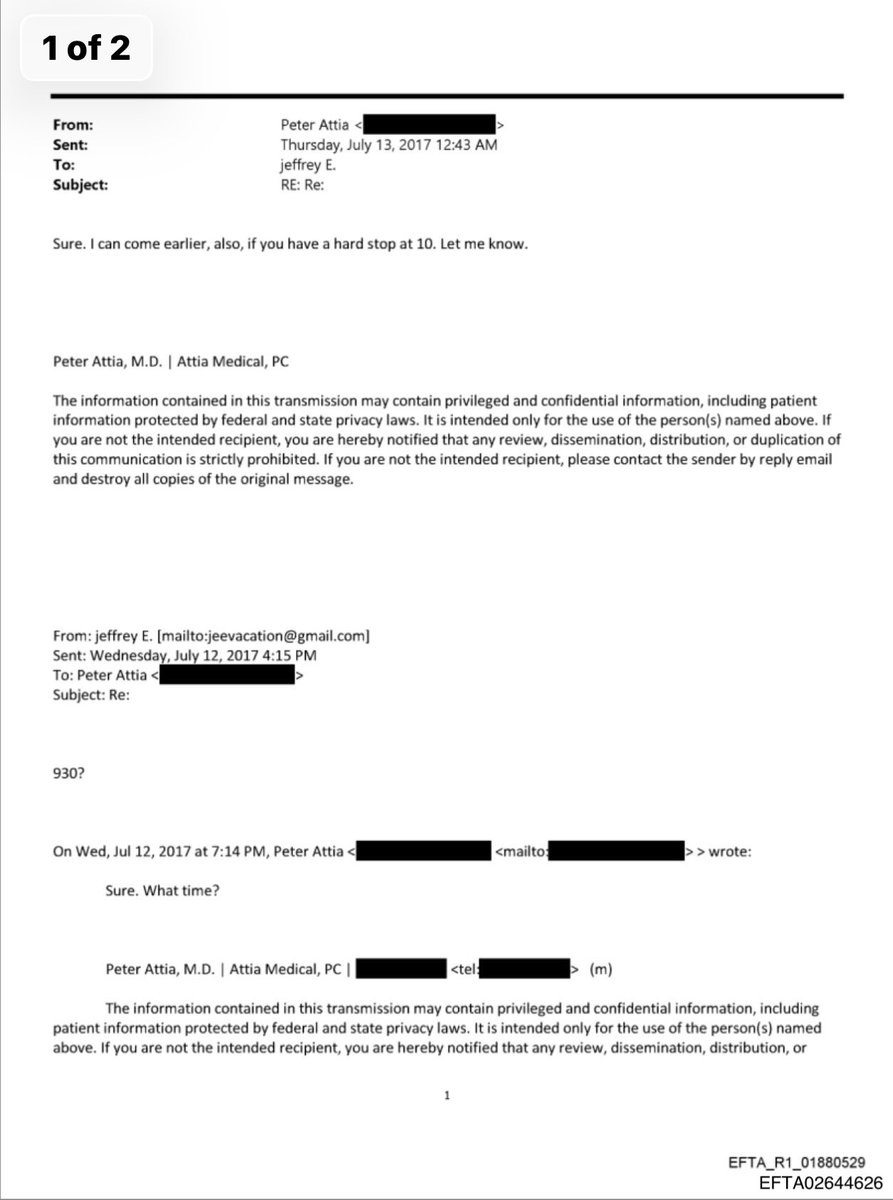
In his book Outlive, Peter Attia shares that his 1 mo old son almost died & his wife begged him for 4 days to come to the hospital where she was alone, but he didn’t due to his “important work” in New York.
Turns out that important work was meeting Jeffrey Epstein. Psychopath!
How has China systematically built a vast pipeline of AI talent? My debut feature in FT Magazine explores the pivotal education program behind this achievement, weaving in some personal reflections.
China’s Genius Plan
https://t.co/MUZTIDaw6g
Great nugget from Schwarzman’s What It Takes:
His strategy for getting a job out of college. Didn’t limit himself to reaching out to people a few yrs older.
Instead, he connected w the Old Bulls of finance, recent retirees w incredible networks & not much to do.
Brilliant.
The Adolescence of Technology: an essay on the risks posed by powerful AI to national security, economies and democracy—and how we can defend against them: https://t.co/0phIiJjrmz