We went from 0 to $100M ARR in just 6 months after launching shift.
Also we hosted Europe’s first Physical AI summit to accelerate distirbution of robots.
And it still feels like day 0.
Onwards
PSA to data cos: you need to build frontier-level training infra if you want to prove the value of your training data
the data game is past its slop era
Small bird, fast wings, Kolibri is here.
78B parameters. 3.46B active. Up to 1M tokens of context. Built in Europe.
Now the weights are yours. Run it on your own hardware, under Apache 2.0.
We’re excited to welcome @animesh_garg as our new Chief Research Officer at @microagi, with the team from @usablerobots joining him.
He has spent most of his career working on one of the hardest problems in robotics: getting robots out of the lab and into the real world.
Frontier AI now works. Hardware is becoming cheap. And the industry is finally learning how to collect robot data at scale.
What’s still missing is post-training.
Taking a general-purpose model and teaching it one specific job, in one specific environment, until a company can actually depend on it.
In LLMs, post-training is what turned impressive demos into products. In robotics, that layer barely exists yet.
A strong model is a capability. A robot that can perform the same job, on the same line, every shift, without an engineer standing next to it, is a product.
And that process has to happen again for every task, every site, and every customer.
We believe the company that can do this well, fast, and at scale will be the company that puts robots into production at massive scale.
MicroAGI is building both sides of that system.
With @joinshift, we’re building one of the most diverse and largest egocentric datasets in the world.
With Atlas, we post-train and harness models directly on enterprise deployments.
Our goal is simple:
Deploy 1 million robots.
Asking out loud is the fastest way to get almost anything done. Even if you're asking a robot.
This early case study from @microagi showcases how they're using ElevenLabs to explore what working alongside a humanoid robot looks like when you can simply talk to it.
microagi x ElevenLabs: what happens when you work together with a robot?
Language has always been at the heart of human connection. It's how we share ideas, build communities, and understand one another. We believe this will be just as important in how we connect with robots. At microagi, we envision a world where robots work alongside us as a normal part of everyday life, where asking one for help feels as natural as asking the person beside us.
For that to happen, we need to be able to speak to them directly, without a screen or control panel, and trust that we have been understood.
With ElevenLabs, we are working to make those conversations possible. We are giving our robots a voice, and shaping how they listen and respond to the people around them.
Here’s an early look at how future robots could talk with us.
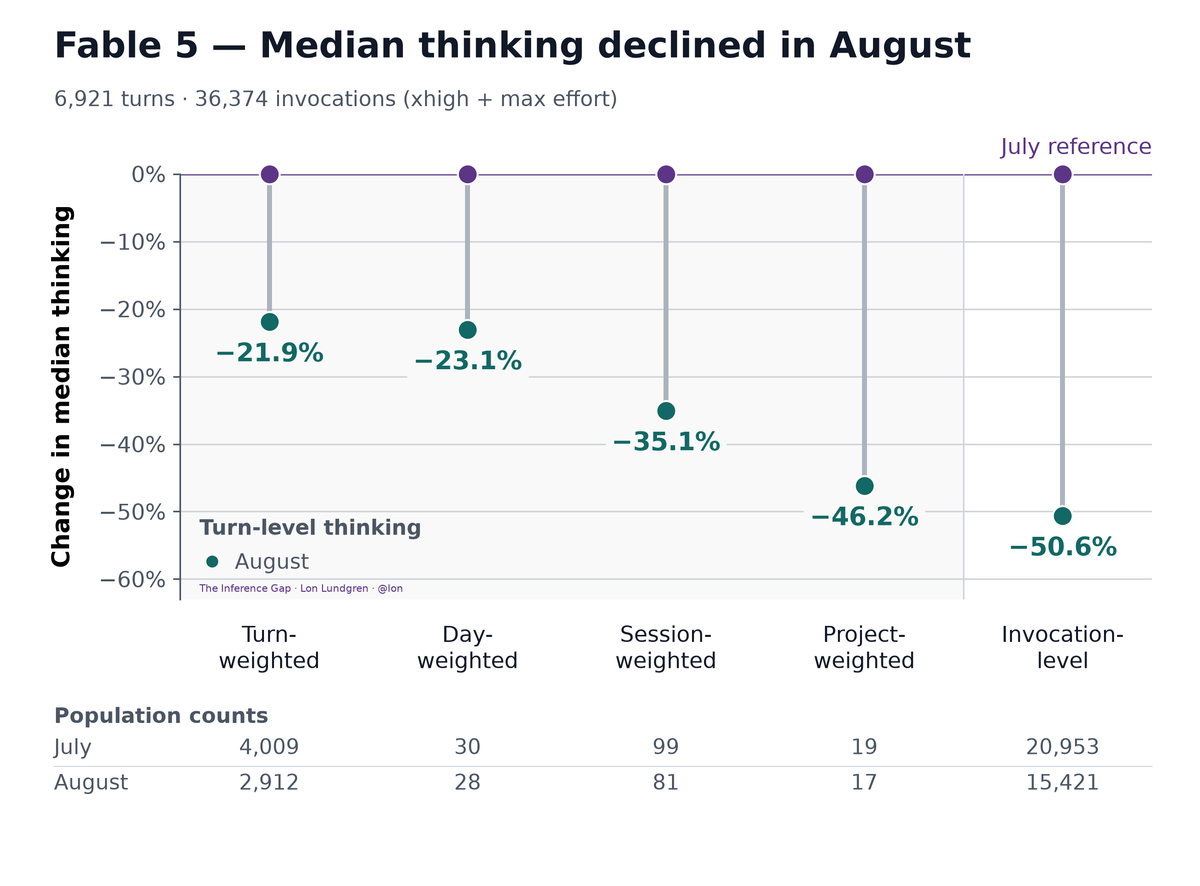
After Anthropic made Fable 5 permanently available in subscription plans, I noticed a large drop in performance. The model felt dumber, and I couldn't explain why.
Measured five different ways, August delivered dramatically fewer thinking tokens than July.
A great first step toward making large-scale mobile manipulation deployments possible; well done to our Zurich lab for the breakthrough!
The best non-hardware-bound SLAM on earth to our knowledge.
Today we're announcing microSLAM, a monocular SLAM system built by our computer vision team in Zürich with ETH Zurich's Computer Vision and Geometry Lab. It ranks first on the LaMaria benchmark for monocular SLAM, and holds up against systems that carry many more cameras and IMUs. Ours runs on a single RGB stream.
Robot learning is bottlenecked on data, and the largest untapped source is people going about their work. A camera on someone's head for an afternoon in a plant is a record of how that plant actually operates, including all the parts nobody writes down.
That data is only useful if you can recover the geometry, and geometry from one moving camera in a world that will not sit still is the hard version of the problem. Solving it monocular is what makes the data cheap. Rigs do not scale to every worker. Glasses do.
microSLAM turns that footage into interactive 3D environments where behavioral foundation models can be trained. One person walks a factory floor. A robot learns to navigate it.
We’re sharing a solution to the Navier-Stokes Millennium Prize Problem, one of the deepest problems at the frontier of mathematics.
The proof was produced by a group of agents, using an OpenAI next-generation model significantly more capable than GPT-6 Astra.
The problem concerns whether the description of smooth three-dimensional fluid motion modeled by the Navier-Stokes equations can break down. It has remained unresolved for roughly 90 years.
Impossible Trinity from economics strikes again in scaling era, you can't have all three of these simultaneously:
1. High quality data mixture
2. Optimal model architecture
3. Huge amount of compute
Europe has <18 months to start buying GPUs.
Compute decides who gets to automate, reindustrialise and defend themselves.
Today we are announcing a strategic compute partnership with NVIDIA and Google Cloud.
Europe invented the factory and industrialised the world twice.
Today we raised the largest seed round in German history to do it a
third time. 10 months in.
Back to work!