Make the move. There’s something intriguing about people who are willing to find out. Certainty is overrated. Confidence isn’t. A no is survivable. An unanswered “what if” is terribly inefficient. Somehow, fortune has always had a soft spot for the appropriately bold.
If that company's dividend yield "appears low" today, it does not mean it will remain low forever.
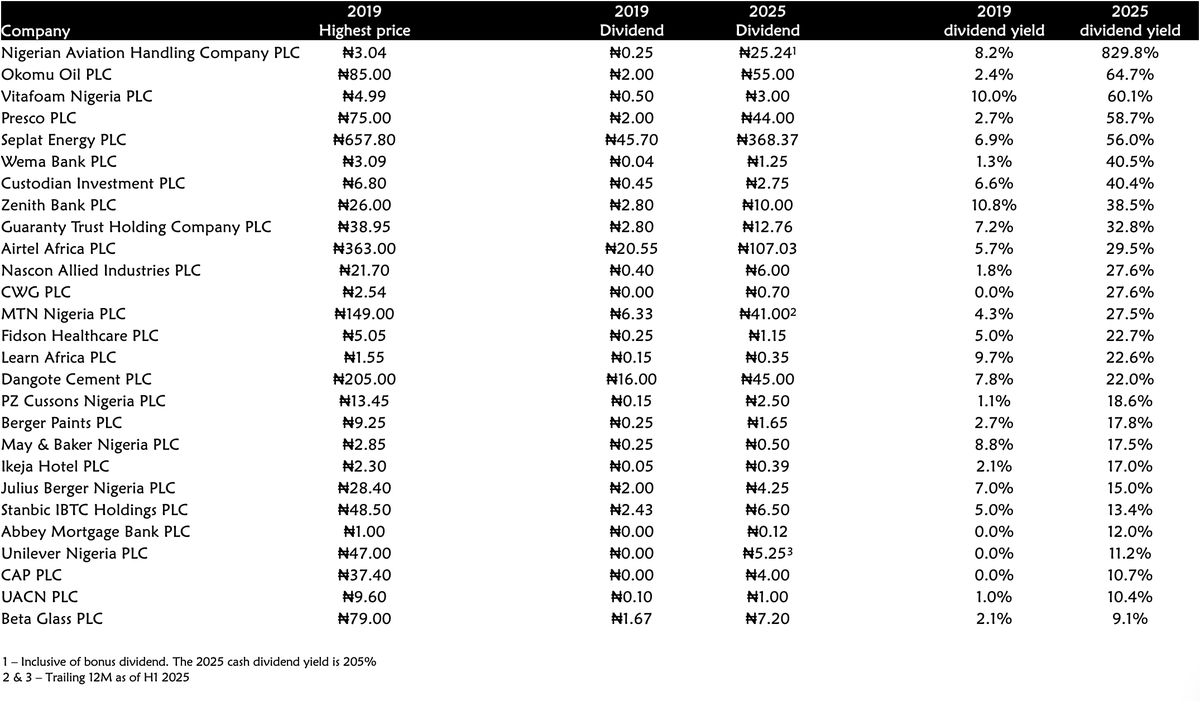
Look at some of these companies. The share prices there are the highest for each stock in 2019.
That is, the highest prices NAHCO, Okomu, and Vitafoam traded at in 2019 were ₦3.04 per share, ₦85.00 per share, and ₦4.99 per share, respectively.
If you bought any of the three stocks at their 2019 highs, based on the 2019 dividends declared, the respective yields were 8%, 2%, and 10%.
As of 2025, assuming the 2019 base/locked price, the dividend yields were 829% (not a typo), 64%, and 60%, respectively. This is because the profits of these companies grew significantly over the period, thus higher dividends followed.
Please note that the bonus shares declared for NAHCO were factored in. If we exclude that, the dividend yield is still nuts at 205%.
These are exclusive of the capital appreciation of these companies. For example, NAHCO trades at ₦132 today (40x), Okomu trades at ₦1,418 (17x), and Vitafoam trades at ₦194 (39x).
A growing business can still be a sick business.
- More customers.
- More sales.
- More branches.
- More employees.
Everyone is excited and busy. There is so much activity, energy is high, and that is exactly why things can go wrong unnoticed. Your margins may be shrinking, waste increasing, processes breaking down, productivity falling, and cash getting tighter, but all covered by the noise of growth.
I've learnt that growth doesn't automatically mean the business is getting healthier. Sometimes, growth simply magnifies existing problems and creates new ones at a larger scale.
So don't just ask, "Are we growing?"
Ask: How are we growing? Are we becoming better?
Your answers will always be in the numbers. And these numbers have to go beyond revenue and number of customers. As you grow, you need to have a robust set of data that you monitor daily, weekly, monthly, quarterly, half-yearly, and yearly.
Oh yes, growing and scaling a business is unending work!!
Financially, watch your gross margin, contribution margin, operating costs, cash flow, working capital, and profitability.
Operationally, watch productivity, waste, quality, customer complaints, service levels, inventory accuracy, and process compliance.
For sales, look beyond the headline numbers, watch your Average Order value, customer count, sales by channel and product category, product mix, like-for-like growth, volume vs price, and frequency.
And don't wait for the monthly or quarterly report to tell you something is wrong. Build simple dashboards, review the critical numbers frequently, and set clear thresholds that trigger action when performance starts moving in the wrong direction.
Most importantly, don't let growth become a distraction from fixing the business.
Always be asking:
What can we do better?
Because there will always be something to fix.
Good growth should not just make the business bigger, it should make the business better.
#BuildingSoFresh #BusinessLessons
Day 7/30
In World War II, the American military had a deadly problem. Too many bombers were not coming home.
So they studied the planes that did return, mapped every bullet hole, and prepared to add armour where the holes clustered thickest. The wings. The tail. The body.
A statistician named Abraham Wald stopped them.
Put the armour where there are no holes, he said. The engines. The cockpit.
They were stunned. Why reinforce the parts that were never getting hit?
Because, Wald explained, the planes hit in the engine never made it back to be studied. The survivors in that room were the lucky ones the engine shots had missed.
They had been reading the data of the winners and drawing the opposite of the right lesson.
We do this all the time.
We study the founder who dropped out and got rich, and never count the thousands who dropped out and vanished. We copy the visible survivors and call it a strategy.
The most important information in your life is often the data that never survived to reach you.
Before you copy a winner, ask a harder question. Who is missing from this room, and why.
As an entrepreneur, here is a list of 10 groups you ultimately work for and must keep happy:
1. Customers
2. Employees
3. Shareholders
4. Government
5. Regulators.
6. Suppliers & Vendors
7. Lenders.
8. Strategic Partners
9. Community
10. Board / Trustees.
Did I miss anyone?