Academia already did what you’re proposing.
Universities are now run like businesses with professional administrators, branding strategies, risk management, consultants, and KPI dashboards. The result hasn’t been better research or teaching. It’s been the transformation of universities into brand-management and lifestyle companies, where prestige, expansion, and revenue extraction matter more than scholarship or education.
Research and teaching don’t reliably maximize short-term financial returns, so they get crowded out. What grows instead is administration because once an administrative class is established, its primary function becomes self-preservation and expansion, not mission fulfillment.
This is exactly what happens when a nonprofit adopts corporate logic without corporate accountability. You don’t get efficiency. You get mission drift and an institution optimized to look successful rather than to be successful.
LINE-1 retrotransposons mediate cis-acting transcriptional control in human pluripotent stem cells and regulate early brain development https://t.co/jBy0rG3FFp
Courage is rarely priced in.
This is true of markets, public or private, elections, movements, or any organization that seeks to grow. When you see a courageous act, it can take many months for scale to follow and the narrative to catch up.
This is because analysts and experts have no idea how to price courage until the numbers or polls confirm it. But courage begets more courage in organizations. It energizes. It leads to more action from more people, which means more shots on goal, more chances at winning, more chances for growth, contracts, votes, etc.
Markets teach the principle but it’s true everywhere: when you see a courageous act, the impact it will have on an outcome is often positive and rarely understood in the moment.
Never ignore courage.
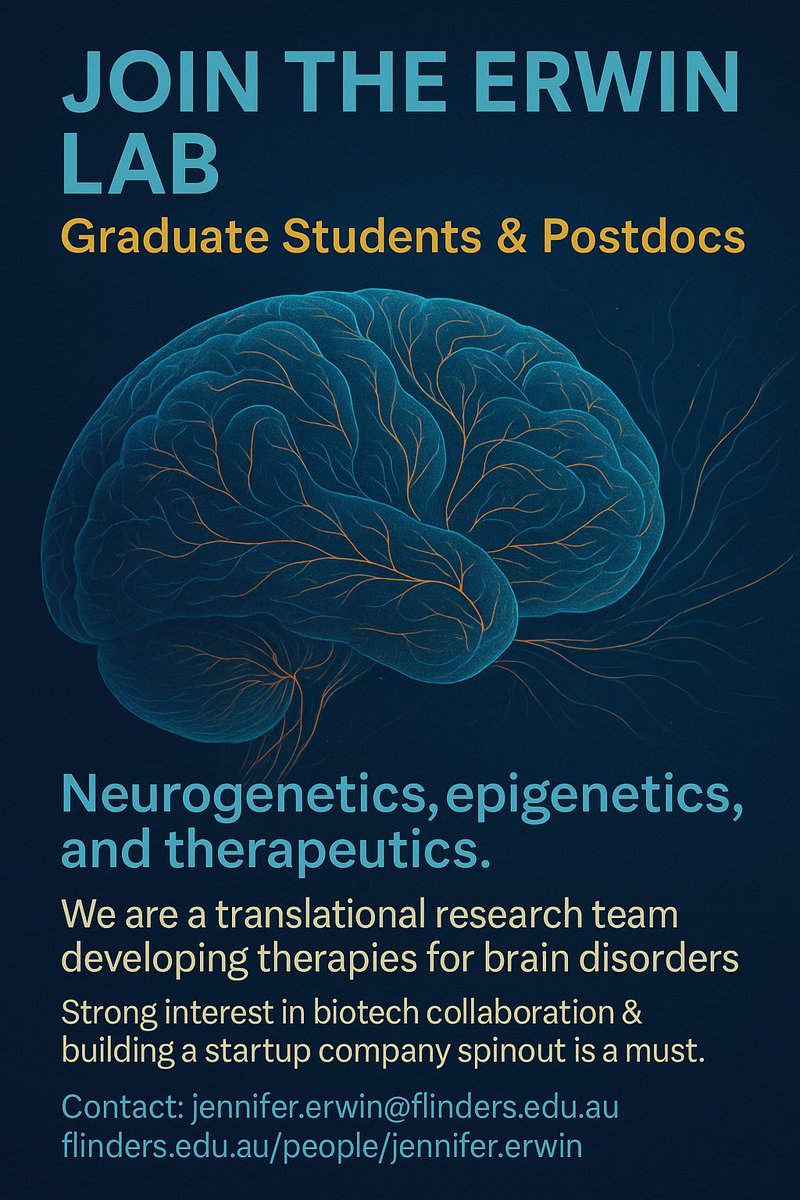
🚨 We're hiring! The Erwin Lab at Flinders University is looking for graduate students and postdocs passionate about neurogenetics, epigenetics & therapeutics.
Collaborate with biotech & launch a spinout.
📩 [email protected]
�� https://t.co/Oh18JYKH0i
1/ Just out in @NatureMedicine : we show the opioid system modulates ketamine’s effects in major depressive disorder, with naltrexone pre‑treatment reducing acute glutamatergic activity and acute antidepressant effects. https://t.co/DErg4rqYz3
🧠 Our new study is out in Nature Communications!
DNMT1 regulates the migration of cortical interneurons, with implications for cortical layering and function — and potentially neuropsychiatric conditions.
🔗 https://t.co/ChAL3z1Yx0
Huge thanks to the amazing team/collaborators!
Are you passionate about harnessing innovative brain organoid technologies to explore the mysteries of neurodegenerative disorders? Would you like to pursue a Postdoc, MSc or PhD degree in Medical Neuroscience? Join our exciting journey of discovery!
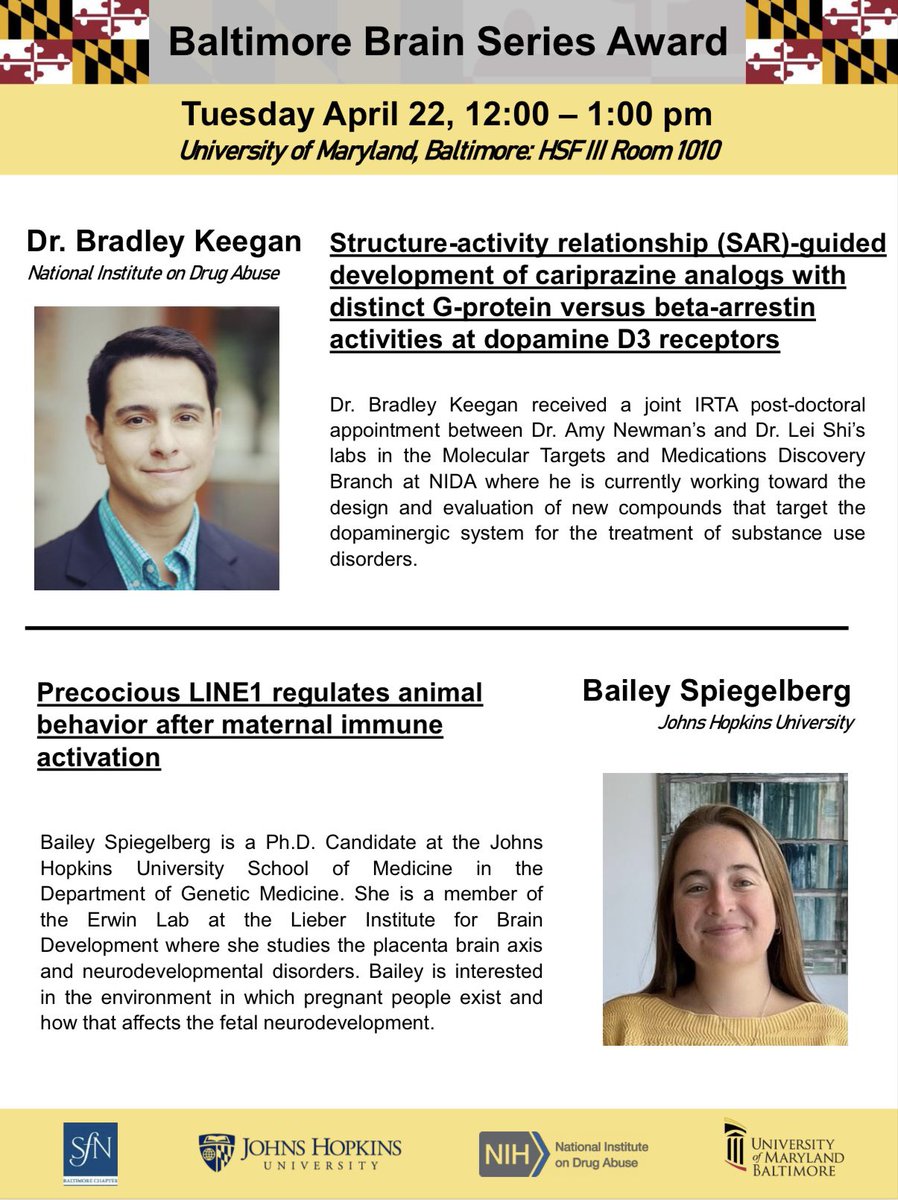
Join us next Tuesday from 12:00-1:00 at UMB for another Baltimore Brain Series seminar! Awardees Dr. Bradley Keegan from NIDA and Bailey Spiegelberg from UMB will present their exciting work. Zoom link provided upon request! @UMMedNeuro
How did humans develop unique traits despite sharing nearly identical genomes with other primates like chimpanzees? Together with Han Yang (@HanYang_Henry), our new study on human accelerated regions (HARs) sheds light on this question @ https://t.co/B4yHNIm7ho. 1/12
It’s been a tough few weeks. My 10yo daughter was diagnosed with a very rare, aggressive cancer called interdigitating dendritic cell sarcoma (IDCS). I’m reaching out to identify clinicians/patients who have encountered pediatric IDCS, indeterminate dendritic cell histiocytosis or other (non-LCH) histiocytic sarcomas cases.
I'm trying to understand non-surgical chemo and targeted therapy options, new pathology markers to better diagnose subtypes/treatments, and any data on progression in pediatric patients. Please feel free to share – I’m trying to cast a wide net due to the rarity of this condition and how little is known.
People can contact me directly at my first name (as written in my profile) at https://t.co/ubo0zQRMn0.
📢 CUT&Tag version 3
Sometimes the preprint to paper route can be quite the odyssey. And so in that vein, we are delighted to give you version 3 of our CUT&Tag optimization and benchmarking manuscript:
https://t.co/OUgpMyG9F7
Check out our narrative review published in the new npj_Women's Heath "The biomechanics of the vagina: a complete review of incomplete data" written with the ultimate expert on vaginal biomechanics @devita_vt@UCSD_ObGyn@Nature_NPJ
"...By strengthening collaborations among experts in biomechanics and women’s health, [vaginal] mechanical attributes can guide the development and implementation of diagnostic and treatment strategies, improving women’s physical, mental, and emotional well-being throughout their lives.
https://t.co/KwtEAleTdW
1/ 🧵 So excited to finally share our preprint! Long-read sequencing of hundreds of diverse brains provides insight into the impact of structural variation (SV) on gene expression and DNA methylation- A new genomic resource for brain research! 🧠✨https://t.co/vYcbGIJWXU
Delighted to see the completed Special Issue of Current Opinion in Genetics and Development on "Genome Architecture and Expression”
It was a pleasure putting this together with Maya Capelson.
Thanks to all the authors that contributed articles
https://t.co/RQI7HBy6uZ
Topic collection on Brain Cancer – Exploring Genetic and Epigenetic Mechanisms - in Neurogenetics - submissions are welcome, check here for further details: https://t.co/12LCIDzUo7
Excited to share my lastPhD publication! We discovered non-inherited mutational patterns in schizophrenia occurring before birth. Huge collaborative effort w/
@seplyarskiy@jones_attila
https://t.co/yR9x5e8dLa