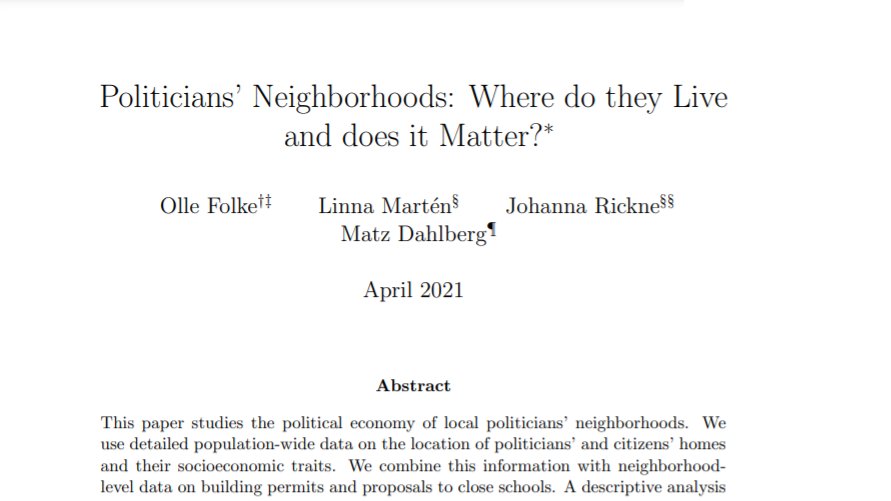
We have a New Working Paper on the political economy of politicians’ neighborhoods! We show that politicians live in richer neighborhoods and protect them from undesirable buildings and the removal of public goods. A thread 1/11, and the Paper: https://t.co/lPdBM6NmSm
@namalhotra@JakeMGrumbach Added this to the paper recently (partly in response to your feedback on the original tweet)! Section A.5 of the appendix uses measure of home equity. Basic story is bc candidates tend to have purchased earlier in time compared to non-candidates, equity measure increases gaps
.@beckerdavidj praises the election workers and volunteers who put in long hours to count ballots: "We won't know all of their names. It's too bad, because they are heroes of democracy." https://t.co/JKLQXRyvdE
Paper is https://t.co/UG9gF8sHcO.
Election aggregates and even polls are ambiguous wrt actual rate of ticket splitting. For anyone planning to work w/ election administrators to study this data in other states, I'd love to get in touch.
How much wealthier are local elected officials in the US than those they represent, and why? In a new paper, I link candidates in CA to their home values to estimate wealth gaps between candidates and constituents. (https://t.co/tErXwO6yHV)
@KNF100 Sure thing. In sec 3.3 I discuss incorporating renters into the analysis. Some challenges in doing so, but I show in the appendix that bc homeownership rate among candidates > homeownership rate among public, incorporating renters increases the wealth gap estimates even more
@namalhotra Thanks Neil! CA counties and CoreLogic do record mortgage transactions, along with the date, amount, type (conventional vs. fha), etc. I'm setting those aside for now: just asking whether candidates' owner-occupied units are higher value, but working on incorporating this info
Taken together, the findings show large wealth gaps between elected officials and those they represent at all levels of elected office + many features of elections may contribute to the gap. This is a draft version, so all feedback welcome!
Finally, I show switching from at-large to district elections, a reform many localities in CA adopted in staggered fashion due to CA Voting Rights Act, seemed to decrease the wealth gap, at least for school board races, possibly bc the reform reduces costs of campaigning.