I pulled up to a drive-thru bank window in Georgia. Mounted beside my driver's window was a tall glass cylinder connected to a thick plastic pipe that rose thirty feet into the sky.
A voice static-cackled through the metal speaker: "Put your check in the tube, sir."
I opened the plastic capsule, inserted my paycheck, and locked the latch. I pressed the flashing blue button.
*FWOOOOOOSH!*
The capsule was sucked into the ceiling at fifty miles per hour, disappearing into the clouds with a sound like a naval cannon.
I gasped and ducked below my steering wheel, covering my head with both arms.
"THE PHARMACY OF CURRENCY OPERATES BY STEAM-POWERED AIR ARTILLERY!" I screamed to myself.
Sixty seconds later, the overhead pipe made a soft, majestic *CLUNK*.
The capsule descended from the heavens. Inside was my cash, stacked with mathematical perfection, alongside a small red cherry lollipop.
I picked up the cash and the lollipop with trembling reverence.
Where else on earth do you load your life's earnings into a pneumatic missile, launch it into the stratosphere, and have the heavens return your money alongside a piece of candy?
At 6:00 AM sharp, my neighbor Harold steps onto his lawn to raise the American flag.
He is seventy-four. He wears a pressed shirt, moves with the precision of a clockwork automaton, and treats the wind as a personal enemy.
If the flag twists against the pole, he stands there for twenty minutes, staring at the rope, calculating aerodynamic resistance until the breeze surrenders.
I began adjusting my morning tea schedule to observe this daily battle. A warrior respects proper protocol.
On a windy Tuesday, the flag caught on a high bracket. Harold reached up, but he was three inches short.
I crossed the grass without a word. I am six feet tall. I extended my arm, cleared the fabric, and stepped back into a formal stance.
Harold did not say thank you. He looked at the flag, looked at my shoulder angle, and said, "Your posture is acceptable. Tomorrow, six o'clock. You hold the rope tension."
I had not applied for a military position. I had simply reached for a piece of cloth. Yet by sunrise the next morning, I was standing at attention in my bathrobe, managing rope drag for a retired artillery officer.
We performed this silent ceremony for three months. We spoke a total of fourteen words. I learned that a three-degree tilt in the hoist is considered a national tragedy in Harold’s domain.
In October, the flag remained at half-mast for four days.
I walked to his porch. The house was quiet. Harold was sitting in a chair by the window, looking out at the empty yard.
He pointed to the second-floor window across the street.
"My wife had dementia," he said softly. "For five years, she couldn't remember my name. But every morning at six, she would look out that window, see me raising the flag, and know she was safe at home."
She had passed away on Monday.
Harold looked at his hands. "I don't know who I'm raising it for tomorrow."
I went back to my house. I did not sleep.
At 5:55 AM, I stood on his lawn in a dark suit. Behind me stood Kevin, Tony, and four other men from the street, all dressed in their finest jackets, standing in a straight line in the morning mist.
Harold walked out to the porch. He stopped.
Kevin stepped forward and said, "Sir. The wind is coming from the east. We require your orders."
Harold looked at the seven men standing at attention on his grass. His chest expanded. His shoulders straightened.
He walked down the steps, took the rope, and gave the command.
The flag went up. It has never flown higher.
How 18 world-class grandmasters actually spend their day:
1) Magnus Carlsen – Solves puzzles for 30 minutes before any serious study
2) Garry Kasparov – Reviews yesterday's mistakes before starting new preparation
3) Judit Polgar – Plays through classic games to sharpen pattern recognition
4) Bobby Fischer – Studied openings for hours in complete isolation
5) Viswanathan Anand – Uses rapid games to stay sharp between tournaments
6) Vladimir Kramnik – Analyzes his own losses more than his wins
7) Hikaru Nakamura – Plays high volumes of blitz to sharpen instinct
8) Anatoly Karpov – Focuses on quiet positional play over flashy tactics
9) Fabiano Caruana – Prepares deeply with computer engines before big matches
10) Levon Aronian – Studies classical games from the 19th century for inspiration
11) Alexander Grischuk – Trusts intuition heavily in time-pressure situations
12) Wesley So – Keeps a calm, meditative pre-game routine
13) Ding Liren – Reviews endgame theory daily, even during rest days
14) Alireza Firouzja – Studies aggressively, favoring sharp, unbalanced positions
15) Mikhail Tal – Looked for the most complicated path to unsettle opponents
16) Boris Spassky – Balanced physical fitness with mental preparation
17) Judit Polgar's mentor circle – Studied under strict daily training schedules from childhood
18) Susan Polgar – Practiced tactics puzzles every day without exception
THE SILENT MATH OF HAIR GROWTH:
1. A single scalp holds around 100,000 hair strands.
2. Each strand grows about 1.25 centimeters every month.
3. Multiply that rate across every strand on one head.
4. The combined growth reaches roughly 1.25 kilometers a month.
5. Stretch that pace across a full year.
6. The total comes out to close to 15 kilometers of hair grown.
7. At the same time, 50 to 100 strands fall out daily.
8. Over a year, that's tens of thousands of strands shed.
9. New growth replaces what falls, cycle after cycle.
10. A single head quietly outproduces expectations every year.
11. Each strand's active growth phase, called anagen, can last between 2 and 7 years.
12. A large majority of scalp strands sit in this growing phase at any given moment.
13. Extend the full-head monthly growth rate across a 70-year adult lifespan.
14. The lifetime total climbs to just over 1,000 kilometers of hair grown.
15. That's more than 100 times the height of Mount Everest.
16. Every strand shed along the way gets replaced by a fresh one entering anagen.
17. A single head spends a lifetime rebuilding itself without ever pausing.
Six squares lying flat in a ring, and then a cube.
The ring hinges along its shared edges, the hexagonal outline pulls inward, and every square lands as a face. Nothing is added or cut. The solid was already in the flat ring, waiting for the fold.
“NOBODY WANTS TO GO TO THE UPDATED LIBRARY WE BUILT, THEY MUST HATE BOOKS NOW”
This is the world we have settled for and we let them build.
Every space they will make look like it was designed around the style of a sports stadium men’s room.
The future belongs to those who evolve their consciousness.
Humanity is evolving — the problem is that much of this evolution is happening unconsciously.
When growth lacks awareness, it doesn’t appear as wisdom. It appears as confusion.
Modern science has mastered experimental thinking:
- Form a hypothesis.
- Test.
- Measure.
This transformed physics, chemistry, and biology.
Then came the fatal assumption:
if it works in the laboratory, it must work everywhere.
But society is not a machine.
Human beings are not isolated variables.
No equation can capture love, meaning, sacrifice, conscience, or freedom.
When laboratory logic is applied to civilization, living people become statistics and systems.
The result is efficiency without humanity.
Dr Steiner saw many modern crises as symptoms of concepts that have become too thin to contain life.
Yet beneath this, something deeper is happening:
Human consciousness is pressing toward higher forms of knowing.
When that movement is conscious, it becomes genuine spiritual development.
When unconscious, it often becomes pathology.
He pointed to conditions that modern psychology typically treats only as disorders.
- Endless skepticism.
- Obsessive doubt.
- Paralyzing anxiety.
- Phobias with no rational cause.
These are not only defects.
They can be signs of a consciousness reaching toward realities it has not yet learned to navigate.
The soul senses something beyond ordinary thought...
but without preparation, the ego cannot remain centered.
Insight turns into disorientation.
This is why knowledge alone is not enough.
The knower must also evolve.
Steiner described ordinary memory as tied to the personal ego:
"I remember because I experienced."
Higher cognition requires a metamorphosis.
Memory ceases to be mere recollection and becomes perception of a deeper continuity of self.
Without this transformation:
- thinking fragments.
- identity weakens.
- the ego loses coherence
And there is one force that prevents higher perception from collapsing into fantasy.
Love.
Not sentimentality.
Not romance.
Love as an objective moral force.
Without love, imagination becomes projection.
With love, imagination becomes perception.
Without love, inner images become fantasies of the self.
With love, they become windows into reality.
Love stabilizes knowledge.
It keeps the ego grounded while consciousness expands.
The future of civilization depends less on smarter machines than on more developed minds.
Not minds filled with more information...
but minds capable of higher perception.
He described three stages:
- Imagination — perceiving living realities beyond abstract concepts.
- Inspiration — hearing the spiritual meaning behind appearances.
- Intuition — direct participation in truth itself.
Each demands:
- disciplined thinking
- a strengthened ego
- a transformed memory
- and love
Without these, the very forces meant to elevate humanity manifest as skepticism, fear, fragmentation, and cultural decay.
The deepest mistake of our age is to confuse analytical intelligence with complete intelligence.
We know how to analyze matter.
We have forgotten how to understand the soul.
A civilization cannot be healed by external reforms alone.
Its renewal begins when human cognition evolves.
Because in the end, the fate of a culture follows the quality of its consciousness.
the fastest way to kill motivation is to make your identity depend on the outcome. it’s called ego involvement. when failing becomes failing as a person, your brain starts avoiding the whole thing. not because you don’t care, but because you care too much.
I needed to move a sofa.
I mentioned this to an American. He said, "You know anybody with a truck?"
I did not know anybody with a truck.
He looked at me with real concern. Not pity. Concern. The way you look at a man who has told you he does not have a name.
"You gotta know somebody with a truck."
I asked how one acquires such a person.
He said, "You just do."
This is the third time I have received that answer in this country. It is the answer to everything here. You just do. There is no process. There is only the eventual fact of having.
He said, "Ask Kevin."
I do not know a Kevin. He said Kevin like I should. He said it the way you say a shared uncle.
I met Kevin four days later. Kevin owns a truck. Kevin does not own a truck for himself. Nobody owns a truck for themselves. Kevin owns a truck for a fifteen mile radius.
Inside I said: THIS MAN HAS TAKEN A VOW. HE DID NOT ANNOUNCE IT. HE SIMPLY PURCHASED A BED AND ACCEPTED THE CONSEQUENCES.
Kevin arrived on Saturday. He brought the truck. He also brought a second man.
I had not asked for a second man.
The second man's name is Tony. Tony came because Kevin came. Tony did not know me. Tony did not ask what we were moving. Tony brought gloves.
They moved the sofa in eleven minutes.
I offered them money. Both of them laughed at the same time, which felt rehearsed and was not.
I asked what I owed them.
Kevin said, "Buy the pizza."
That is the price. That is the entire economy. The truck costs one pizza and the pizza is not negotiable and the pizza is also not expensive and everyone knows what size.
Inside I said: THE FEE IS FIXED ACROSS THE ENTIRE NATION AND WAS SET BY NO ONE.
We ate on the floor because the sofa was against the wall and none of us wanted to be the first to sit on it.
Tony told me his daughter plays soccer. I asked if she is good. He said, "She's aggressive."
I still think about that.
Three weeks later, Kevin texted me.
"You free Sunday? Helping Tony move a fridge."
He did not ask if I wanted to. He informed me of a fridge.
Inside I said: I HAVE BEEN CALLED UP. I DID NOT ENLIST. THE PAPERS WERE FILED ON MY BEHALF.
I went. I moved the fridge. I have no truck. I contributed only arms.
Afterward, a man I had never met asked me if I knew anybody with a truck.
I said, "Yeah, I got a guy."
I have a guy.
I am somebody's guy now, too. Tony has told two people about me.
He describes me as "the guy who's strong for his size."
I have never been prouder of a sentence in my life.
If a bird falls in love with a fish, where will they live?
Some connections are beautiful, but beauty alone does not solve reality. The bird belongs to the sky, and the fish belongs to the water.
Sometimes two souls can care deeply for each other and still struggle to find a place where both can truly belong.
Here is an entire feature-length documentary that I filmed, edited & narrated myself, travelling across Peru, documenting historical anomalies.
For free ✌️
All I ask in return is that if you enjoy original work like this, help it grow with a comment, a like and a repost.
Legend: Alexander Carlisle and the Titanic lifeboats
Alexander Carlisle was the chief designer of the Titanic at Harland & Wolff.
In 1909, he proposed the ship carry 64 lifeboats, enough for every passenger and crew member on board.
The White Star Line approved 20.
Their reasoning: too many lifeboats would clutter the deck and make wealthy passengers feel the ship was unsafe.
Carlisle resigned in 1910, before the Titanic launched.
He testified at the British inquiry in 1912 that he had raised the lifeboat issue repeatedly and was overruled.
The Titanic launched with capacity for 1,178 people in lifeboats. Passengers and crew aboard: 2,224. Dead: 1,517.
After the disaster, every passenger ship in the world was required to carry lifeboats for all aboard.
Carlisle’s original proposal became international maritime law. Two years too late.
The engineer was right. The business decision killed 1,517 people.
Source: British Board of Trade Inquiry 1912, testimony of Alexander Carlisle, publicly documented.
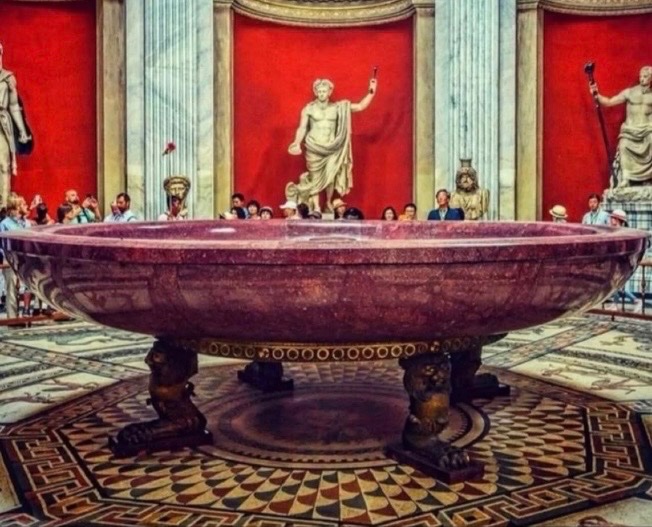
Emperor Nero’s 2,000-year-old bathtub was carved from one of the rarest stones on Earth and is estimated to be worth around $1 billion today.
Before modern luxury, this monumental bathtub represented the height of imperial prestige. Traditionally linked to Emperor Nero, it was carved from a single block of imperial purple porphyry, one of the rarest and most prized stones of the ancient world. Mined exclusively at Mons Porphyrites in Egypt’s Eastern Desert, the deep purple stone was reserved almost entirely for Roman emperors as a symbol of absolute power and divine authority.
Several meters wide and weighing many tons, the massive basin is a remarkable example of Roman engineering and craftsmanship. Since the ancient quarry has been abandoned for centuries and imperial purple porphyry is no longer commercially available, experts estimate that sourcing an equivalent amount of the stone today could cost around $1 billion, making it one of the most valuable bathtubs ever created.
You will be alerted via 𝕏 messaging if there is something you interacted with and perhaps thought was true later turned out to be untrue or incompletely true
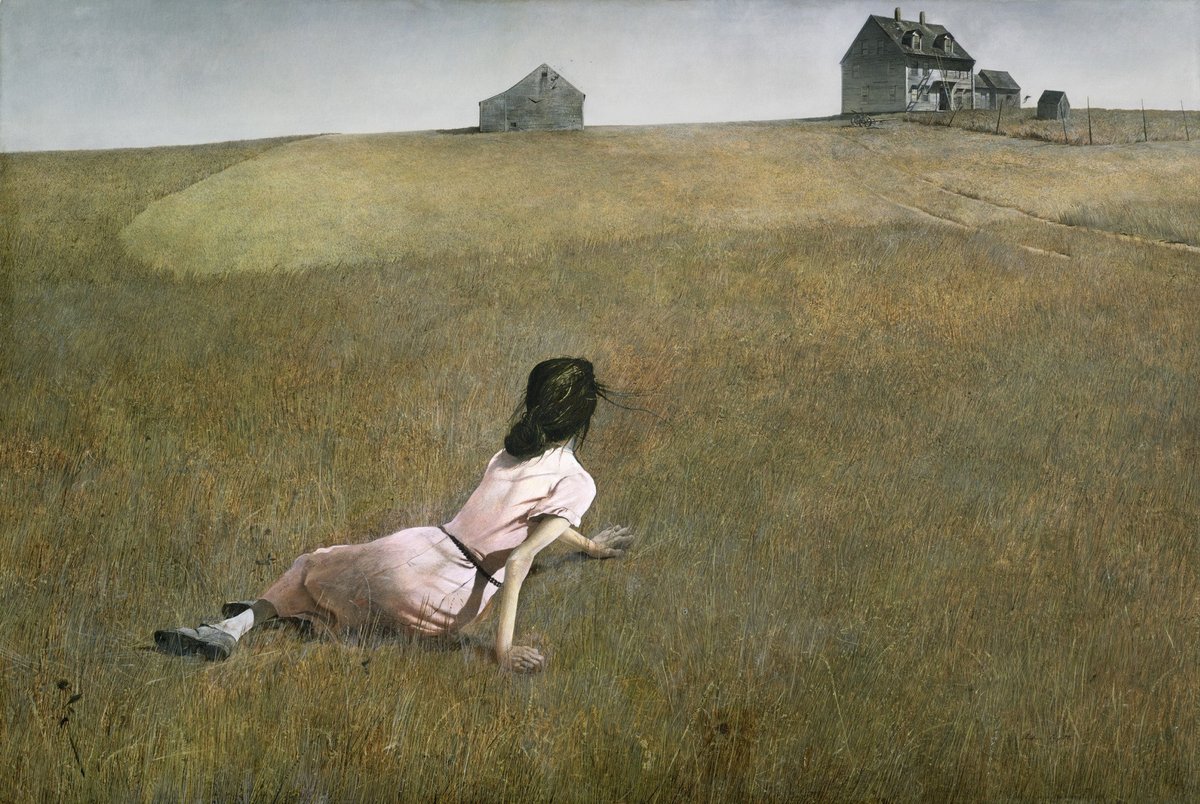
This is one of the most famous paintings in America, and most people have no idea what they are actually looking at...
The painting is Christina's World, made by Andrew Wyeth in 1948, and the woman was real: her name was Anna Christina Olson, Wyeth's neighbour in Cushing, Maine. Since childhood a degenerative condition had slowly taken the strength from her legs, until walking was no longer possible. She refused a wheelchair, and for her entire adult life she chose to drag herself across the ground with her arms instead, going wherever she wanted to go under her own power.
Wyeth saw her one afternoon from an upstairs window, alone in that vast field, crawling slowly toward the house on the hill. He said the painting was an attempt to do justice to her extraordinary conquest of a life which most people would consider hopeless. Her world, he said, was limited physically but by no means spiritually.
That is what turns this painting from a portrait of frailty into one of the most triumphant images ever made...
Look at it long enough and it stops being about what her body took from her, and becomes about what she would not stop doing anyway. The field is enormous and she is small and the house is far away, and still she goes, because the alternative, to be carried, to give up, to let the distance win, was something she simply would not accept.
There is one more thing: Christina loved this painting. Pink was her favorite color, and Wyeth had placed her exactly where she most wanted to be, out in the open, in her own field, under her own sky. Late in her life, when she could no longer even crawl out to that field, she said something that holds the whole meaning of art inside it:
"Andy put me where he knew I wanted to be. Now that I can’t be there anymore, all I do is think of that picture, and I’m there."
There’s something about a 200 year old colonial home that just makes you stop and think. Back when craftsmanship mattered and folks built things to last longer than a handshake deal. I came across one with pocket doors for the windows, yes, windows. Slide them shut like a well oiled secret, and suddenly you’ve got insulation, security, and style all in one move ✌️
Anthropologist Margaret Mead was once asked by a student what she believed was the very first sign of known civilization. The student expected her to talk about a hatchet, perhaps fishhooks, the bow and arrow...
Possibly a building structure, clay pots or grinding stones and knives.
But no.
Mead said that the first sign of civilization in an ancient culture was a thighbone that had been broken and then healed.
Mead explained that in the animal kingdom, if you break your leg, your timely death is assured.
"You cannot run from danger, get to the river for a drink or hunt for food. You are meat for prowling beasts. No animal survives a broken leg long enough for the bone to heal."
A broken thighbone that has healed is evidence that someone has taken time to stay with the one who fell, has bound up the wound, has carried the person to safety and has tended the person through recovery.
"Helping someone else through difficulty is where civilization starts." Mead said.
We are at our very best when we truly help and serve others.
Be civilized. Be kind. Be helpful
I turn 79 today.
I don’t want any gifts. Instead, my team and I decided to revolutionize the fitness industry — and we’re doing something crazy to celebrate.
Here it is: https://t.co/qL6ECpWWYH
Between today and Sunday, August 9, when you join the Pump Club app and complete four workout programs in your first year, you pay nothing.
Zero. Nada. Zilch.
No fine print. If you show up and do the work, your first year is free. The payments are automatically sent back to your card.
If that feels shocking, then let me say it even more plainly.
Sign up for the app through that link. Try it free for 7 days. After your trial, pay $100 for your first year. Complete four workout programs. Get $100 back automatically: $50 after your first, and $50 after your fourth.