Saylor reflects on his biggest mistake as a younger entrepreneur.
On "the curse of the 30-year-old alpha male," and why Bitcoin laser eyes mean so much to him.
I think officially re-branding the USD dividend reserves as the "Strategy₿attery" will go a long way in getting people to understand the concept @saylor@Strategy $BTC #Bitcoin
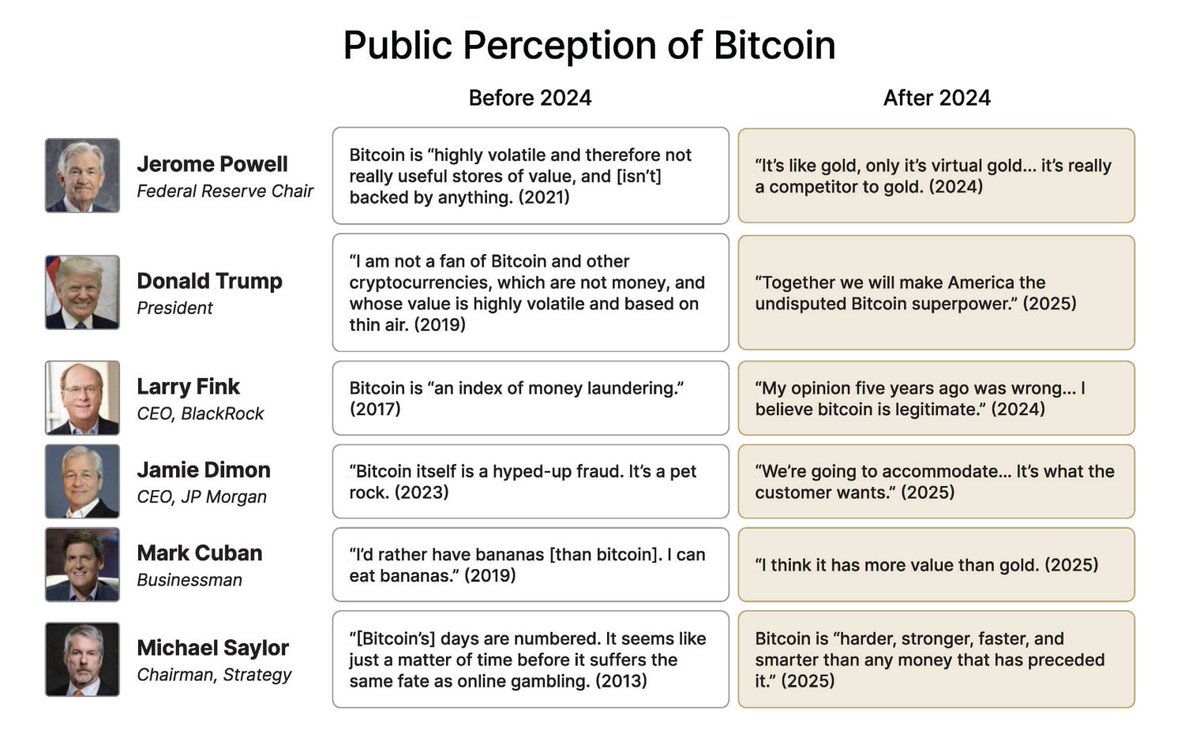
It only took a few years to go from “governments are going to ban bitcoin!” to “bitcoin is an essential part of a ceasefire between nations engaged in kinetic combat.”
Bitcoin is quite literally empowering peace.
Ultimately the world will recognize what bitcoiners have known for a long time.
The world needs a digital, decentralized, non-sovereign, neutral asset to conduct global trade between countries that don’t trust each other.
Just a matter of time.
BTC didn't fail as an asset. It succeeded as an ETF.
And that's the problem.
From $126K to $63K. Every time IGV sells off, BTC sells off with it.
That's not a store of value.
That's a high-beta tech position with a different logo.
IBIT changed who owns Bitcoin.
In 2021, the marginal buyer was ideological.
No allocation limits. No risk budget. No rebalancing.
In 2026, the marginal buyer is institutional.
Same desks that own IGV. Same desks that de-risk on the same day.
The thing that was supposed to make BTC mainstream is the thing that made it correlated.
Why didn't retail save it?
Because retail went to NVDA. To PLTR. To HOOD.
The crypto-native buyer already bought.
There's no second wave walking through the door.
Meanwhile, gold is up 47%.
Gold's holder base doesn't get margin called on tech selloffs.
Central banks don't rebalance into quarters.
Sovereigns don't panic sell at 2am.
When "store of value" is actually tested, the market picks the one with 5,000 years of track record.
Not 15.
So when does this turn?
Watch two things:
1. IGV stabilizes. Not bounces - stabilizes. BTC won't decouple until the desks that own both stop selling both.
2. Stablecoin supply starts expanding. That's new money entering crypto, not existing holders rotating. Right now, it's flat.
But here's what the bears are missing.
Every cycle, the weak hands get filtered out.
And every cycle, what replaces them is longer-duration capital.
2017: retail sold at $20K.
2021: funds sold at $69K.
2025: ETF allocators are selling at $63K.
What comes next?
Sovereign wealth funds. Corporate treasuries. Pension capital.
Money that doesn't rebalance into quarters.
Money that doesn't correlate to IGV.
Money that holds for decades, not cycles.
The institutional exit isn't the end of the BTC thesis.
It's the purification of it.
Here's the math most people won't do.
Gold's holder base is sovereign-heavy. Gold is a $22 trillion asset.
BTC's supply is fixed at 21 million coins.
If BTC's next holder base even partially resembles gold's -
sovereign, pension, corporate treasury capital that measures in decades, not quarters -
then the asset that trades at $63K during an ETF shakeout is the same asset that trades at $1M when the holder base finally matches the thesis.
Every prior cycle, the ceiling was set by who was buying.
Retail gave you $20K. Funds gave you $69K. Institutions gave you $126K.
Sovereigns don't have ceilings.
They have mandates.
BTC doesn't go to $1M because of halving math.
It goes to $1M because the last class of sellers gets replaced by the first class of permanent holders.
That's not a prediction.
That's the structure.
Infrastructure doesn't fail.
Holder structures evolve.
If you were ever jealous of people buying crypto on the cheap, and able to hold them through the cycles, think about what they did in moments like this.
I think officially re-branding the USD dividend reserves as the "Strategy₿attery" will go a long way in getting people to understand the concept @saylor@Strategy $BTC #Bitcoin
This is an excellent article by Jordi.
But a lot of people understand the “Musk Discount.”
Nobody realizes there’s a Saylor Discount that’s even bigger.
Markets punish anyone building the foundations of a new economic regime.
Musk gets dismissed because he builds too far out in front of the curve.
Saylor gets dismissed because he built beyond the curve entirely.
The market is acting like Saylor is speculating on Bitcoin when in reality he is INDUSTRIALIZING Bitcoin.
He turned corporate treasury into a strategic weapon, created the first Bitcoin-backed capital engine, and is now scaling digital credit instruments that price risk more accurately than legacy fixed income.
If a traditional CEO built a balance sheet with the strongest asset, the lowest counterparty risk, the most durable treasury structure, and a capital stack that compounds faster than sovereign debt, analysts would be falling over themselves to re-rate the company.
When Saylor does it, they shrug.
Not because the ideas lack merit, but because they imply changes institutions are structurally unable to model.
Digital credit will reprice corporate finance.
Bitcoin treasuries will reshape capital formation.
BTC-backed yield products will compete directly with bonds.
Strategy is out front building the infrastructure today, while markets continue to benchmark yesterday.
The same investors who ignored reusable rockets and global satellite internet are now ignoring the first company to weaponize Bitcoin as a corporate operating system.
The Saylor Discount won’t last.
It’s the most expensive mispricing in the public markets.
Traditional finance is finally realizing what Michael Saylor has been quietly building.
You can feel the panic.
They never expected a public company to walk into their domain and start offering yield structures that outperform corporate debt, demolish fixed income, and price risk with more discipline than the entire bond market.
They spent decades engineering a system where savers lose and issuers win, and now Saylor is pricing capital with Bitcoin collateral that settles globally in minutes, is immune to dilution, and refuses to obey their credit games.
They will fight this. They have to.
Wall Street cannot allow a parallel market to form where a Bitcoin treasury company provides cleaner collateral, tighter spreads, and structurally higher yields than the instruments they have defended since the 1980s.
Yet the tragedy for them is that this resistance changes nothing.
Bitcoin’s monetary gravity keeps pulling capital away from decaying fiat instruments.
Every cycle strengthens the companies that understand this shift.
Strategy is at the center of that shift. It attracts capital because it is built on an asset that never bends to political incentives, never inflates to save incumbents, and never needs a bailout.
Traditional finance can complain, lobby, and posture, but they cannot repeal mathematics.
The yield curve cannot defy Bitcoin’s long term compounding.
Collateral quality cannot exceed something that cannot be printed.
There is no financial engineering trick left that can outperform a balance sheet levered to a monetary network that grows stronger with every attack.
Saylor will succeed because the system he is competing with is already failing under its own weight.
Bitcoin is inevitable.
The companies that embrace it become gravity wells.
Everything else becomes driftwood.
The biggest skill will always be walking away from the casino
If you can’t do it, it doesn’t matter how much you’ve made. You’ll always give it all back.
You know the best thing about being a Bitcoiner?
You no longer pretend.
You stopped pretending your boss is a “mentor.”
You stopped pretending your girlfriend respects your job.
You stopped pretending stocks are “ownership.”
You stopped pretending your Roth IRA will matter in 40 years.
You stopped pretending the war is “over there.”
You stopped pretending your life was fine.
You broke the spell.
You read The Creature from Jekyll Island at 2am and couldn’t sleep.
You watched Saylor on Tucker and felt your ancestors stir.
You sat in your one-bedroom apartment with a laptop, a cold black coffee, and a cracked iPhone screen,
staring into the void, realizing you’re in a digital serfdom.
You didn’t buy Bitcoin for gains.
You bought it because your dad spent 40 years in a factory and still couldn’t retire.
Because your bank flagged a $600 Venmo transaction like you were Pablo Escobar.
Because a man in a suit on CNBC told you inflation was "transitory" while eggs hit $8.49.
Because you saw a generation laugh at masculinity while begging the government for rent relief.
Bitcoin didn’t just change your portfolio.
It REWIRED your SOUL.
You eat steak now. You lift.
You don’t trust anyone with a lanyard.
You value time, energy, freedom, and truth.
And for the first time in your life, you feel dangerous again.
Bitcoin didn’t make you rich.
It made you sovereign.
And that’s what they’ll never forgive you for.