4/ Document → exam cheat sheet
Prompt:
Study [document] and extract every important definition, formula, framework, concept, and fact. Organize everything into a clean revision sheet with memory tricks, flashcards, and a one-page summary optimized for exam prep.
Thought-provoking!
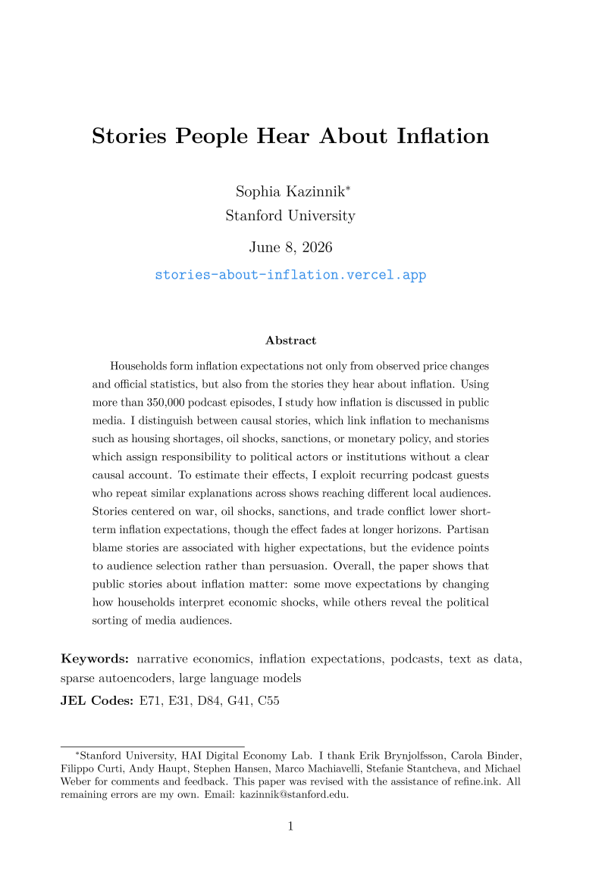
"Stories People Hear About Inflation" by Sophia Kazinnik.
"Households form inflation expectations not only from observed price changes and official statistics, but also from the stories they hear about inflation. Using more than 350,000 podcast episodes, I study how inflation is discussed in public media. I distinguish between causal stories, which link inflation to mechanisms such as housing shortages, oil shocks, sanctions, or monetary policy, and stories which assign responsibility to political actors or institutions without a clear causal account. To estimate their effects, I exploit recurring podcast guests who repeat similar explanations across shows reaching different local audiences. Stories centered on war, oil shocks, sanctions, and trade conflict lower short term inflation expectations, though the effect fades at longer horizons. Partisan blame stories are associated with higher expectations, but the evidence points to audience selection rather than persuasion. Overall, the paper shows that public stories about inflation matter: some move expectations by changing how households interpret economic shocks, while others reveal the political sorting of media audiences."
https://t.co/gUlQax7A8i
Tests by Uber have shown we’re more likely to accept a surge price of 2.1x than 2x. The reason lies in our distrust of round numbers - we assume they’ve been simply marked up to get more money out of us. On the other hand, precise numbers feel like there's some kind of hidden logic or maths behind them. Even if we don't know how they came to be, they feel less arbitrary than a round number, and so, are more believable.
This is backed up by a 2008 study from Chris Janiszewski and Dan Uy at the University of Florida.
They showed participants prices for different goods. Some saw rounded prices (e.g. $5), while others saw precise ones (e.g. $5.15). People invariably thought the round prices were marked up more.
Then they ran a real world test by analysing 25,564 house sales in Florida. They found that sellers who requested a more precise price (e.g. $799,499 vs $800,000) got much closer to their asking price.
Now back to surge pricing. When Uber customers had to manually accept or reject a higher fare, a precise surge price (2.1x) was chosen more often than a rounded one (2x). Knowingly or not, Keith Chen, then head of economic research at Uber, used the behavioural science explanation:
"When you tell someone, your trip is going to be two times more than it normally costs, they think, wow, that’s capricious and unfair… Whereas if you say, your trip is going to be 2.1 times more than normal then there must be some smart algorithm in the background here that’s at work. It doesn’t seem quite as unfair.”
So when pricing your offering, opt for precise over rounded numbers. Even if the precise price is a bit higher than the rounded one, it will look more credible, helping to boost purchase intent.
And if you’re curious about how Uber applied two other behavioural biases to get to the top, have a read of my new @MarketingWeekEd article from my monthly “Why it Works” column.
Here's the link: https://t.co/Iie7nUcjMU
Ever come across the door-in-the-face technique? This is when you start with an unreasonably big request. Then, when it gets turned down, you follow up with your smaller, genuine ask. That makes the second request feel a lot more acceptable than if it had been presented straight away.
The classic evidence comes from a 1975 study by the legendary @RobertCialdini.
He asked 72 participants if they would volunteer for 2 hours at a juvenile detention centre.
Some people were asked this directly - and 17% of them agreed.
Others were first asked to commit 2 hours a week for a minimum of 2 years. When the majority declined, Cialdini made the real request - just 2 hours of volunteering. This time, 50% agreed - a more than 2.9x uplift for the exact same ask.
This technique taps into one of Cialdini’s 7 principles of persuasion - Reciprocity. That's the idea that we feel a strong social pressure to return favours. Since the requester adjusts the ask in our favour by making it smaller, this makes us feel somewhat indebted. In turn, we're much more likely to comply.
The door-in-the-face technique can be a useful tool for better marketing. Have a listen to my new podcast episode with MichaelAaron Flicker, where we cover tactics from two of Cialdini's 7 principles: Reciprocity and Liking.
This is the first instalment in our four-part series on the updated version of his book, Influence. Next time, we’ll be covering ideas from three other principles and how to apply them to business and marketing problems…
Listen on Spotify: https://t.co/N2Sbrkvcbw
Listen on Apple: https://t.co/eRw4EIS6G1
Listen on YouTube: https://t.co/XwLkGp8znC
Let me know what you think!
Still on a high after the Norway game? If so, you might want to avoid a trip to the bookies. There’s some evidence that people become more prone to risk-taking after a positive sports result.
In 2016, Ross Otto from NYU led a study into whether a win boosts mood and, in turn, increases gambling.
However, he argued that it wasn't the victory alone that made people feel more upbeat, but whether it was unexpected. So Man City beating Southend might not change many people's mood, but if they beat Liverpool it would.
To test this, he analysed lottery ticket sales the day after an unexpected win by a New York sports team and - just as he hypothesised - he saw repeated uplifts.
So if you were surprised by England beating Norway (with Haaland and all), Otto's work suggests you'll be just that little bit more open to taking risks!
***
If you're interested in learning about more behavioural science insights, sign up to my newsletter, AstroHacks. Each fortnight I look at one bias and explain how you can apply it to business or marketing challenges.
You can sign up here: https://t.co/3DOkjfucAB
🚨 STOP WASTING HOURS READING.
NotebookLM can now become your personal AI research assistant—for FREE.
It can analyze articles, PDFs, videos, notes, and documents in minutes...
Then turn them into clear insights, summaries, and action plans.
Here are 10 powerful NotebookLM prompts that will completely change how you research.
🔖 Save this—you'll thank yourself later.
GOODBYE LOGO DESIGNERS IN 2026.
Here are 10 Claude prompts that generate brand identity, visual direction, and logo concepts without hiring anyone.
Save this before it goes viral. 👇👇
Change the comparison set for a product and you change what people think is a fair amount to pay. Trojan aren't the cheapest condoms on the market, but they're a fraction of what you might pay for nappies if you forgo contraception.
I ran my own research into this concept (what I call price relativity). I told consumers that a 250g box of PG Tips cost £2.29 and that a 250g box of Tesco’s own label tea cost £1.
In this setting, 31% of people thought the PG Tips was good value.
Then I told another group of consumers about the same PG Tips box for £2.29 and about a Twinings tea box of the same weight for £3.49.
In that scenario, 65% of participants thought the PG Tips was good value - a more than 2x uplift in perception for the exact same item.
People didn’t respond by weighing up the cost and benefits of the PG Tips. They asked themselves an easier question: is it cheaper or more expensive than the comparison item?
The beauty of behavioural science is that you don't need to be in the tea or condom business to harness this principle. Whatever industry you're in, if you change your shoppers' mental comparison set you’ll change their willingness to pay.
It’s a simple and powerful tactic that's criminally underused.
But if a corner shop can do it, there's no excuse for professional marketers.
***
Price relativity is one of hundreds of practical behavioural biases. If you're keen to learn more, I’m running a training session on applying behavioural science for better marketing on the 17th and 18th of August.
See here for more details: https://t.co/NVzbInvnKy
My paper "Corruption, Salience, and Political Selection" just got published in the Journal of Behavioral and Experimental Economics, my first published paper! 🎉Wrote it as my second-year paper, let it sit in a drawer for years, glad I picked it back up! 🧵1/6
Creative habits may help keep the brain younger.
A 2025 study in Nature Communications looked at creative experiences across dance, music, visual arts, gaming, and learning.
The researchers found that creative expertise and short-term creative learning were linked with delayed brain-aging measures and stronger brain connectivity.
Perspectiva superinteresante!
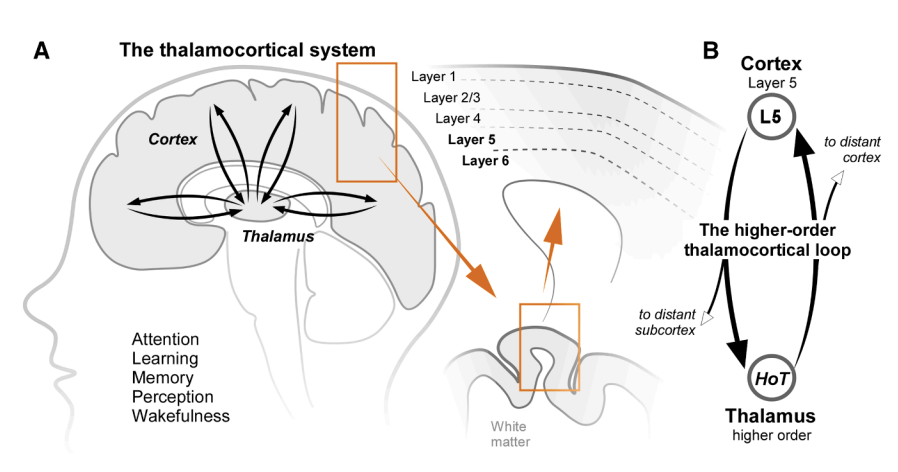
Y es sobre la atención y toca de refilón a la conciencia. Además, tiene que ver con mi hipótesis de que el PFC informa al tálamo sobre el resultado de las operaciones corticales.
La teoría propuesta en el artículo sostiene que la atención surge de la interacción entre la corteza y el tálamo (bien), donde cada capa cortical desempeña un papel distinto.
Las neuronas de la capa 5 (L5) envían información al tálamo de orden superior (los específicos, HoT), formando bucles corticotalámicos que sustentan la percepción consciente, pero estas conexiones se debilitan rápidamente... yeeeeah
La capa 6a (L6a) modula esos circuitos de forma indirecta a través del núcleo reticular del tálamo, ejerciendo un control inhibitorio y de filtrado de información al sistema tálamo-cortical
En cambio, la capa 6b (L6b) proyecta directamente tanto a L5 como al HoT, evitando el núcleo reticular, y recibe, además, señales de alerta (orexina, acetilcolina, dopamina, etc.) junto con órdenes de la corteza prefrontal... esto es lo que dicen los autores que regulan la atención... es decir, las conexiones de la capa 5 con el reticular talámico las percepciones conscientes, mientras que las conexiones de la L6b con los núcleos específicos (HoT) la atención... it makes sense...
Según los autores, esto permite que L6b seleccione, active y mantenga activos los bucles corticotalámicos relevantes, haciendo posible dirigir, sostener y cambiar la atención de manera precisa.
Sin embargo, este papel de L6b sobre la atención constituye una hipótesis que aún debe confirmarse experimentalmente, pero como hipótesis no está nada mal ✍️
Fuente: https://t.co/wtCGvPMDtm
4/ But who is good at guessing bilateral trade flows by product? And what signals do they pick up?
Is it just about picking larger and richer countries? Or is there something more subtle going on?
(If you want to read the analysis go to:
https://t.co/4xHyZf4UVR )
The common technique of simply asking people what they think about brands is a recipe for disaster. This week on the podcast, we look at some market research mistakes and alternative approaches from behavioural science.
MichaelAaron Flicker and I cover:
1. Social Desirability Bias - how people often default to the most socially acceptable answer when asked how they would behave
2. Self vs Others - how we’re much better at predicting other people’s behaviour than our own
3. Real World Experiments - why field studies with a bit of subterfuge are better at uncovering the drivers of behaviour compared to a standard survey
Listen on Spotify: https://t.co/bjAaBVRcHN
Listen on Apple: https://t.co/SbcfkvVaEO
Listen on YouTube: https://t.co/vGrPpdDnKJ
Hope you find it useful!
This ad was made to shock. But shock tactics often backfire because of the ostrich effect - we tend to block out negative information, burying our heads in the sand like metaphorical ostriches.
Evidence comes from a 2013 study by Josh Tasoff from Claremont Graduate University and Ananda Ganguly from Claremont McKenna College.
They tested students for oral or genital herpes, and then gave them two options:
1. Earn $11 and find out the result
2. Earn $1 and don't find out the result
5% of students declined to see their oral herpes result, and 15% refused to see their genital herpes result. For these participants, finding out if they had herpes made them stressed and anxious. So to avoid that feeling, they simply chose not to know, even if that meant losing $10.
The same principle has been shown to extend beyond STI tests. Unless change is very easy, ads that try and scare or guilt trip people into changing their behaviour tend to fail.
This applies to many charity and non-profit campaigns, like this one by Project Slingshot. Showing distressing or shocking images might feel like the best way to boost attention. But because these messages make people feel uncomfortable, they're more likely to tune them out, rather than engage with the content.
***
If you'd like to learn what tactics can prevent the ostrich effect, I’m running a small group training session on the 17th and 18th of August on applying behavioural science for better marketing.
See here for details: https://t.co/NVzbInvnKy
AI is amazing but often the technological sophistication translates into a terrible customer service
Needed to booked a hotel on the phone as I had a booking code
Completely automated voice interaction in a way not possible a year ago
But the result of the wizardry? whole process became 10 mins booking rather than the normal 2