Six weeks ago, Ben Affleck sat on Joe Rogan’s couch and said AI making movies is “bullshit.”
He Called AI writing really shitty and said AI would never replace the filmmaker.
Then he said the line that matters now.
“It’s going to be good at filling in all the places that are expensive and burdensome.”
He wasn’t speculating but was pitching because he’d already built it in secret for four years.
And this week, he sold it to the same Netflix he sat there criticizing for dumbing down filmmaking.
For making directors repeat plot points because viewers are on their phones.
For killing the incentive to make films look beautiful.
He called out their creative compromises on camera.
Then handed them the tools to make more.
Affleck told you AI won’t replace the artist.
He never said it wouldn’t replace the crew behind them.
🚨BREAKING: MIT hooked people up to brain scanners while they used ChatGPT.
What they found should concern every single person reading this.
ChatGPT users showed 55% weaker brain connectivity than people who didn't use it. Not after years. After just four months.
Here's how they tested it. 54 people were split into three groups: one used ChatGPT to write essays, one used Google, and one used nothing but their own brain. They wore EEG monitors that tracked their brain activity in real time across four sessions over four months.
The brain-only group built the strongest, most widespread neural networks. Google users were in the middle. ChatGPT users had the weakest brains in the room. Every time.
Then the memory test hit. Participants were asked to recall what they'd just written minutes earlier. 83% of ChatGPT users couldn't quote a single line from their own essay. They wrote it. They couldn't remember it. The words passed through them like they were never there.
It gets worse. In the final session, ChatGPT users were told to write without AI. Their brains were measurably weaker than people who never used AI at all. 78% still couldn't recall their own writing. The damage didn't go away when the tool was removed.
Meanwhile, brain-only users who tried ChatGPT for the first time? Their brains lit up. They wrote better prompts. They retained more. Their brains were already strong enough to use AI as a tool instead of a crutch.
The researchers also found that every ChatGPT essay on the same topic looked almost identical. More facts, more dates, more names. But less original thinking. Everyone using ChatGPT produced the same generic output while believing it was their own.
MIT gave this a name: cognitive debt. Like financial debt, you borrow convenience now and pay with your thinking ability later. Except there's no way to pay it back.
The question isn't whether ChatGPT is useful. It's whether the price is your ability to think without it.
Psychology says the 1960s and 70s accidentally produced one of the most emotionally durable generations in modern history — not through better parenting but through benign neglect that forced children to self-regulate, problem-solve, and develop emotional- https://t.co/ySUKm2ei79
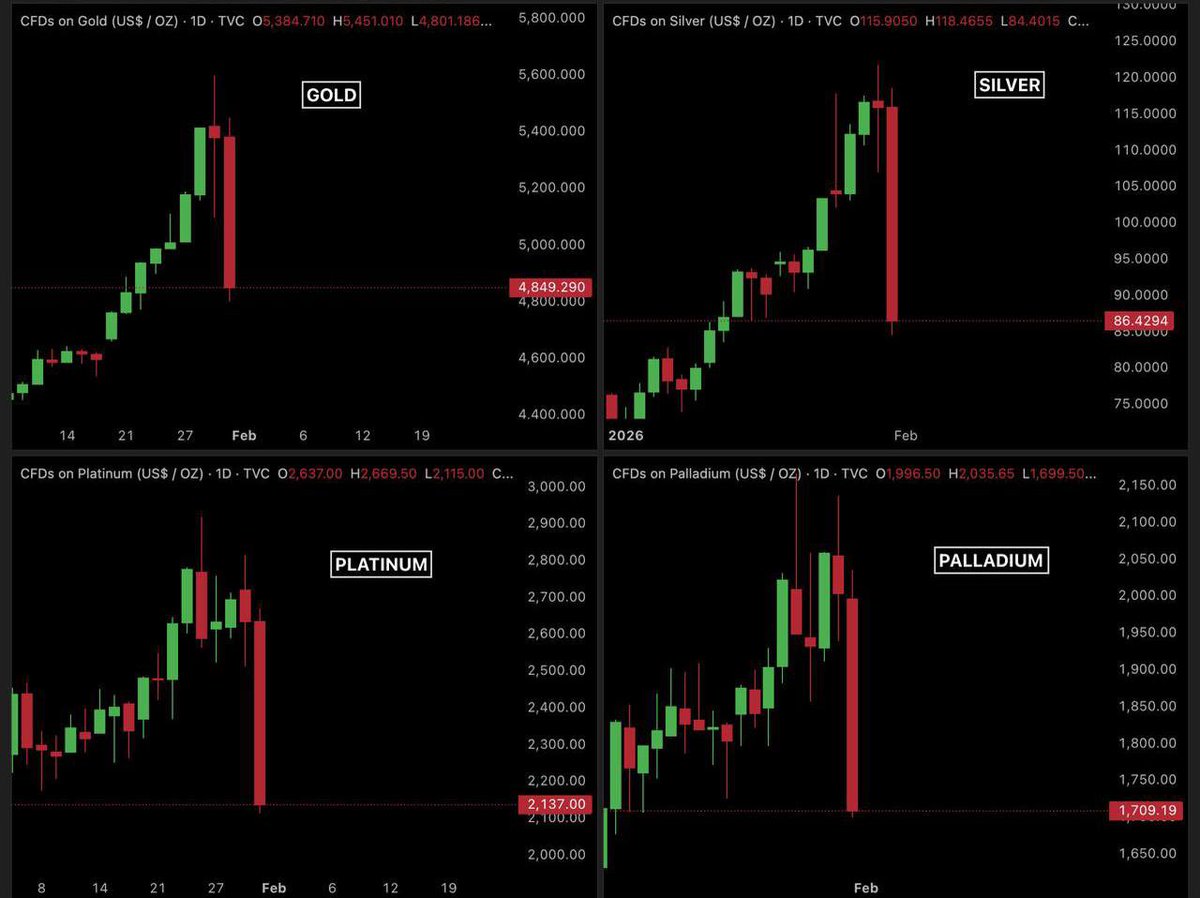
Gold crashed from $5,600 down to around $4,700. Silver fell from $121 to $77.
Platinum and palladium got crushed similarly.
All of this happened in less than 36 hours, and when you calculate the total value lost across all precious metals globally, it adds up to roughly $7 trillion.
This morning, Trump announced Kevin Warsh as his pick to become the next Federal Reserve chairman, replacing Jerome Powell when his term ends in May.
Warsh is known as an inflation hawk, he's focused on fighting inflation and keeping the dollar strong, which is the complete opposite of what traders had been betting on for months.
The entire metals rally was built on a simple narrative, traders assumed Trump would pick someone who'd aggressively cut interest rates and weaken the dollar.
When that happens, precious metals become more valuable because people lose confidence in fiat currency.
Traders loaded up on huge leveraged bets that metals would continue surging, using borrowed money to amplify their potential gains.
But when Warsh, a known inflation hawk got nominated instead, the thesis completely flipped.
Suddenly, every trader who had bet on falling rates and a weaker dollar realized they were wrong.
They needed to sell to cover losses.
The selling cascade happened extremely fast because once it started, leverage got flushed out violently.
Banks and market makers raised margin requirements on futures contracts, which forced smaller traders to sell whether they wanted to or not.
The forced selling pushed prices down even further, which triggered more liquidations in a vicious spiral.
On top of that, the dollar strengthened as markets processed the reality of a hawkish Fed incoming.
A stronger dollar makes metals cheaper for international buyers and reduces buying interest.
Every time metals dropped another few percent, more traders got wiped out and the selling accelerated harder.
The key thing to understand is that metals didn't crash because the fundamentals changed.
China still has export controls on silver, physical supply is still genuinely tight, and industrial demand still exists.
They crashed because the Fed policy narrative completely flipped in a single announcement, wiping out a crowded speculative trade that was entirely built on betting against the Fed and betting on a weaker dollar.
Former Phillies shortstop and current franchise hits leader Jimmy Rollins will be added to the Phillies Wall of Fame at Citizens Bank Park. https://t.co/skjMfj4SUY
NHS, Interact, and Key Club are collecting donations for the Hammonton Family Success Center and Unforgotten Haven of Blackwood - full or trial sizes accepted. The Drive begins December 1st.
@975BestShowEver Maybe Fangio has an influence on the draft and we improve our back end more than Howie would on his own. Remember, Fangio doesn’t want to give up the big play.
The https://t.co/tiOeY026Fu Cape May County High School Basketball Preview Show is set for Sunday 12/10 from 4 to 7 pm at @MudhenBrew in Wildwood. Coaches and players from all county teams on hand. Stop by!
@CMTHawks@LCMRAthletics@MTHSAthletics1 @WildwoodPSD @WCAcademy_NJ
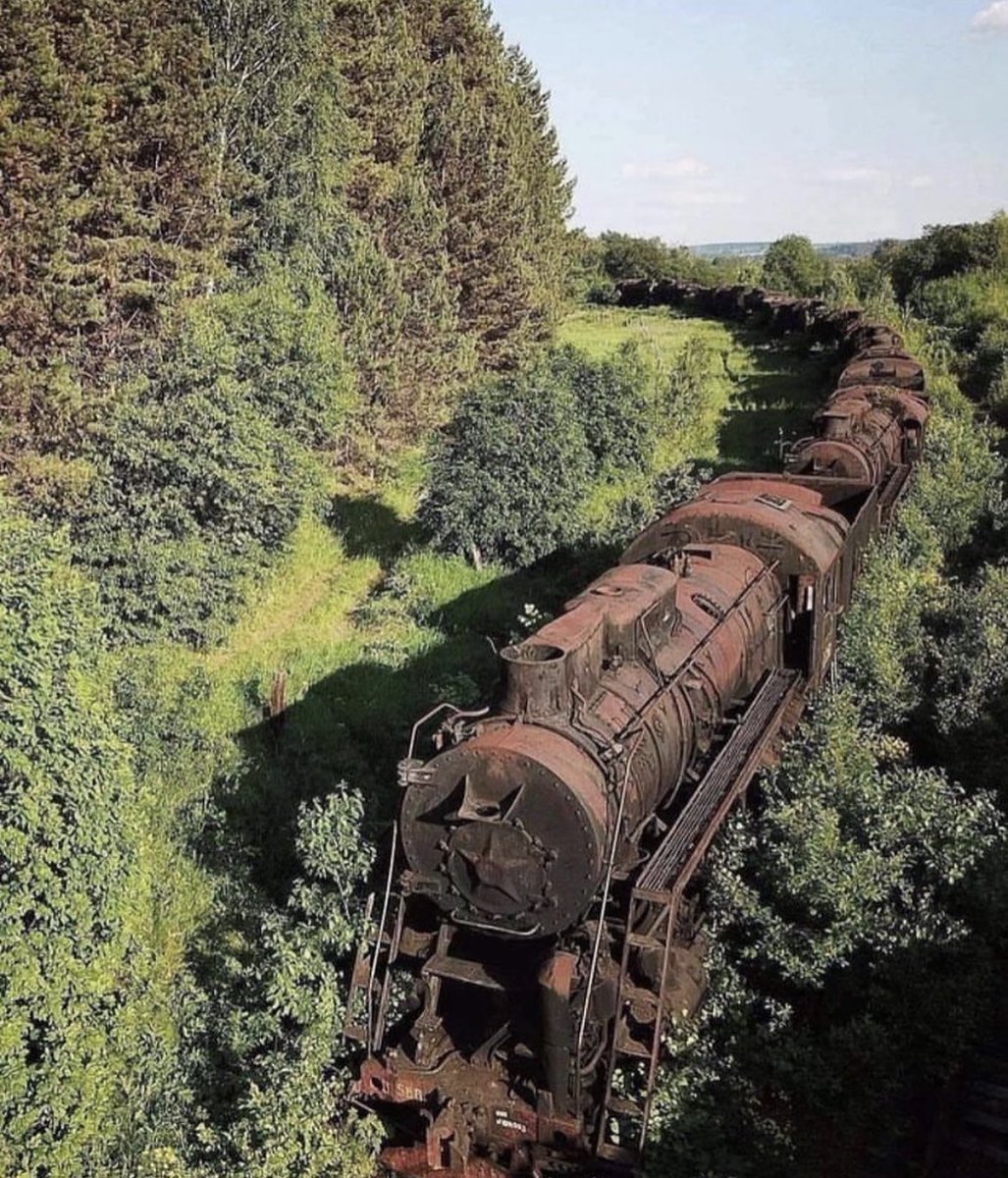
In Russia, during the Cold War, hundreds of old steam-engine trains were strategically parked on old tracks as a contingency plan in case the Russian electric grid faced any disruptions. The central Perm region of Russia is home to a unique sight - a train cemetery filled with dozens of steam locomotives from the 20th century, dating as far back as 1936 and as recent as 1956. Over the years, around 140 locomotives were stored there, but as technology advanced, steam engines were gradually replaced by electric power, rendering these reserve trains obsolete. As maintenance on the locomotives ceased, they fell into disrepair, succumbing to rust and overgrown vegetation.
In recent times, some of the abandoned trains have been purchased and removed by Chinese owners, while others have been restored and transformed into exhibits at various museums and memorials. This train cemetery remains as a testament to an era when steam locomotives played a vital role in Russia's transportation infrastructure during the Cold War.