Applied Micro interested in Causal Inference & ML. Ph.D. Econ @Georgetown and B.S. @LoyolaMarymount.
All models are wrong but some are useful - George Box
If you're an economist and haven't heard about the double descent phenomenon, you might be overlooking one of the most interesting developments in computer science and statistics today. Personally, I haven't come across anything as fascinating since I first learned about Markov chain Monte Carlo in the fall of 1996.
Let me walk you through the idea with an example and a figure from my recent survey “Deep Learning for Solving Economic Models” (check my post from yesterday):
🔗https://t.co/Tr4YrkiQW8
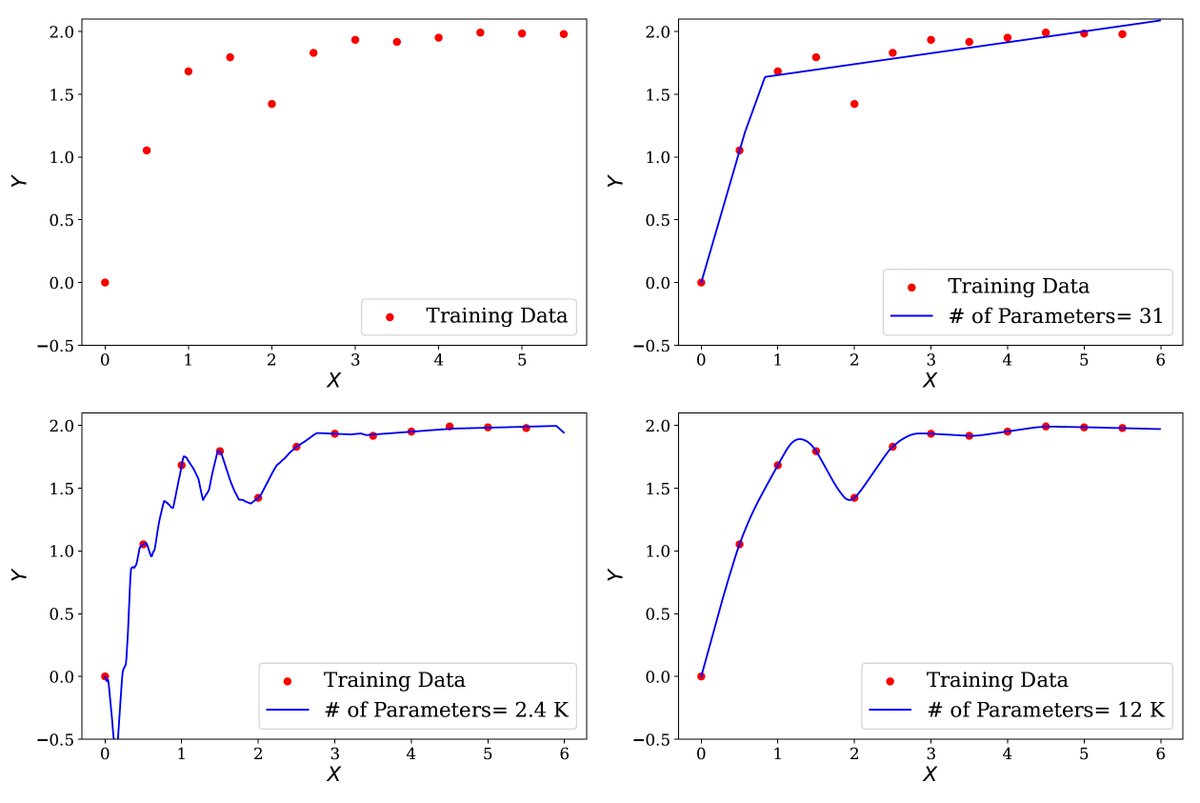
◽ Step 1. Draw 12 random points from the function
Y = 2(1 - e^{-|x + \sin(x)|})
and plot them in red (panel 1, top left, in the figure I include).
◽ Step 2. Train a very simple single-hidden-layer neural network with a ReLU activation and 31 parameters on these 12 data points. This is a “simple” network, and if some of the jargon is unfamiliar, do not worry; the key is just that this network is small.
The result is the blue line in panel 2 (top right). The network captures the overall shape of the data but lacks the capacity to interpolate all points.
◽ Step 3. Increase the network’s size to 2,401 parameters. Now we hit the interpolation threshold: the network can perfectly fit the training data.
The blue line in panel 3 (bottom right) does interpolate all 12 points, but it becomes wiggly, oscillating wildly outside the observed data (see the fluctuations between the second and third points on the left).
This is the textbook warning we teach in econometrics: overparametrization fits the training data beautifully but performs poorly out of sample. This is the U-shaped bias–variance tradeoff curve in action.
◽ Step 4. Now do something insane: push the network to 12,001 parameters for just 12 data points. Surely disaster must await.
Instead, panel 4 (bottom left) shows the opposite: the network fits all the data perfectly and creates a smooth, intuitive curve.
It reminds me of the old connect-the-dots puzzles from childhood: instead of drawing a wiggly mess, the network finds the “right” curve you would have drawn by hand.
This is the double descent phenomenon: the classical U-shaped bias–variance tradeoff extends into a double dip, where performance out of sample improves again once models become massively overparameterized.
So, the solution to too many parameters might be…even more parameters! Or, as we say in Spanish: if you don’t want broth, you’ll get two cups!
Why does this happen? I will try to explain our current (incomplete) understanding of this phenomenon tomorrow in another post, as it involves quite a few ideas.
But in the meantime, three key points to keep in mind:
1️⃣ We only have 12 points — double descent is not about large datasets.
2️⃣ We are using a single-layer neural network — this is not about depth.
3️⃣ The effect is not even specific to neural networks — you can find similar behavior with high-degree polynomials.
👉 This is why double descent is so surprising: it challenges decades of conventional wisdom in statistics and econometrics.
Finally, let me thank @MahdiKahou, my coauthor on much of my recent work on machine learning, for his help in preparing this example. He is the one who truly masters these methods and patiently teaches me about them every day. Anyone who wants to understand this material in depth would benefit greatly from talking to him.
For those who want to jump to the frontier in select areas of economics, the AEA has posted the webcasts of this year’s continuing lectures. Thanks much to @lkatz42 for his leadership and vision in assembling these lectures. https://t.co/waqw7yeQrk
If you have ever tried to read free books from sites like Project Gutenberg, you noticed that they can be uncomfortable to read, due to their layouts, type & occasional errors
This project takes those free books and makes them beautiful (and still free). https://t.co/GQPFSgWXZm
I have received a lot of DMs recently about how difficult the job market is this year. I hope below can give some kind of solace and advice for the market.
Keep your heads up everyone. ❤️
#Lecturarecomendada 📚🔎
🎯Nuevo trabajo de @el_BID 🎯
🇨🇷El modelo de financiamiento de centros educativos en Costa Rica: las juntas de educación y administrativas.
Accede aquí 👉🏽https://t.co/3N9LYlVS26
Interesting tool to turn research papers into AI generated podcast discussions that provide a high level overview: https://t.co/trjS8ISDTL Fed it some of my papers and it did a very reasonable job, especially with the ML pubs. #econtwitter
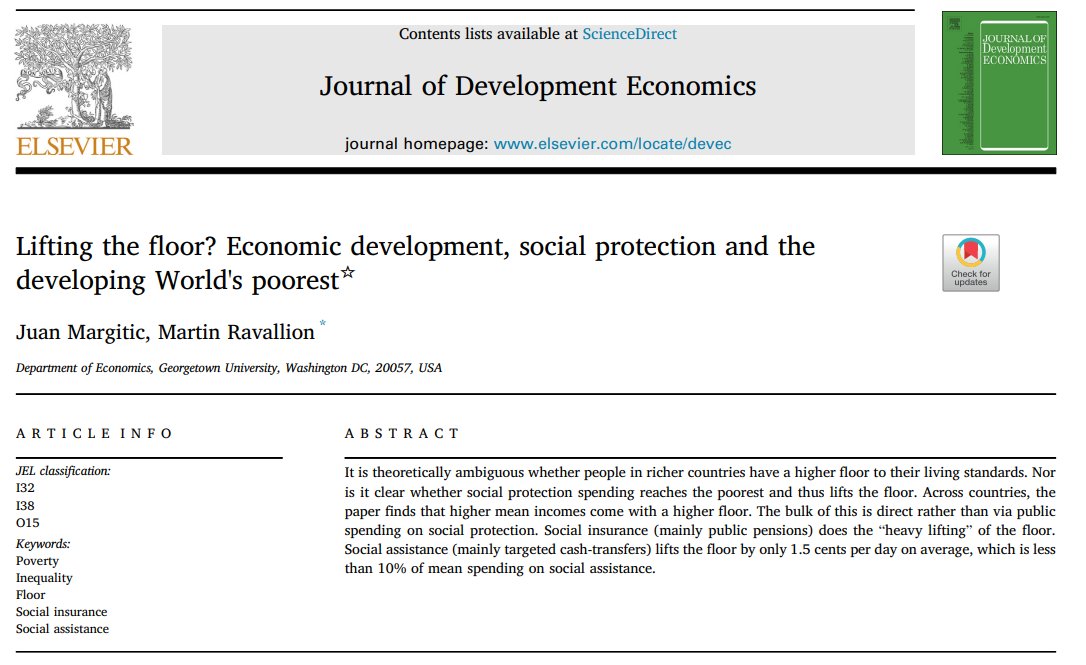
#CashTransfers may have limited impact lifting the floor of living standards for the poorest: "Social assistance (mainly targeted cash-transfers) lifts the floor by only 1.5 cents per day on average ...less than 10% of mean spending on social assistance."
https://t.co/gpPXOG4mqI
✨✨ New Package ✨✨
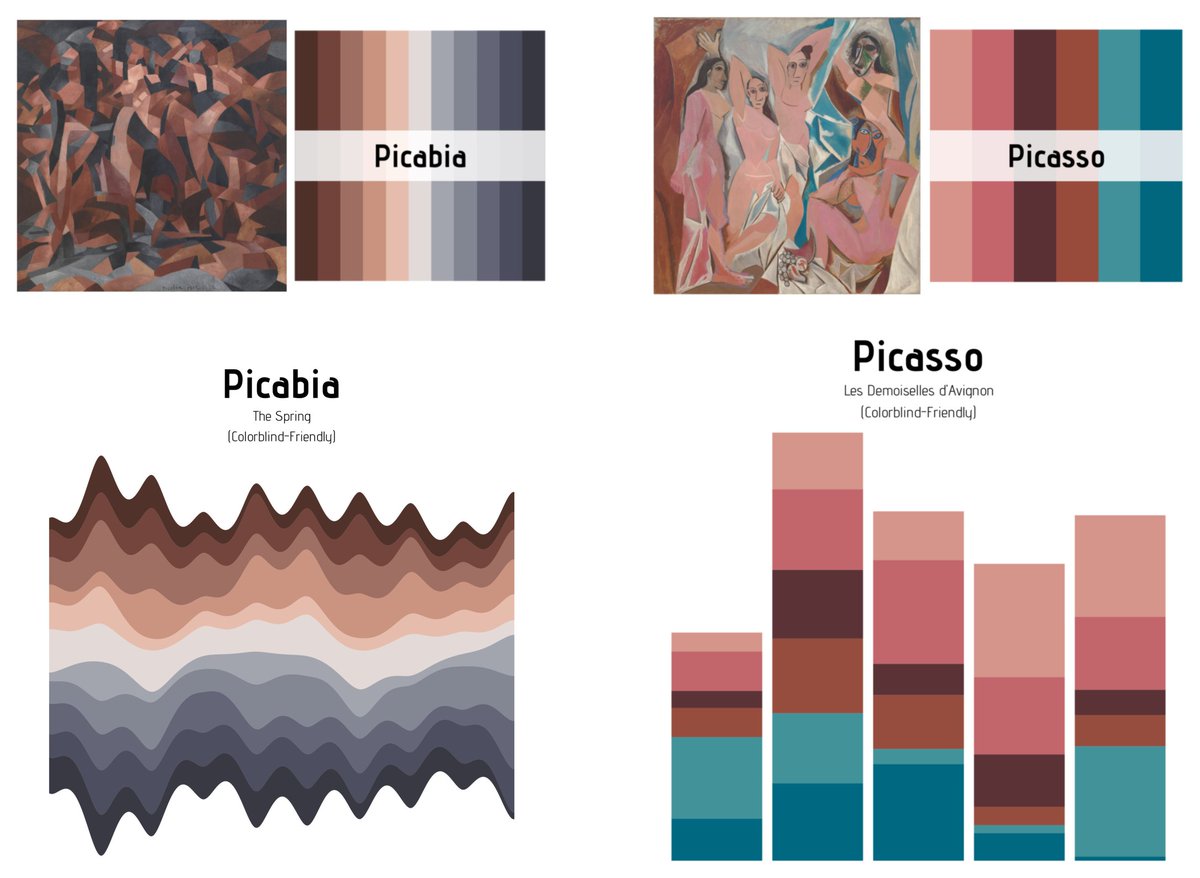
Happy to announce that I am soft launching another R color palette package, {MoMAColors} today! Currently has 35 palettes based around artwork at @MuseumModernArt.
Download Instruction and Palettes here: https://t.co/xWbfV1vsGm
#r4ds#dataviz#rstats
¿Es #ChatGPT el fin de los profesores? ¿Adiós a la #educación tal y como la conocemos? La irrupción de esta herramienta de inteligencia artificial sacudió a los sistemas educativos del mundo. Sobre sus consecuencias, lee este blog de @alejmordu@el_bid https://t.co/877mXaaAVs
Las nuevas generaciones incorporan la tecnología y el juego de manera natural. Por eso, las industrias creativas pueden contribuir a transformar los sistemas educativos. ¿Qué puede aportar el edutainment a la #educación? Lee este blog de @el_BID aquí https://t.co/RXfE8RgRoM
Hi #EconTwitter!
Interested in 𝐜𝐚𝐮𝐬𝐚𝐥 𝐢𝐧𝐟𝐞𝐫𝐞𝐧𝐜𝐞 and program evaluation using the #econometrics of 𝐫𝐞𝐠𝐫𝐞𝐬𝐬𝐢𝐨𝐧 𝐝𝐢𝐬𝐜𝐨𝐧𝐭𝐢𝐧𝐮𝐢𝐭𝐲 𝐝𝐞𝐬𝐢𝐠𝐧?
Check out this cool survey by the top experts Matias Catteneo and Rocìo Titiunuk (@Princeton)!
Martin was the principal author of the first World Bank report that established the one-dollar poverty line and that remained immensely influential ever since. His work esp. on China and India was seminal. He was a great colleague and a tutor to many.
A tragic loss for the world of research on global development & global poverty and for many of Martin's colleagues and collaborators across the five continents.
@MartinRavallion always greeted me with a smile as I ranted on a crazy idea and then proceeded to kindly and patiently explain the clear fallacies in my thought process. The field of development has lost a juggernaut and I will miss him dearly
So sad to hear of the tragic loss of @MartinRavallion — pioneering poverty researcher, one of the most influential economists of the @WorldBank, and a respected @Georgetown professor. His contribution to our understanding of development was truly enormous.
This is another shock to the world's poor, and coming so soon after the pandemic. And not only poor people in wheat importing countries. Urban, and the many rural families who are net purchasers, will see welfare losses across the world. https://t.co/xeSIKoLu2T