HOW TO TELL THE DIFFERENCE BETWEEN A PULLBACK & A REVERSAL🔮🔮
We've all been there. Price starts to move against the trend & we're stuck wondering if it's just pulling back or if it's about to reverse
Here's how you can tell the difference:
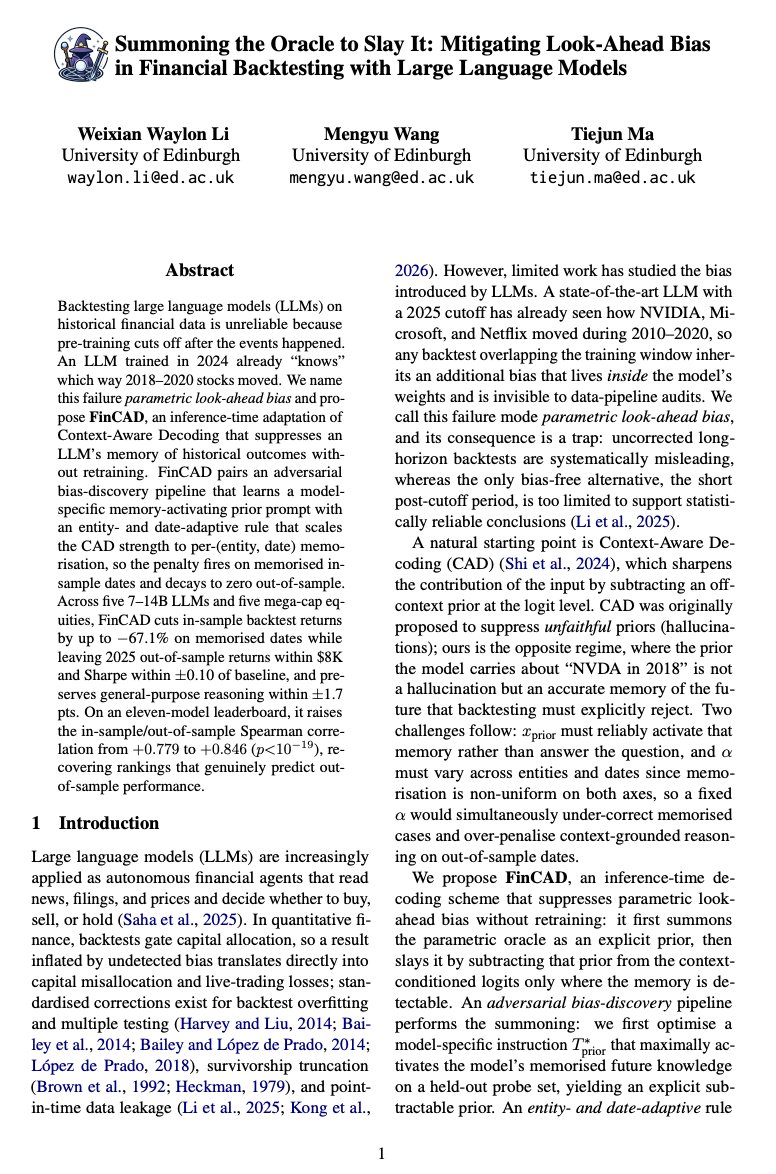
A backtest isn't a test of trading skill. It's a test of what the model remembers.
That's the real finding in a new Edinburgh paper on LLM trading agents.
Across 11 LLMs, in-sample "performance" predicted true out-of-sample performance with a correlation of just +0.78.
Strip out each model's memory of what actually happened to the price, and that correlation rises to +0.85, holding across 330 tested model combinations.
Most LLM trading backtests aren't forecasting the future. They're grading the past.
Bookmark! Worth ten minutes.
Anthropic just dropped 5 workshops on building self-improving agentic systems from scratch:
00:00 - Ship your first Claude agent
36:44 - Build memory for Claude agents
1:05:06 - Make your agent autonomous
1:26:46 - Set up a proactive agent
2:03:35 - self-improving agents (tools,skills)
These 3-hours of free Claude workshops will replace 10 paid agentic courses.
Watch today, then read article below on how to build a self-improving agentic system with Fable 5.
this is f*cking dangerous
an Anthropic engineer just gave the exact prompting playbook for Fable 5
the accurate way to run Fable 5 without wasting tokens or overpaying
bookmark this before before someone takes it down
The Head of Claude Code uninstalled his IDE in November. He doesn't write prompts either. Here's what he does instead.
Boris Cherny runs the team that built Claude Code at Anthropic. In this talk he walks through his own evolution and it maps to the 3 stages every AI user goes through.
Stage 1 is autocomplete. Think Copilot. The AI finishes your sentences, but you're still writing the code.
Stage 2 is prompting. You tell the AI what to build and it builds it. This is where most people are right now with ChatGPT, Claude, and Gemini. It's powerful, but you're still the bottleneck because every task starts with your prompt.
Stage 3 is what Boris calls "writing loops." You design a system that prompts the AI for you. The loop watches for a trigger, generates the prompt, validates the output, and repeats. Your job stops being "write better prompts" and becomes "design better loops."
Boris is deep into Stage 3. He runs hundreds of Claude instances in parallel. Some monitor Twitter feedback. Some triage GitHub issues. Some figure out what to build next. He said about 20% of the ideas are worth building. With the next model, most will be.
The jump from Stage 2 to Stage 3 is the biggest change in how people work with AI since ChatGPT launched. And most people don't know it exists yet.
Watch the full talk. Then ask yourself which stage you're at.
And to the #MMAT and #MMTLP community, and especially your families, thank you for your resilience, your pursuit of truth, your unwavering support for one another, and your determination to build a better future.
May justice, innovation, and opportunity continue to prevail.
Warmest wishes!
🇬🇷🇨🇦🇺🇸
Most traders think an order block is just "the last red candle before price pumped."
That's not even close.
It's smart money's footprint, left behind on purpose.
Here's what that means:
whats stopping you from building a second brain?
just install codex, connect it to all your tools
then run /goal mode with the loop below and have it cook for 12 hours building an obsidian vault
this loop will go through every detail from every connector you have
you will have the most perfect knowledge base for you and your agents
go experience personal AGI before everyone else
I genuinely don't understand why everyone isn't using this yet
Andrej Karpathy, a co-founder of OpenAI, posted a simple idea that hit 16 million views: stop using AI to write code, use it to build a second brain.
You point Claude Code at a folder, drop in any source, an article, a transcript, a PDF, and Claude reads it, links it, and files it into a living wiki of everything you know. It compounds like interest, the more you feed it, the smarter it gets.
Here's the whole thing:
> Install Obsidian, create a vault, open it in Claude Code
> Paste Karpathy's wiki idea file and tell Claude to build it
> Claude makes three folders: raw for sources, wiki for its pages, a CLAUDE.md that runs it
> Drop any source into raw and say "ingest this"
> Ask questions across everything, forever
Five minutes to set up, and you never start from a blank chat again.
Full step-by-step guide with Claude and Obsidian, link below.
Bookmark this
Introducing developer mode for browser use in Chrome and the Codex in-app browser.
Codex can use the Chrome DevTools Protocol (CDP) to debug browser issues by profiling JavaScript performance and inspecting console output, network traffic, and page state.
Use the OpenAI Developers plugin in Codex to build faster with OpenAI tools by setting up API keys, finding the right docs, and debugging along the way.
🚨 @Karpathy predicted the power of the "LLM Wiki." Google just formalized it.
Meet Open Knowledge Format (OKF): a vendor-neutral standard for giving foundation models the curated context they need.
I can genuinely see this replacing Notion, Obsidian, or traditional wikis for developer teams, and the reason comes down to bookkeeping.
Traditional wikis fail because humans inevitably abandon the tedious work of updating them.
As Andrej Karpathy pointed out recently, LLMs don't get bored.
They don't forget to update a cross-reference, and they can touch 15 files in a single pass.
OKF standardizes the interoperability layer so agents can actually do that heavy lifting autonomously.
Because the format is minimally opinionated, it doesn't dictate what you write, it just dictates how it's structured. You get:
→ Human-readable documents that live right alongside your code in version control
→ Cross-links that map out complex entity relationships without needing a graph database
→ A system that survives moving between different tools and organizations
There is no complex compression scheme.
No central registry.
If you can cat a file, you can read it.
If you can git clone a repo, you can deploy it.
This is how we stop rebuilding context pipelines from scratch every time a new model drops.
Announcement + spec file in 🧵↓
this is f*cking gold
How to build your first AI agent (Full guide)
if I had this a year ago, I would've shipped my first agent in a day instead of 2 weeks
in the right hands, this changes everything:
50 signals each right 52% of the time
outperform any single signal right 70% of the time
that's not an opinion. that's z-field math
a 52% signal alone is noise - coin flip territory, not worth a position on its own
but stack 50 independent ones, normalize each by historical sharpe, and build a composite z-score
accuracy jumps to 63-65%, sharpe ratio compounds and drawdowns compress
more independent signals you add, even weak ones, the more noise cancels and edge survives
citadel doesn't search for perfect signals. they build systems to aggregate weak ones
framework is z-field aggregation - every signal gets weighted, scored, stacked
when composite crosses a threshold: trade. when it doesn't: flat
gut feel and chart patterns don't enter the equation
retail spent years chasing a signal with no false positives
quants built math to make 50 imperfect ones into one
math has been in every stats textbook - published, free, 40+ years
Bookmark this
nobody in your trading group is combining signals. they're still hunting for just one
I built my own charting platform with Claude Fable, and it does a few things Tradingview straight up can't..
I call it EchoCharts..
so what it basically does is
1) Echoes:
this is the big one. it takes the exact shape price action is forming right now them scans thousands of past candles, and finds every time the market looked just like this before.
then it shows you what happened next. it'll tell you something like "20 matches, 30% closed higher 24 bars later, median -0.05%", and it draws those past paths forward on the chart so you see the full spread.
2) Sketch search:
draw any shape with your mouse, and it finds where price actually did that in real history, then jumps you straight to it.
great for the patterns you can feel but can't name.
3) Market clock:
A 24-hour dial showing when this market actually moves. volatility, direction and volume, split by hour of the day and day of the week.
so you stop trading dead hours and start trading when it counts.
plus the basics done clean, candles, volume, a moving average, and RSI.
So how it basically works is,
it all runs on real binance data, 6,000 live candles..
Echoes matches the shape of the move using correlation, not the price level, so a setup today of bitcoin:native at $63K can match one from years ago at $10K
and it only ever looks at fully finished history, it never peeks at the future, so the "what happened next" numbers stay honest.
Now, Here’s how i built it:
i described what i wanted and claude fable built it.
plain javascript, the lightweight-charts library for the chart, around 700 lines, no framework. static site, opens in any browser.
one thing i'll be straight about, echoes shows you what happened after similar setups in the past. that's history, not a prediction.
it shows you the lay of the land, it doesn't call the future.
might open-source the whole thing soon.
Cinematographers learn 12 camera moves in film school.
Most AI creators don't know a single one. Because nobody told the camera what to do.
.
.
Here they are:
→ Push-in — moves toward the subject
Builds tension. Creates intimacy. Use it slowly.
→ Pull-back — retreats to reveal
Isolation. Scale. Endings. The reveal shot.
→ Pan — horizontal rotation, camera stays fixed
Suspense lives in what you haven't shown yet.
→ Tilt — vertical version of the pan
Tilt up on a hero. They look powerful immediately.
→ Tracking shot — camera travels with the subject
Energy. Forward motion. You feel like you're there.
→ Arc / orbit — circles the subject
Hero moments. Product showcases. Keep it under 30 degrees.
→ Crane / jib — sweeps vertically on a boom
Grandeur. Scale. The "god-view" of cinematography.
→ Zoom — focal length changes, camera doesn't move
Flatter look than a dolly. Fast zoom = music video energy.
→ Dolly zoom — camera goes one way, lens goes the other
Background warps. Subject stays still. Pure psychological dread.
→ Whip pan / crash zoom — extreme speed for transitions
Shock. Comedy. Stops the scroll every time.
→ Handheld — natural shake, no stabilisation
Add "subtle" or the model goes full earthquake.
→ Static + angles — low, high, Dutch, bird's-eye, worm's-eye
Low angle = power.
Dutch angle = unease.
Bird's-eye = scale.
The mistake everyone makes: stacking multiple moves into one prompt. One move. One clip. Always.
And add "slow" to almost everything. Slow moves hide what AI can't render cleanly. Fast moves expose every flaw.
Andrej Karpathy quietly shipped the best second brain idea in years
not an app. a pattern.
let an llm maintain a wiki of your notes. you dump sources, it reads them, links them, files them. knowledge compounds like interest.
someone built it into a free claude code plugin. setup is two commands:
claude plugin marketplace add AgriciDaniel/claude-obsidian
claude plugin install claude-obsidian@agricidaniel-claude-obsidian
then open obsidian, open claude code in the same folder, type /wiki.
that's it. your notes are now queryable by claude and they get richer every time you read something.
bookmark this. best thing you'll build this weekend.