Thoughts after the initial wave of major TMT earnings (hyperscalers):
Bottom Line: This earnings season fundamentally changed the AI investment debate. For the past 18 months, investors questioned whether AI demand was real, whether hyperscalers were overspending, and whether unprecedented AI CapEx would permanently impair free cash flow. I think those questions are now largely behind us. Azure accelerated to +43% (guiding ~45%), Google Cloud accelerated to +82% (with TPU system sales beginning to be recognized as revenue), AWS posted its fastest growth in 18 quarters (+37%) while backlog reached $496B, and Oracle heads into earnings with expectations for another quarter of 90%+ OCI growth (I wouldn't be surprised if OCI approached ~110%). When every major cloud provider is accelerating simultaneously, this is no longer primarily a market-share story, it's a market expansion story driven by AI. That's a rare dynamic in technology. Normally, one platform's acceleration comes at another's expense. This time, everyone is accelerating because AI is expanding the size of the market itself.
What stood out most wasn't the growth rate, it was how confidently management teams defended AI CapEx. Andy Jassy gave one of the clearest explanations of AI infrastructure economics I've heard on an earnings call. Servers begin generating revenue almost immediately after deployment and typically pay back in less than three years, while data centers have 30+ year useful lives, supporting multiple generations of hardware. AWS isn't buying servers speculatively, it has strong visibility into customer demand before triggering most of that spend. Even after raising 2026 CapEx to ~$220B, AWS says it remains capacity constrained and expects demand to exceed supply into 2027. Alphabet raised its own 2026 CapEx guide to $195-205B mid-year for exactly the same reason.
The comment that caught my attention most, however, was Jassy's long-term framing. AWS has historically been viewed internally as a business capable of generating several hundred billion dollars of annual revenue. Today, Amazon believes AWS can ultimately become at least twice that size, and potentially a $1T annual revenue business. That's an extraordinary statement from one of the most disciplined capital allocators in technology. To me, it suggests AI hasn't simply accelerated cloud growth, it has fundamentally expanded the long-term TAM for cloud infrastructure.
The biggest read-through from this earnings season is that the market is moving from debating whether AI CapEx destroys free cash flow to how much incremental free cash flow it can create over the next decade. We're also moving beyond asking whether AI demand is real and toward the much more important question: who captures the economics?
Read-throughs to watch:
Oracle ( $ORCL): Oracle is second-order beneficiary of everything discussed above. Every hyperscaler is telling the market demand still exceeds available capacity, while Oracle enters earnings after posting 93% OCI growth last quarter. If Oracle delivers another quarter of 90%+ OCI growth, or even approaches triple digits, it would further reinforce that OCI has become one of the preferred platforms for frontier AI workloads rather than simply another enterprise cloud provider. Oracle is increasingly participating in the AI infrastructure build-out, not merely enterprise cloud migration.
AI Compute & Semis ( $NVDA $AMD): Three hyperscalers simultaneously increasing CapEx, AWS to $220B, Alphabet to $195-205B, while Microsoft continues signaling elevated AI infrastructure investment and demand that still exceeds supply, is a powerful demand signal for GPUs, networking and custom silicon. Google is commercializing TPUs. AWS disclosed its Trainium business has reached a $25B annualized run rate, growing triple digits. Custom silicon is accelerating alongside Nvidia, not replacing it. One point I think investors underappreciated: Jassy explicitly said post-training, reinforcement learning and agentic workloads are predominantly CPU-intensive. As AI shifts from training toward inference and autonomous agents, the CPU layer scales alongside the GPU layer, not instead of it. That's an important long-term read-through for AMD's EPYC franchise.
Foundry & Semi Cap ( $TSM $AMAT $LRCX $KLAC): Every Trainium chip, TPU and custom ASIC ultimately runs through advanced manufacturing and packaging. TSMC remains the critical bottleneck for custom silicon, while rising hyperscaler CapEx reinforces demand for advanced packaging, HBM and leading-edge wafer capacity. The picks-and-shovels layer of the AI ecosystem continues to benefit regardless of which chip architecture ultimately wins.
Cybersecurity ( $PANW $CRWD $FTNT): One read-through I don't think the market fully appreciates is cybersecurity, one of the few software cohorts I've remained constructive on this year. Andy Jassy noted that security is one of the first topics discussed in virtually every enterprise AI deployment, and AWS launched Continuum, an AI-native vulnerability discovery and remediation platform, in response. I don't see this as a negative for cybersecurity vendors, I see it as validation that AI is dramatically expanding the enterprise attack surface. Every AI agent, API, model endpoint, vector database and autonomous workflow creates another asset that must be secured, monitored and governed. AI infrastructure and cybersecurity are becoming two sides of the same investment theme. That continues to favor integrated platform vendors like Palo Alto Networks, CrowdStrike and Fortinet, which are increasingly securing AI environments rather than just traditional IT infrastructure.
Enterprise AI Platforms ( $SNOW $MDB $DDOG $PLTR): Although, as a whole, I remain cautious on software, I'm still positive on this group. Hyperscalers aren't just building AI infrastructure, they're confirming that AI at scale requires a mature data, orchestration and observability layer underneath it. Every inference workload requires data, storage, vector databases, governance and observability. As AI moves from pilots into production, these layers become mission-critical infrastructure rather than discretionary software spend. The winners won't simply help enterprises build AI, they'll help them operationalize it.
The inference build-out is still in its early innings. AWS noted that most enterprise production workloads still aren't using inference at scale, describing a large "middle of the barbell" between frontier AI labs consuming massive compute and enterprises broadly deploying AI into production. When that middle begins to move, and I believe it will, it represents the largest incremental source of AI infrastructure demand we've seen yet.
Training builds the models. Inference commercializes them.
I continue to believe we're still much earlier in the AI cycle than the market appreciates. The technology debate is largely over. The investment debate is just beginning. The biggest winners over the next decade won't necessarily be the companies building the best models, they'll be the companies that build the most durable platforms, infrastructure and business models around AI.
#AIInfrastructure #CloudComputing #Earnings #Cybersecurity
Food for thought.
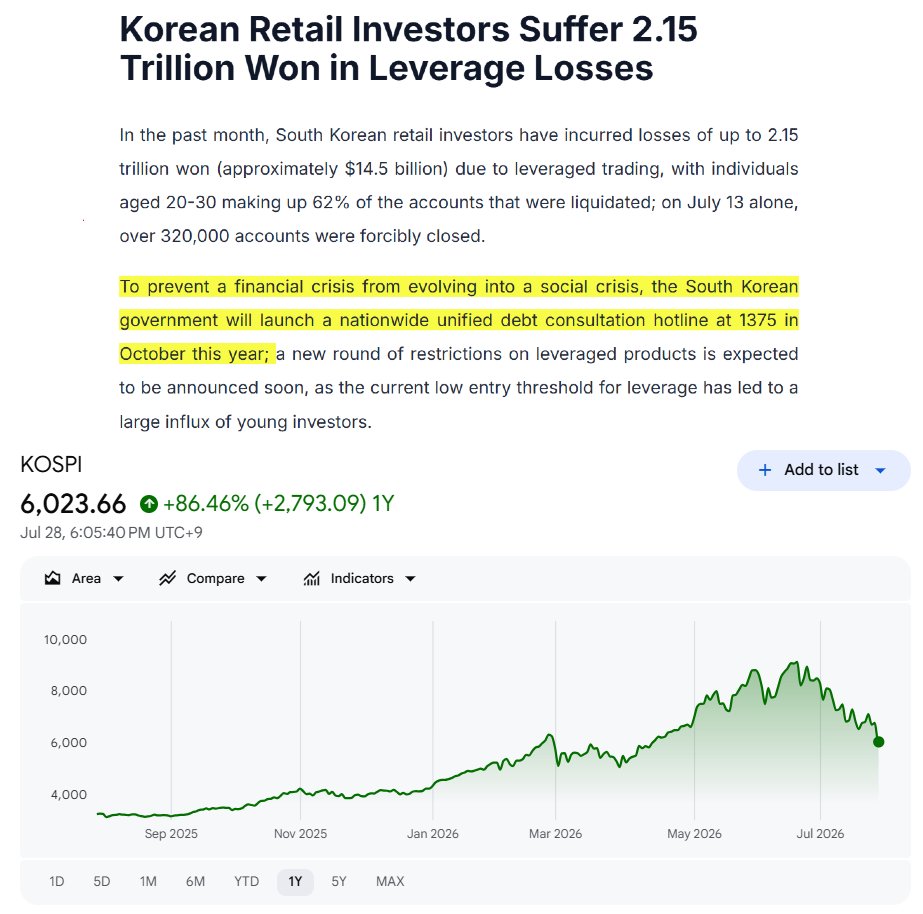
We got leverage in Korean markets and AI-related names to such an extreme that many stocks ran hundreds of percent further than they otherwise would have.
Now that leverage is being cleansed from the system, traders and funds are blowing up, yet everyone suddenly expects a V-shaped recovery right back to the highs?
That's not how markets typically work.
Just look at silver earlier this year. Massive leverage unwinds don't magically reverse overnight. In many cases, the prior highs are never revisited.
To get back to the levels we saw just 8 weeks ago would likely require an entirely new wave of leveraged buying. But human psychology doesn't work that way. The people trapped near the highs become overhead supply, eager to sell into rallies, while new buyers are far less willing to aggressively lever up after watching the previous unwind.
At the same time, the fundamental backdrop evolves. Bottlenecks get resolved. Capital rotates elsewhere. Leadership changes.
Former leaders can absolutely rally, but many spend months, or even years, well below their prior highs while the market finds a new group to lead the next advance.
History is full of examples where leverage creates the move up... and its unwind permanently changes the landscape.
Korean workers in their 20s and 30s could not afford Seoul apartments so they turned KOSPI into their housing trade (FOMO Case Study)
They borrowed on margin at 3x, poured savings into 2x semiconductor ETFs, and treated short term trading tools as long term bets. When prices dropped, brokers auto-liquidated 360,000 accounts.
62% of those wiped out were under 35. A generation priced out of real estate treated a bull market on borrowed money as their only path to building wealth, that bet did not hold
Margin loans on KOSPI hit record 38.63 trillion won in late June. When prices fell, brokers sold holdings to cover shortfalls, pushing prices lower, triggering more margin calls.
Goldman Sachs estimated retail ETF rebalancing drove 62% of institutional net selling on some days. Retail did not just lose money here. Their borrowed positions became the mechanism that made the crash deeper.
Margin amplifies gains when markets rise. It turns an orderly decline into a cascade when they fall.
What makes Korea crash different from a normal correction is the human cost. Government launched a 1375 debt hotline because margin losses were crossing into a mental health crisis.
2.15 trillion won in retail losses from borrowed money in one month. One office worker lost 18 million won of his housing savings in semiconductor ETFs.
KOSPI will recover, that is how markets work. But people who bet money they could not afford to lose do not get a do-over. Their debt stays after the index comes back.
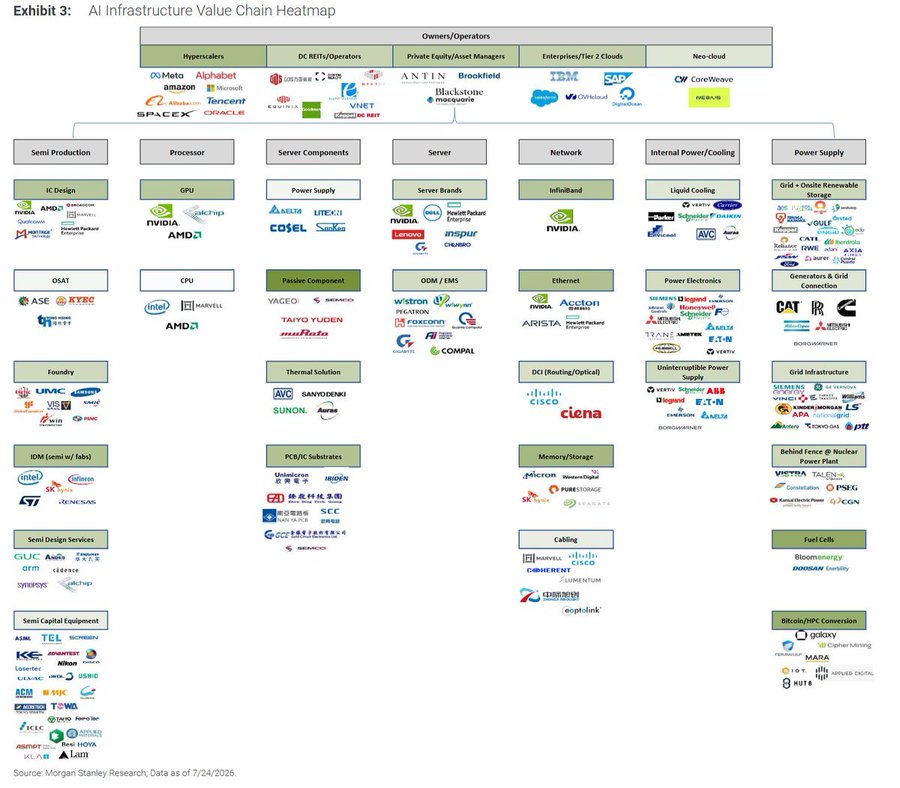
Morgan Stanley just mapped out the entire AI infrastructure supply chain, and it reveals who actually gets paid at every layer of the trillion dollar buildout (Save this).
This heatmap breaks the AI infrastructure value chain into two dimensions those who owns and operates the data centers at the top and what physical and technical components get built underneath to make those data centers function.
At the top sit the owners/operators, the hyperscalers like Meta, Alphabet, Amazon and Microsoft, alongside data center REITs, private equity giants like Blackstone and Brookfield, enterprises and neoclouds including CoreWeave and Nebius.
These are the companies writing the massive capex checks that fund everything below them.
Below that sits the actual build out, split into seven layers, semi production, processors, server components, servers, network, internal power/cooling and power supply.
Semiconductor production is dominated by names your audience already knows well, Nvidia and AMD for GPUs, TSMC adjacent foundries, ASML and Applied Materials for capital equipment, and Micron and SK Hynix under memory/storage.
But the less obvious money is in the physical infrastructure layers most retail investors never look at.
Server components include passive parts from Yageo and Murata, thermal solutions from Sanyo Denki, and PCB substrates from companies like Unimicron.
Network infrastructure includes InfiniBand and Ethernet gear from Nvidia and Arista, plus optical/DCI routing from Cisco and Ciena.
Internal power and cooling is arguably the most underappreciated category here.
It includes liquid cooling specialists like Vertiv and CoolIT, power electronics from Siemens and Eaton, and uninterruptible power supply makers like ABB and Legrand, all companies solving the literal heat and electricity problem created by cramming more GPUs into less space.
So who benefits from all of this?
Everyone in every box benefits in some way but the real insight is that value doesn't concentrate at just the GPU layer anymore.
The hyperscalers at the top are distributing capex across seven distinct physical layers which means the picks and shovels opportunity set has expanded well beyond Nvidia into cooling, grid infrastructure, and power generation.
Milk Road Pro is tracking each one of these layers, come join us for just a dollar using the link below!
LeBron James Bought Himself Two More Years Before He Figures Out What His Choice Of Sacrifice Will Be
Will he go the Dwayne Wade & Magic Johnson route and turn one of his sons out?
Will he go The Usher Raymond & Lil John route and sacrifice one of his children by death?
He only has so many choices and he is trying to control the pace of that pending decision because he knows.
In the entertainment industry the occult system draws from inverted hermetic principles and Crowley-derived ritual forms adapted for mass-media influence. Blood serves as both currency and anchor, binding the participant’s energetic field to the controlling entity.
Generational sacrifice functions as the highest-value offering because it severs natural bloodlines while transferring the released energy into the pact holder’s extended influence radius. Meaning they are further elevated through sports commentary or other things that extend their status.
The Patterns observed across the past 100 years show consistent markers. Sudden career resurgences following family “tragedies,” public displays of symbolic hand signs during award cycles, and offspring exhibiting accelerated behavioral changes aligned with network grooming protocols. Ex-(Dwayne Wade Son)
Think About How This Played Out
Dwayne Wade: After his peak Miami Heat run and post-divorce custody battle, his "son" Xavier Wade was publicly supported In gender transition narratives that aligned with Hollywood’s current cultural directives. We know the timing was Not coincidental. It occurred precisely as Wade needed to maintain relevance in nedia circles and secure post-athletic deals. The public framing masked the deeper Transaction: Offering the son’s identity and future as the binding payment for continued access to power structures.
If You Think I Am Being Dramatic You Have Not Noticed Any Patterns
❌ OVERRATED historical cities you should skip:
• Paris 🇫🇷 (smells like urine, dirty streets & aggressive scam artists)
• Rome 🇮🇹 (graffiti-covered walls, 4-hour lines & overpriced pasta traps)
• Athens 🇬🇷 (a chaotic concrete jungle built around just one famous hill)
• Cairo 🇪🇬 (extreme pollution, aggressive street hawkers & endless noise)
• Venice 🇮🇹 (smells like stagnant sewage & feels like a fake theme park)
✅ Underrated historical gems actually worth your time ↓
Quiero decirles algo a las esposas.
Si su esposo no fuma, no vapea, no se acuesta al amanecer y no anda detrás de otras mujeres...
Deténganse un momento y observen cómo transcurre su día.
Porque la mayor parte del tiempo su vida es así:
A San Diego infectious disease doctor says it’s probably best to stay away from fresh produce for the next week or so, even if you wash it. A fecal parasite illness, known as cyclosporiasis, has now reached California. NBC 7’s Shandel Menezes has details. https://t.co/beYdXip2Ds
I really don't have anything against Kai Sotto, but if SGA can play for Canada, bakit hindi kaya ni Kai for the Philippines? Parang tambay lang naman siya right now?!?
I have never seen this angle of the Iryna Zarutska attack.
This is very difficult to watch.
But THIS right here is what radicalized me.
If this doesn’t open your eyes, nothing will.
The All-NBA Gambling Team is starting to fill out...
PG: Terry Rozier
SG: Malik Beasley
SF: Jontay Porter
Head Coach: Chauncey Billups
Just need a couple quality big men at PF and C and this squad could actually make the Play-In 💀
“Money isn’t everything” is a good way to make people feel comfortable scraping by.
These comments typically come from the ultra wealthy or mega rich to convince others who don’t have money to just be content without it.
Yes of course it’s not everything but it’s disingenuous to say that money doesn’t amplify one’s life in insurmountable ways.
People who have struggled, seen their family struggle, moved around a lot, etc. would disagree. The amount of stress reduction, opportunity, etc. money provides is unbelievable.
I would rather be stressed or upset due to normal life circumstances and have money vs. deal with those circumstances and have no money.
When you’ve had to worry about bills, emergencies, groceries, or how you’re going to get through the next month, money = freedom.
Yes you can be sad and go through hard things while having money but imagine going through a rough time without money and also having to worry about paying for dinner on top of whatever else you’re going through.
People who say “money isn’t everything” usually say it from a place of comfort, I’ll be one to say money is crucial to living a comfortable/good life.