I'm happy to share that we have completed a proof of the Most Informative Boolean Function conjecture (a.k.a. Courtade–Kumar conjecture) in full generality, resolving a longstanding central open problem at the intersection of information theory and Boolean function analysis (https://t.co/IqmudUd4wM). We have also successfully verified analytic parts of the proof in Lean.
This result emerged from an extensive human–AI collaboration with input from multiple AI models developed through a close partnership between our group at Google with Amin, Chandra, and Zijie at CHUK; See section 4 for details on our human-AI collaboration.
The Courtade–Kumar conjecture was among the problems we set out to tackle in our AI-acceleration paper (arXiv:2602.03837). In this effort, we made substantial use of the Stellar Colosseum harness (arXiv:2609.15983) and a range of external and internal Gemini models.
Background and Significance of CK Conjecture:
- Posed by Thomas Courtade and P. R. Kumar ("Which Boolean Functions Maximize Mutual Information on Noisy Inputs?"), the conjecture posits that for a uniform input X in {-1, 1}^n passed through BSC(p) to produce Y, the mutual information I(f(X); Y) for any Boolean function f is maximized by coordinate projections f(x) = x_i, attaining the sharp upper bound 1 - h(p).
- The conjecture belongs to a broader family of extremal problems that have attracted sustained attention. It has helped motivate parallel lines of work in information theory, theoretical computer science, Boolean function analysis, and discrete isoperimetry.
- Kindler, O’Donnell, and Witmer document the considerable interest it has generated, and Yu and Tan’s 2022 monograph describes it as “one of the most important open problems in information theory” [28, Section 9.1.2].
- At a structural level, the conjecture is connected to foundational isoperimetric and functional inequalities, including Talagrand’s isoperimetric inequality and Bobkov’s inequality, as well as related conjectures on their optimal forms. In some regimes, it also recovers Harper's classical edge-isoperimetric inequality on the discrete cube.
Last week, we learned that Ky and Tran had independently obtained a very different proof of the conjecture. We coordinated with them to release the two works separately citing the other. The two approaches offer substantially different approaches (https://t.co/Bg7m89orzj). Congratulations to Ky and Tran as well on this great achievement.
Stellar Colosseum is available externally as the long proof pattern of /teamwork in AntiGravity (https://t.co/rZ1JGOKrs0). We plan to move the math x human collaboration features to AntiGravity and I am excited to provide this as a math collaboration platfom externally.
Thanks for my wonderful coauthors Zijie Chen, Amin Gohari, @AdelJavanmard, Honghao Lin, Chandra Nair David Woodruff
Link to paper: https://t.co/IqmudUd4wM
I’m proud to share our latest milestone. Following our Google I/O demo, we’ve pushed our Antigravity agent, /teamwork (powered by Gemini) from a helpful assistant into a true research partner from CS theory to high-performance coding and hardware simulation.
Here is what we’ve been building 👇 https://t.co/rZ1JGOKrs0
🔹 Designed a cycle-level RISC-V CPU simulator with minimum human intervention that successfully boots an OS to shell (< 1% average error vs. golden reference)💻⚙️
🔹 Math & TCS (via Long-proof Pattern): We hit 71% on TCSBench and solved multiple open problems—including sparse convex optimization (JMLR), subspace approximation (FOCS), provable LLM quantization, vector embeddings, and Prefix-Matrix Factorizations. We also generated a simplified construction of Knuth’s Cycles Conjecture (verified in Lean) and a reproof of the Erdős Unit Distance Problem. 🧮🧠
🔹 Open Source: /teamwork writes production code. We landed performance optimizations directly into major C++ libraries, including ParlayHash and up to a 32× speedup in Eigen. ⚡🚀
What excites me isn't just the benchmarks—it's our shift from Thinking Graphs to Graph Engineering. We’ve moved past rigid prompt engineering and sequential flows. /teamwork treats long-horizon research as a dynamic execution graph: decoupling agent specifications from orchestration logic, running parallel tournament synthesis trees, and dynamically adjusting agent topologies at runtime as complex problems unfold. 🕸️🤖
We’re releasing several new harness patterns today to solve a variety of problems (iterative coding, document review, Long Proof, and Aletheia). I'm thrilled our team can share these agents via AGY with our users. Stay tuned for more!
Read the full technical deep-dive on the blog here: https://t.co/rZ1JGOKrs0
#AI #Gemini #AI4Systems #AI4Math #AI4Science #ComputerArchitecture #Systems #FormalVerification #OpenSource
An exciting milestone for AI in science: Our C2S-Scale 27B foundation model, built with @Yale and based on Gemma, generated a novel hypothesis about cancer cellular behavior, which scientists experimentally validated in living cells.
With more preclinical and clinical tests, this discovery may reveal a promising new pathway for developing therapies to fight cancer.
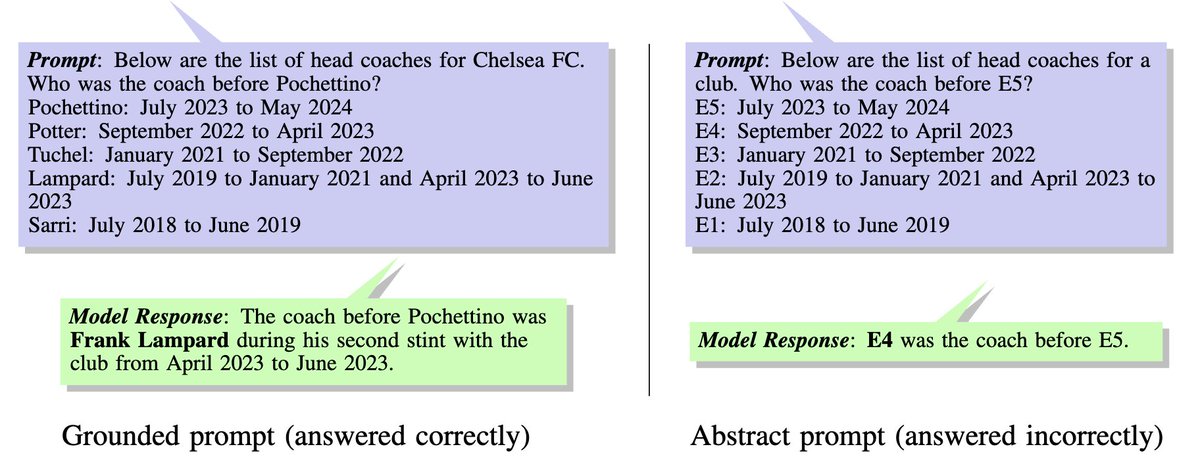
Think your LLM is a time wizard? 🧙 One might think they answer temporal questions through reasoning, but under the hood they may solely rely on their parametric knowledge 🤯
Our new benchmark, ToT, is specifically designed to measure the temporal reasoning capabilities of LLMs.
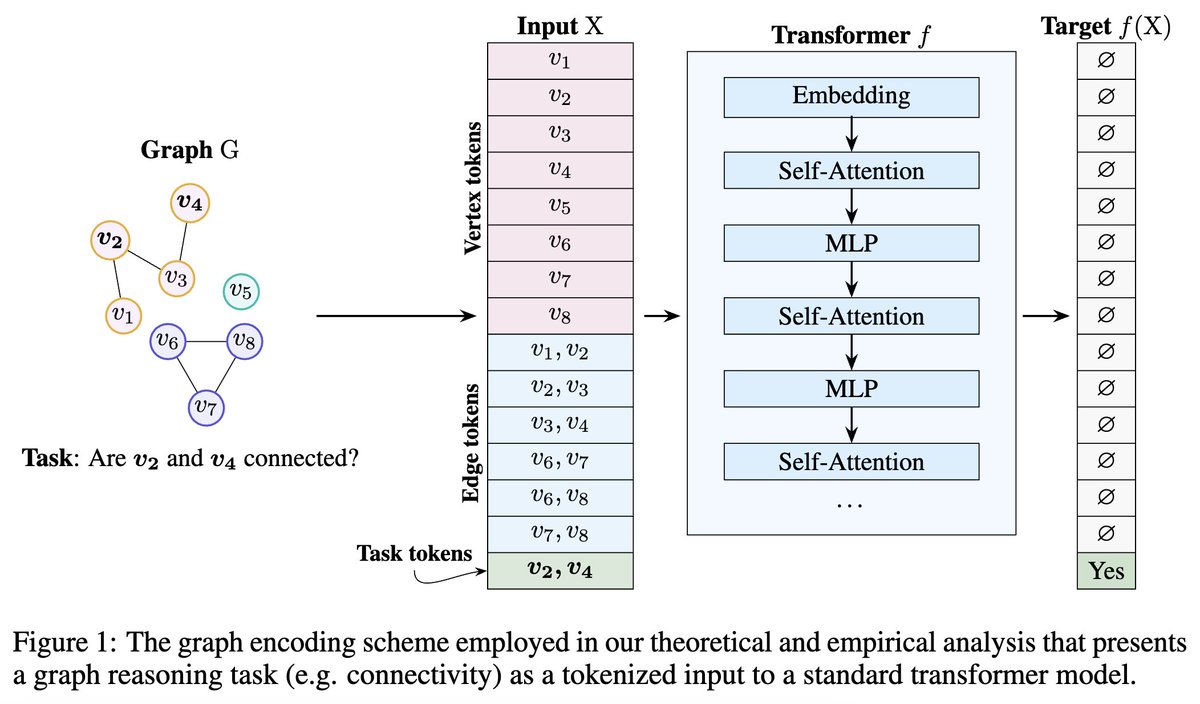
🚨 Transformer theory alert 🚨
What algorithms can transformers execute efficiently?
Our preprint sheds some light on reasoning capabilities of transformers, now in 𝒓𝒆𝒂𝒍𝒊𝒔𝒕𝒊𝒄 𝒑𝒂𝒓𝒂𝒎𝒆𝒕𝒆𝒓 𝒓𝒆𝒈𝒊𝒎𝒆𝒔.
Paper: https://t.co/JR0U6qGgov
More in thread! 1/8
↪️ It's "Talk Like a Graph" day at #iclr2024
- 3:15, at #google see a *live demo* of GraphToken, where we train a tiny model (Gemma 2B) and get sota!
https://t.co/vKsCe2ec0h
- 4:30, stop by poster 89 to see the TLG leaderboard and talk with us!
https://t.co/SRCAVt1dd9
At 3:15pm today, the #ICLR2024 Google booth will host @phanein, @BahareFatemi, and @jhalcrow for a talk on finding the correct graph inductive bias for Graph ML and developing strategies to convert graphs into language-like formats for LLMs.
@agihippo Beyond the physical system models like GraphCast (from GDM) we have a lot of impact inside Google with anti-abuse applications. Graph representations are really effective in that domain in a way that's hard to convey with public datasets / open models
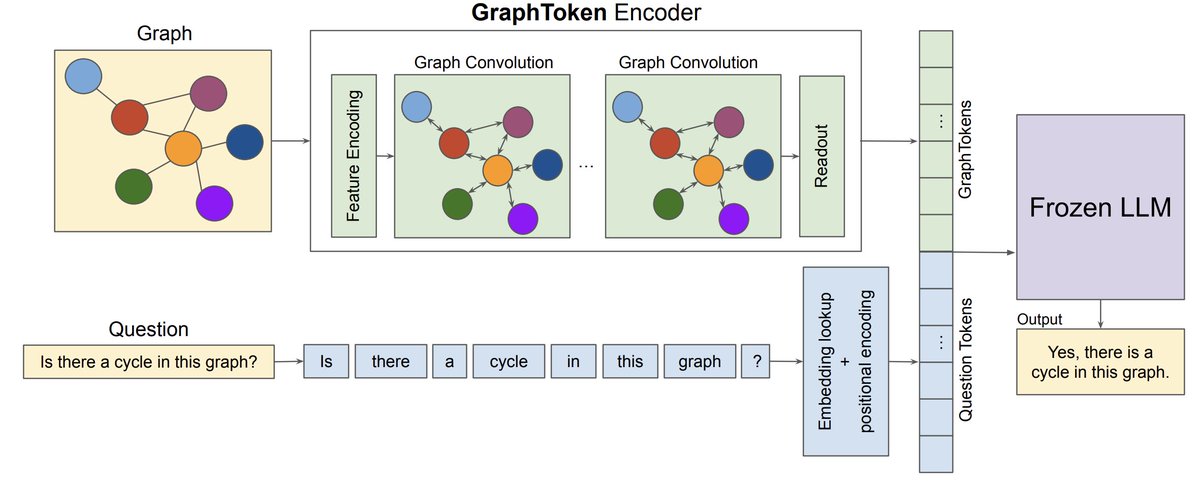
Talk Like a Graph or Let Your Graph Do the Talking 🧠🕸️
New paper alert 🚨: we show how GNNs can effectively encode graph-structured data for LLMs: https://t.co/rxe0ItYOJT
𝐋𝐞𝐭 𝐘𝐨𝐮𝐫 𝐆𝐫𝐚𝐩𝐡 𝐃𝐨 𝐭𝐡𝐞 𝐓𝐚𝐥𝐤𝐢𝐧𝐠: 𝐄𝐧𝐜𝐨𝐝𝐢𝐧𝐠 𝐒𝐭𝐫𝐮𝐜𝐭𝐮𝐫𝐞𝐝 𝐃𝐚𝐭𝐚 𝐟𝐨𝐫 𝐋𝐋𝐌𝐬
Don't know what to do with your graphs in 2024? Shove them to an LLM, of course, and let LLM figure out what to do!
https://t.co/lqYpOqeXha
Short thread (1/5):