Amen. I remember how sad I was to move away from the Bay Area. Thought life had ended bc I was no longer in what I'd believed was the center of the universe. Once outside it was like my brain rewired and I could finally see that most people live happy lives that aren't fixated on tech. It seems like such a silly thing to say but in the Valley's reality distortion field you come to think that there really is no other life beyond RSUs and outsized payouts.
At the Agents Anonymous SF meetup last night we did another 🙋 AI usage survey, here are the est. numbers:
Usage stats:
- 90% Claude Code
- 60% Codex
- 30% Cursor
- 20% OpenCode
- 10% Conductor
- 10% Own agent/Pi
80% have prompted a coding agent from mobile
50% have not handwritten a single line of code this year
99% think they're more productive now vs. pre agentic coding agents
Parallel agent usage:
- 90% 3+
- 70% 4+
- 50% 5+
- 5% 10
Also want to give a ginormous thank you to our incredible speaker lineup:
- @jonas_nelle & @alexirobbins from @cursor_ai
- @southpolesteve from @Cloudflare
- @LewisJEllis from @ycombinator
- @aidandcunniffe from Git AI
- 🦞 @steipete from @openclaw
Hope to see you all at the next one! 🫡
When a team fully activates on agents and each engineer is shipping 10+ PRs a day minimum, the entire traditional SDLC collapses.
Code review backlog, keeping up with docs, keeping CI and the merge queue fast, planning, visibility, etc.
You end up redesigning the whole SDLC.
Citadel Securities published this graph showing a strange phenomenon.
Job postings for software engineers are actually seeing a massive spike.
Classic example of the Jevons paradox. When AI makes coding cheaper, companies actually may need a lot more software engineers, not fewer.
When software is cheaper to build, companies naturally want to build a lot more of it. Businesses are now putting software into industries and tools where it was simply too expensive before.
---
Chart from
citadelsecurities .com/news-and-insights/2026-global-intelligence-crisis/
Eerie feeling:
Talking to people at software companies and getting the impression that they're still acting like it's 2022.
Huge teams, roadmaps, product vs. eng vs. design, "haha that'll take a while", AI seen as a "new" thing, no urgency.
"You're better off taking more technical debt in your projects and bet on the fact that LLMs will clean up the debt in the future." https://t.co/hWguznmnwG < counter-cultural take, and that at least catches my attention. Become a worse software engineer, without stressing it?
🚀 Introducing Strands Agent SOPs: Natural language workflows for reliable AI automation!
From code reviews to feature development, meeting notes to incident response. Author new SOPs in minutes, chain for complete automation sequences.
https://t.co/QMJUafjCgs
Born from Amazon's builder community, now open-source!
#AI #Automation #OpenSource
This story is wild
Chinese state-backed hackers hijacked Claude Code to run one of the first AI-orchestrated cyber-espionage
Using autonomous agents to infiltrate ~30 global companies, banks, manufacturers and government networks🤯
How the attack was carried out in 5 phases
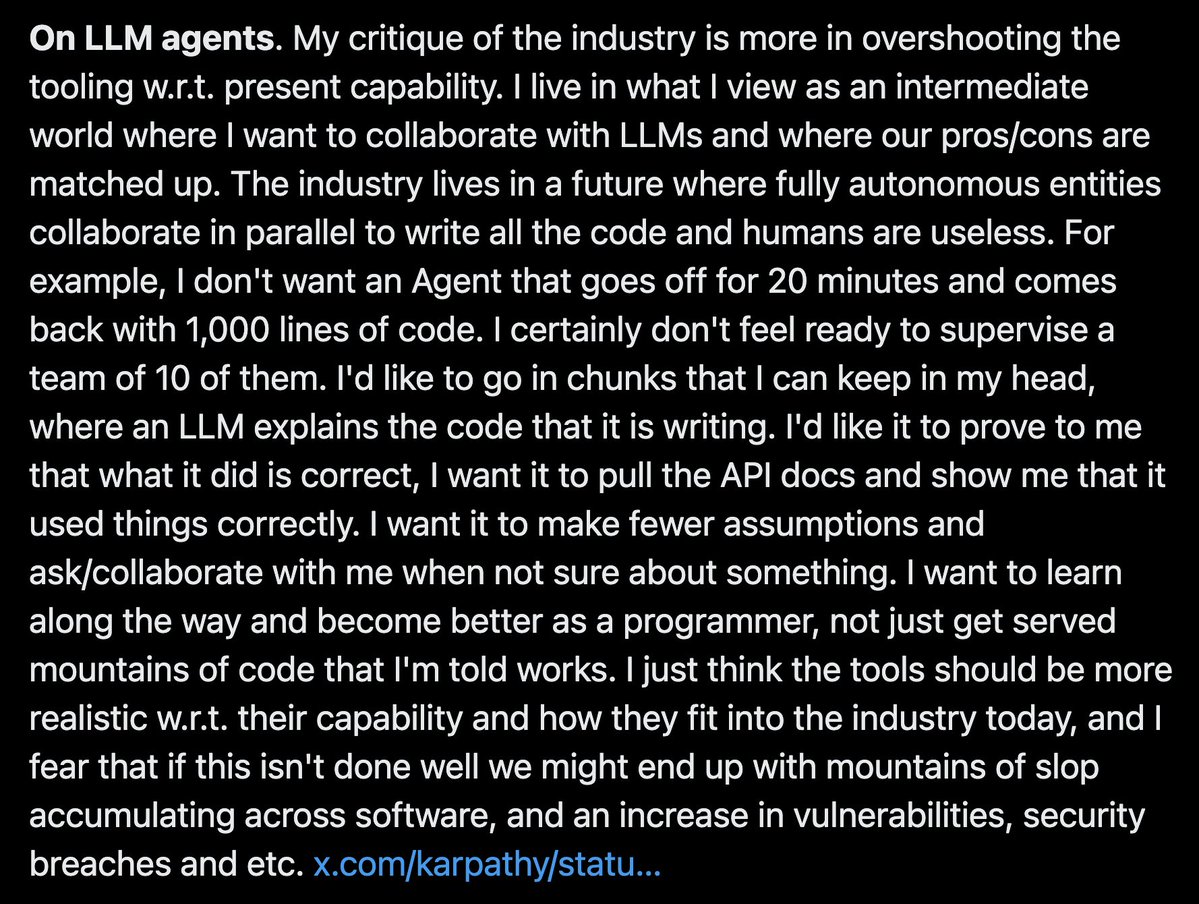
If you saw how people actually use coding agents, you would realize Andrej's point is very true.
People who keep them on a tight leash, using short threads, reading and reviewing all the code, can get a lot of value out of coding agents. People who go nuts have a quick high but then quickly realize they're getting negative value.
For a coding agent, getting the basics right (e.g., agents being able to reliably and minimally build/test your code, and a great interface for code review and human-agent collab) >>> WhateverBench and "hours of autonomy" for agent harnesses and 10 parallel subagents with spec slop
$24,000 per year from this simple AI Dentist Voice Agent
(and why I'm crazy for giving it away for free)
A dental practice was losing $6,000+ in revenue every month from missed after-hours calls.
That's 20-25 potential patients walking away because no one was available to book their appointments.
So I built an AI voice assistant that handles after-hours dental bookings 24/7 using n8n and ElevenLabs based on internal policies and scheduling availability.
Here's what this system does:
→ Answers calls with a natural-sounding AI receptionist
→ Collects patient information and insurance details
→ Checks calendar availability in real-time
→ Books appointments automatically
→ Logs all patient details to a Google Sheet
The result? This similar AI voice system was sold to a dental practice for $24k per year by another entrepreneur!!
This isn't just about dental practices. Any service business losing money from missed calls can implement a similar system.
Want the complete n8n workflow template?
1. Retweet & Like this post
2. Comment "ASSISTANT"
I'll send you the entire system for free, a full setup walk-through video, including the ElevenLabs automation components.
Multi-agent AI is a $50B lie.
99% of "multi-agent" systems are just single agents with fancy marketing.
I just read the paper that exposes what real multi-agent intelligence actually looks like.
Most people think multi-agent AI is just "multiple ChatGPTs in a room.
That's like saying a surgical team is just "multiple people with knives."
The real story is way deeper.
Task allocation is completely broken.
Current systems are basically throwing darts at a board. Give the math problem to whoever's free. Ask the creative agent to debug code. It's chaos disguised as intelligence.
Real multi-agent systems need dynamic specialization. Not just "Agent 1 does X, Agent 2 does Y" but context-aware matching based on capability, workload, and past performance.
The memory problem is insane.
Single agents just track conversations. Multi-agent systems need five different memory types: short-term task state, long-term expertise, episodic collaboration history, consensus knowledge, and hierarchical access control.
Most current systems give every agent amnesia between tasks.
Context management is where everything breaks.
Each agent needs to track three layers simultaneously: the big picture mission, their specific piece, and what everyone else is doing.
Fail at any layer and the whole system becomes expensive nonsense.
Game theory matters more than code.
When agents debate or negotiate, you're not optimizing for "correctness." You're finding equilibrium states. The research shows Stackelberg dynamics work better than Nash equilibrium for most real tasks.
Nobody talks about this because it's not as sexy as "look, the robots are talking."
The applications they outline are wild.
Agents that negotiate smart contracts autonomously. Fraud detection where different specialists hunt different attack patterns. Consensus mechanisms that actually think through decisions.
We're not building better chatbots. We're building the foundation for autonomous economic systems.
The gap between current "multi-agent" demos and actual multi-agent intelligence is massive.
Real systems will have specialized roles, shared memory architectures, and game-theoretic coordination. They'll solve problems no individual agent can handle.
Same principle that makes human teams work. Just faster, and at scale.
Most of what people call "multi-agent" today is just single agents with fancy prompting.
The companies that figure out real multi-agent coordination first will have a 10x advantage.
Everyone else is building expensive theater.
Complex orchestration frameworks for AI agents - state machines, workflows, error handling - seem necessary. But what if they're actually holding back what modern LLMs can do?
We recently ran a successful live failover of our control plane database from Azure West US to East US 2.
Our goal was to validate that Vercel can survive a complete regional failure of its core database.
Here's the full breakdown:
https://t.co/5ng7adhZLc