Yesterday at @ISCB_RegSys I introduced Cherimoya: a lightweight sequence-to-function (S2F) model that achieves state-of-the-art performance.
We've been using it internally at the Programmable Genomics Laboratory for several months and are excited to share it with y'all now!
An encyclopedia of enhancer-gene regulatory interactions — online today! https://t.co/LN4hCxDQ3M
Now with an improved model, expanded maps across 1400+ biosamples, larger validation CRISPR datasets, and guidance on applying the model
1/
1/n What fraction of the human genome is essential for cellular viability?
Excited to share our preprint that explores this question by combining an unusual CRISPR system, phage promoters, and thousands of deletion launchpads.
@sudpinglay@JShendure
https://t.co/rTO1MyFv3q
22/n On a personal note, I’ll soon start an independent research group in the Genome Biology Unit at EMBL Heidelberg. If you enjoy this type of work and want to engineer genomes at the largest scale, please reach out!
https://t.co/PZtPj6fnrE
https://t.co/XMH6FH4dJQ
Excited to share Nona: a unifying multimodal masking framework for functional genomics.
Models for DNA have evolved along separate paths: sequence-to-function (AlphaGenome), language models (Evo2), and generative models (DDSM).
Can these be unified under a single paradigm? 1/15
New pre-print 🧬✂️! We show that paired prime editing can efficiently generate large deletions (>1 Mb! 🤯) with high precision and at scale. We use this to perform the first pooled prime deletion screen across the human genome
👇short thread
https://t.co/YnYgNaFMFi
If you’d like to work in this exciting science area, @LeopoldParts lab at the @sangerinstitute is hiring postdocs! This is all part of the new Generative and Synthetic Genomics programme with nearby @benlehner and Jussi Taipale https://t.co/dpeO86ugnq
We are happy to share our enhancer scramble story, a strategy to create hundreds of stochastic deletions, inversions, and duplications within mammalian gene regulatory regions and associate these new architectures with gene expression levels 🧵
@LeopoldParts, Pierre Murat
It's my pleasure to present the next big preprint from SheqLab! An exciting application of our O-MAP platform that I hope will transform the study of nuclear architecture.
If you've ever wanted to dissect the subnuclear "neighborhood" around an individual locus, read on! (1/30)
Genome engineering excelled at small nucleotide changes, but large edits remained challenging. Recent innovations are changing this.
We reviewed the field of structural variant engineering @NatureGenet 🧬
@JulianeWeller@TVanderstichele @LeopoldParts
https://t.co/vwEEqHQFZC
Super excited to share that ENGRAM is out today! ENGRAM cells are programmed to write their histories into the genome, recording the intensity, duration, and order of biological events simultaneously.
https://t.co/whJgHAm3nO
Cool work! Explores species-specific brain enhancer codes by comparing species-specific data (human, mouse, chicken) and by comparing predictions / attributions from models trained on species-specific data. Large correspondence of cell types & enhancer codes between species
Joins us for Machine Learning in Computational Biology (MLCB) 2024 https://t.co/Fs1E54y7G2
Submission deadline: June 15
Conference dates: Sept 5 & 6
It’s finally out! The PhD work and first first author paper of @MartinoUgolini: https://t.co/tm5MSGQkOA. Congrats to all co-authors @mkierun, @lanoliin, Hiroshi Kimura, and Haruka Oda for the beautiful work! We also thank @cSabrya@NatureCellBio for the pleasant review process.
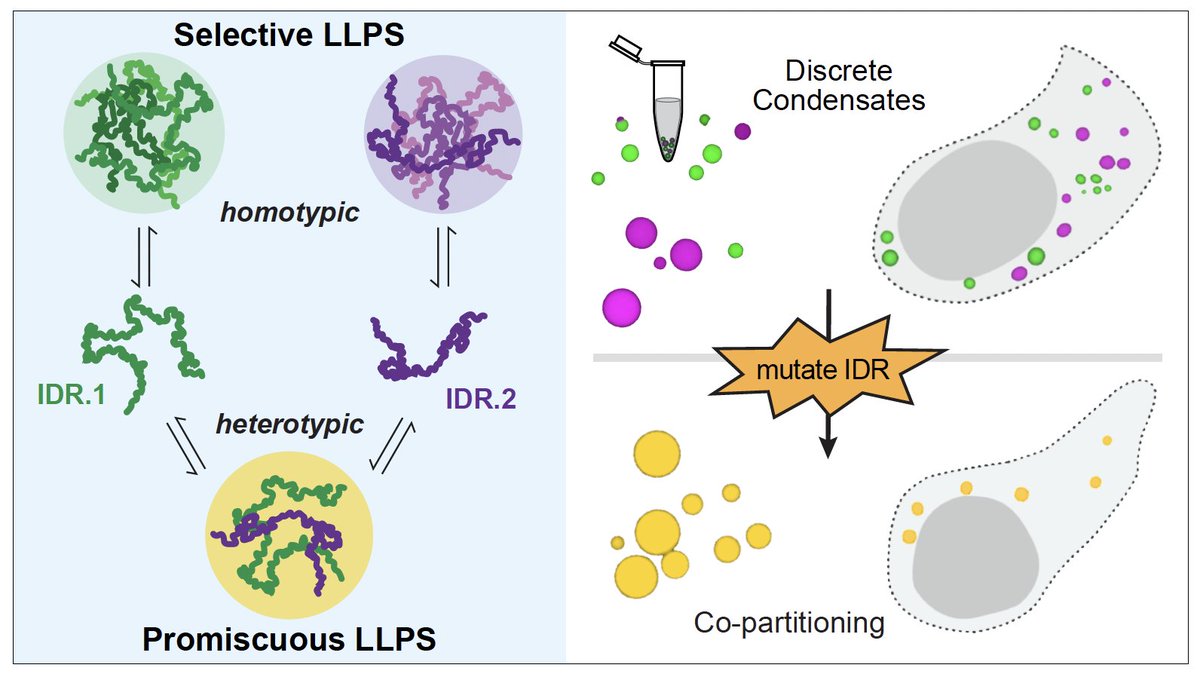
Thrilled to finally announce our work on the selectivity of disordered protein condensation in @NatureChemistry. Great collaboration with @JeetainMittal Led by @rmwelles and @kandarp_sojitra. https://t.co/b9ZO0g0Af1. See related work by Brangwynne lab https://t.co/HiUDH8vl9v
What if we could inducibly create thousands of structural variants and ecDNAs in human cells and see which ones survive?
https://t.co/tbMsyfu8md
I’m excited to share our story on scrambling the human genome by combining prime editing, repetitive elements, and recombinases. A🧵
There is a subset of sites that require the binding of both, which are enriched in the ChromHMM-annotated Heterochromatin subset - these likely require a higher 'activation energy'. 4/
Curiously, they find that while co-expression leads to activation of liver genes, both TFs can independently drive liver-specific gene expression too, and they bind independent subsets of sites, many of which are made accessible independently by either. 3/