Fall in love with some activity, and do it! Nobody ever figures out what life is all about, and it doesn't matter. Explore the world. Nearly everything is really interesting if you go into it deeply enough. Work as hard and as much as you want to on the things you like to do the best. Don't think about what you want to be, but what you want to do. Keep up some kind of a minimum with other things so that society doesn't stop you from doing anything at all.
-- R. Feynman
“If you want to be happy for an hour, take a nap. If you want to be happy for a day, go fishing. If you want to be happy for a year, inherit a fortune. If you want to be happy for a lifetime, help someone else.”
Chinese proverb
When you arise in the morning, think of what a precious privilege it is to be alive - to breathe, to think, to enjoy, to love.
Marcus Aurelius
#writing#writerslife#amwriting
Aetherhart
Reach your muscle goals 💪
Stick to this simple plan to succeed:
1. Take a 1-minute quiz
2. Get a workout and meal plan
3. Follow the program (easy-peasy)
What North America looked like 92 million years ago...
During the Late Cretaceous, about 92 million years ago, North America was split into two landmasses by a vast inland sea known as the Western Interior Seaway. To the west lay Laramidia, a narrow continent bordered by the rising Rocky Mountains, while Appalachia occupied the east. The seaway stretched from the Gulf of Mexico to the Arctic Ocean, covering much of what are now the Great Plains.
The warm, shallow sea teemed with marine life, including giant mosasaurs, plesiosaurs, sharks, sea turtles, and ammonites. On land, dinosaurs evolved separately on each continent. Laramidia was home to famous species such as Tyrannosaurus relatives, Triceratops ancestors, duck billed hadrosaurs, and horned ceratopsians. Appalachia, isolated for millions of years, developed its own unique dinosaur species, many of which are still poorly understood because relatively few fossils have been found.
As sea levels gradually fell over the next 25 million years, the Western Interior Seaway disappeared, reconnecting the continent and shaping the North America we know today.
Fossils of giant marine reptiles and sharks are still found hundreds of miles from today's coastline in states such as Kansas, Nebraska, and South Dakota, evidence that these now landlocked regions were once beneath an ancient sea.
#archaeohistories
Jo Nagai was raising swallowtail butterflies at his home in Kobe, Japan, when he noticed something odd. The ones he had looked after as caterpillars seemed to recognize him. Wild butterflies fled. His didn't.
He was in second grade. He wrote a four-page letter to Dr. Martha Weiss, an entomologist at Georgetown University who had studied whether moths could retain memories through metamorphosis. He asked if she could help him design a version of her experiment for butterflies.
She said yes.
Using a muscle therapy device, Jo trained caterpillars to associate the scent of lavender with a mild vibration. When the caterpillars became butterflies, 70 per cent of them still avoided the lavender. Their brains had been completely rebuilt during metamorphosis. The memory survived anyway.
Then he bred them.
The offspring, which had never been trained, also avoided lavender. So did their grandchildren. Without ever experiencing the vibration, two generations of butterflies inherited an aversion to a scent their grandmother had been taught to fear.
Jo documented it all in a 33-page research paper and presented his findings at the International Congress of Entomology in Kobe in 2024. He was 10.
A second grader wrote a letter to a Georgetown professor, and together they found evidence that butterflies can pass memories down through generations.
-Wilderness Whisper
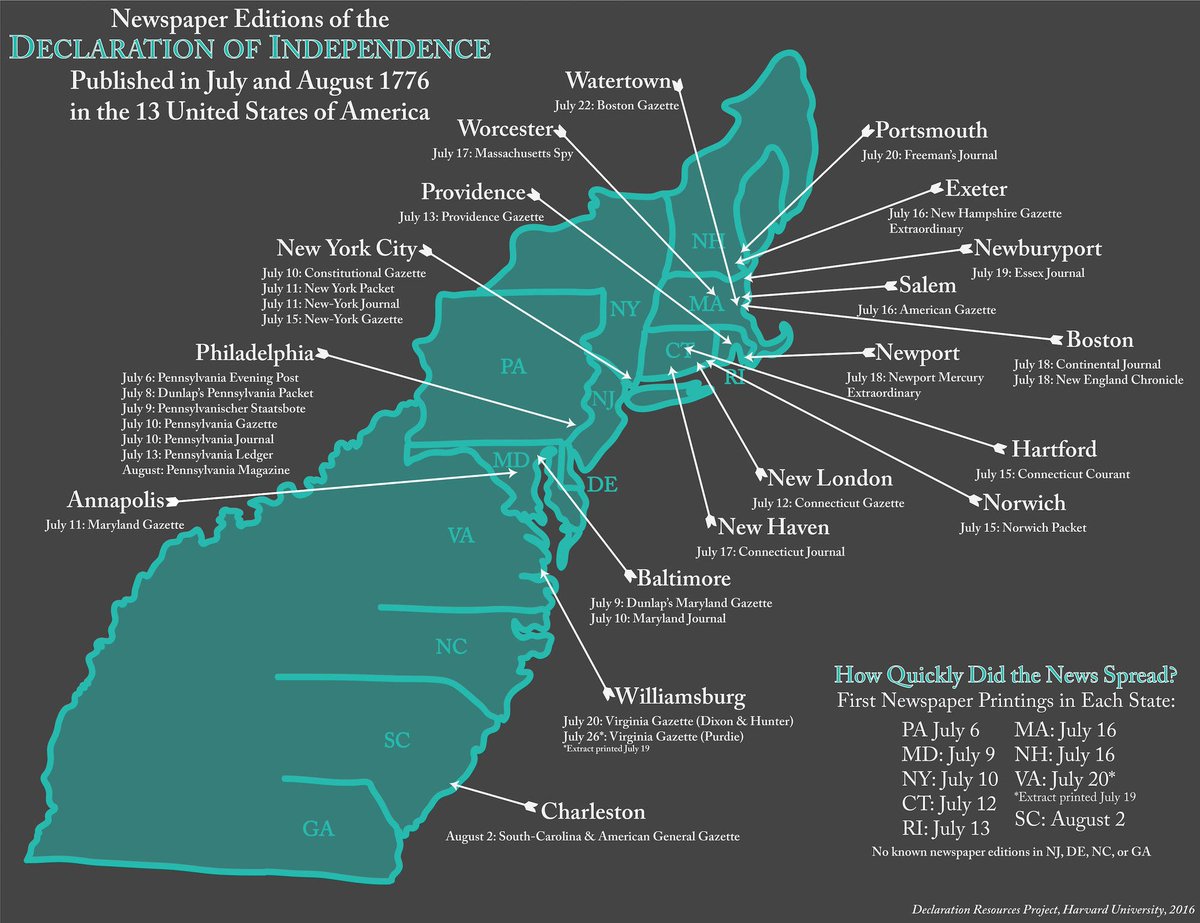
How was independence solemnly published and declared? Through broadsides, newspapers, and public readings of the #DeclarationofIndependence throughout July and August 1776
We cannot consider #AI to be morally neutral. In reality, every technical tool embodies choices and priorities through what it measures, ignores, and optimizes, and how it classifies people and situations. Ethical discernment cannot be limited to asking whether we are using a system for good or bad purposes. It must also examine how that system is designed and what vision of the human person and society is embedded in the data and models that guide it. #MagnificaHumanitas
Bundibugyo virus, a filovirus, is currently spreading in the Democratic Republic of Congo. This report presents early data on symptoms and illness severity as well as diagnostic challenges. Read the full report: https://t.co/BwvZfh8xkb