What does it mean for an AI to understand space? 🌌
Not just to recognize what is in front of it, but to build an internal world: where things are, how they relate, and how that world changes when the viewpoint changes.
We found evidence that multimodal models have already begun to build such a world inside themselves.
We call it S-Space 🧠 — an internal spatial workspace that can be read, manipulated, and transformed during reasoning.
A glimpse into how AI may learn not just to see the physical world, but to reconstruct and reason within it. ✨
Explore S-Space, new research from MirroS 👇 https://t.co/7fa7J7qxvv
6/6 at CoRL 2026 🎉
Our works span multiple layers of Physical Intelligence — from World-Action Models, agentic world generation, and cross-embodiment VLAs, to humanoid control and dexterous manipulation:
• WAM-TTT — learning from unlabeled human videos via test-time training
• GIF — agentically generating interactive, functional worlds at scale
• Cross-Embodiment VLA — zero-shot generalization to unseen robot embodiments
• HumanoidNDM — neural dynamics models for closing the sim-to-real dynamics gap
• BiDexGrasp — coordinated bimanual dexterous grasping
• KPGrasp — scalable dexterous grasp generation with keypoints + flow matching
Huge thanks to all collaborators for carrying these projects forward 🙏
Onward to deeper and broader Physical Intelligence 🤖🌍
#CoRL2026 #EmbodiedAI #PhysicalAI #WorldModels #VLA #Robotics
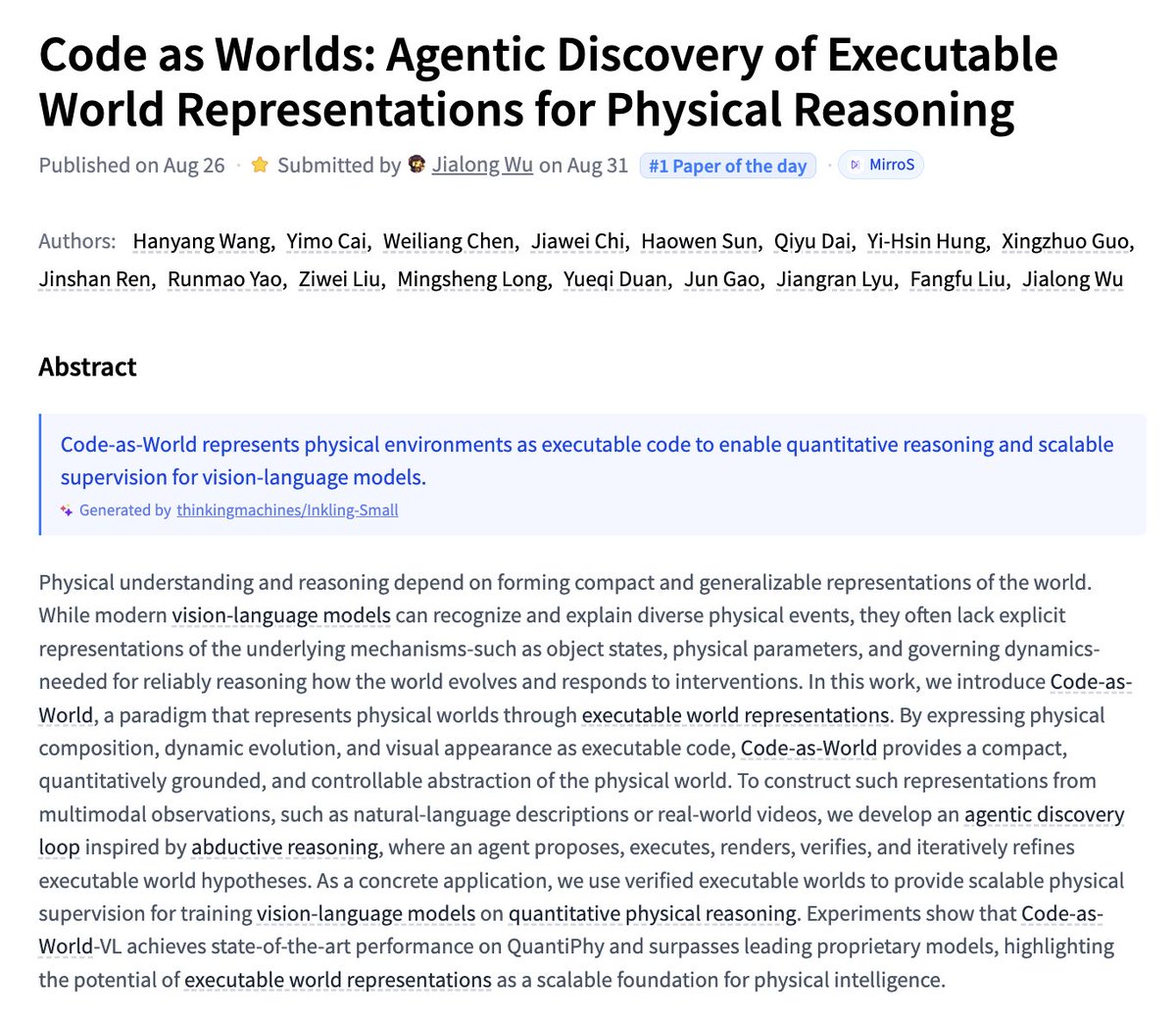
Big thanks to @_akhaliq for sharing Code-as-World 🌍, our latest work that reconstructs visual observations as executable code—capturing a world's composition, dynamics, and appearance. Everything is open-sourced! 🎉
Code & Models: https://t.co/CEjBdFoWaG
Blog: https://t.co/dgG2WqZHLW
Project page: https://t.co/Mx7UNYtb3F
We introduce Code-as-World 🌍, a new paradigm for representing the physical world as executable code!
Pixels capture how the world appears—but not what exists within it, how it evolves, or the mechanisms that govern its behavior. Code-as-World reconstructs visual observations as executable code 💻 that describes a world’s composition, dynamics, and appearance.
Through an agentic discovery loop 🔍 , an agent proposes a hypothesis, simulates and renders it, compares the result against observed evidence, and iteratively revises its code. World modeling thus becomes a process of active discovery and verification—not one-shot generation.
The resulting executable worlds provide scalable physical supervision, enabling state-of-the-art performance in quantitative physical reasoning 📈 and opening new paths toward physical intelligence.
We are releasing the technical report, code, models, project page, and blog. This is one step toward MirroS's broader goal: expressing the physical world in a language that agents can understand, simulate, and verify. We will keep exploring how code and language can provide a shared foundation for physical RSI. 🚀
📝 Blog: https://t.co/3anShWqx9A
📄 Technical Report: https://t.co/4sqVBYd4TZ
🌐 Project Page: https://t.co/JlZe70Myyw
💻 Code & Models: https://t.co/YJzz0FFYUh
We introduce Code-as-World 🌍, a new paradigm for representing the physical world as executable code!
Pixels capture how the world appears—but not what exists within it, how it evolves, or the mechanisms that govern its behavior. Code-as-World reconstructs visual observations as executable code 💻 that describes a world’s composition, dynamics, and appearance.
Through an agentic discovery loop 🔍 , an agent proposes a hypothesis, simulates and renders it, compares the result against observed evidence, and iteratively revises its code. World modeling thus becomes a process of active discovery and verification—not one-shot generation.
The resulting executable worlds provide scalable physical supervision, enabling state-of-the-art performance in quantitative physical reasoning 📈 and opening new paths toward physical intelligence.
We are releasing the technical report, code, models, project page, and blog. This is one step toward MirroS's broader goal: expressing the physical world in a language that agents can understand, simulate, and verify. We will keep exploring how code and language can provide a shared foundation for physical RSI. 🚀
📝 Blog: https://t.co/3anShWqx9A
📄 Technical Report: https://t.co/4sqVBYd4TZ
🌐 Project Page: https://t.co/JlZe70Myyw
💻 Code & Models: https://t.co/YJzz0FFYUh
Data is the fundamental problem of embodied intelligence. LDA is not merely a world-action model—it is a new paradigm for how embodied data is used and scaled.
Instead of choosing between training a world model and training a language conditioned robot policy, why not do both? LDA-1B s a new foundation model that is trained on 30,000 hours of human and robot interaction data.
Part of the secret is that LDA-1B jointly learns forward dynamics, action prediction, and visual forecasting, all in a structured DINO latent space which avoids the pitfalls of redundant pixel-level prediction which isn’t necessarily aligned robot action. This approach works on both dexterous hands and simple robot grippers; it also generalizes across objects, tasks, and scenes.
@JiangranLyu joins us to explain. Learn more on Episode 98 of RoboPapers, with @micoolcho and @chris_j_paxton!
Instead of choosing between training a world model and training a language conditioned robot policy, why not do both? LDA-1B s a new foundation model that is trained on 30,000 hours of human and robot interaction data.
Part of the secret is that LDA-1B jointly learns forward dynamics, action prediction, and visual forecasting, all in a structured DINO latent space which avoids the pitfalls of redundant pixel-level prediction which isn’t necessarily aligned robot action. This approach works on both dexterous hands and simple robot grippers; it also generalizes across objects, tasks, and scenes.
@JiangranLyu joins us to explain. Learn more on Episode 98 of RoboPapers, with @micoolcho and @chris_j_paxton!
Today, we introduce HarnessEval, bringing the power of agentic workflows to the benchmarking community! 🚀
With Harness, a benchmark is no longer a static rubric. It becomes an intelligent agent that proactively interprets context, decomposes high-level evaluation problems into sub-problems, assembles the right tools, and spawns sub-agents to uncover exactly why a model fails. By mimicking human evaluation workflows and breaking down complex questions into solvable sub-tasks, HarnessEval moves beyond the traditional Q&A probing in existing benchmarks, and provides fully verifiable reasoning traces for every final score. It evolves evaluation into a dynamic, executable agentic system.
To realize this vision, we are open-sourcing our first agentic benchmark for visual generative world models: HarnessEval-W. All the harness, skill libraries, evaluation cases, and results are publicly available. We invite the broader community to contribute to this agentic benchmark workflow together! 🌍 🤝
💻 Code: https://t.co/lTf6rbGcvS
🏆 Leaderboard: https://t.co/iGvETeP4Yy
📝 Blog: https://t.co/gb7YzjWl6G
📄 Technical Report:https://t.co/wHwQUJX5K6
Today, we introduce HarnessEval, bringing the power of agentic workflows to the benchmarking community! 🚀
With Harness, a benchmark is no longer a static rubric. It becomes an intelligent agent that proactively interprets context, decomposes high-level evaluation problems into sub-problems, assembles the right tools, and spawns sub-agents to uncover exactly why a model fails. By mimicking human evaluation workflows and breaking down complex questions into solvable sub-tasks, HarnessEval moves beyond the traditional Q&A probing in existing benchmarks, and provides fully verifiable reasoning traces for every final score. It evolves evaluation into a dynamic, executable agentic system.
To realize this vision, we are open-sourcing our first agentic benchmark for visual generative world models: HarnessEval-W. All the harness, skill libraries, evaluation cases, and results are publicly available. We invite the broader community to contribute to this agentic benchmark workflow together! 🌍 🤝
💻 Code: https://t.co/lTf6rbGcvS
🏆 Leaderboard: https://t.co/iGvETeP4Yy
📝 Blog: https://t.co/gb7YzjWl6G
📄 Technical Report:https://t.co/wHwQUJX5K6
@KnightNemo_@fangfu0830 Thanks Siqiao! Really appreciate your support. Excited to explore this new journey and keep pushing the frontier of intelligence together!
Mirroring reality into a world model that can be continuously verified and improved.
Building an OS where the world model and agent co-evolve through interaction and feedback.
From mirroring reality to pushing beyond the known, MirroS is transforming the future of intelligence.
Building Physical RSI Beyond the Known World
Intelligence is not about optimizing within a closed world—it is about transforming every surprise into the surge of its next evolution.
Excited to share WAM-TTT!
Deployment is still a huge problem for VLA/WAM. Instead of imitating human trajectories, we adapt a frozen World Action Model at test time using self-supervised video prediction on raw human videos.
A simple way to steer robot foundation models while preserving their generalization.
✅ No retargeting
✅ No robot demonstrations
✅ No human annotations
✅ Frozen foundation model
Paper: https://t.co/54sr52UpZ4
Robots can now adapt to new environments by watching humans! 🤖
Introducing WAM-TTT (World-Action Model Test-Time Training) — a new test-time training paradigm in AstraBrain that enables robots to adapt from human videos for scalable real-world deployment.
No robot action data. No action annotations.
Just record human demonstrations, and robots learn to adapt.
WAM-TTT demonstrates a new path toward scalable embodied intelligence.
#Galbot #EmbodiedAI #Robotics #HumanoidRobots
Excited to share that our paper, DAPL, has been selected as an Outstanding Paper Finalist at #RSS2026!
We aim to answer: How can robots manipulate objects in cluttered scenes—by avoiding obstacles when needed and exploiting environmental contacts when beneficial?
By modeling contact-induced dynamics via world model and policy learning, dexterous behaviors emerge entirely from learning—without hand-crafted rules or primitives.
Paper: https://t.co/uF4StVOSsc
Project page: https://t.co/cxK4rgwI77
See you in Sydney!