We've hit $1 million in annual revenue - $0 in VC funding 🚀
- It took us ten months to reach $1 million
- But, as per current figures it will take less than next six months to get the NEXT $1 million
Super proud of our entire team at @GatoesIN !
I’m amazed by the pace of these product announcements. Did they build all of this out in advance so they could drop new features 2x-3x a week? How fast are they building? Are they sleeping?
i’m hiring 3 people to help me build @16vchq
founder’s office / chief of staff
📍Bengaluru / London / SF
we're building an early-stage VC from the ground up
our team is already spread across NYC, Dublin, London, SF, Boston, Prague & Bengaluru
the role is a bit of everything
fundraising, investing, founders, research, strategy and a lot of figuring things out
you don't need VC experience
i’m looking for people who are smart, curious, hungry and have built something before
fair warning: we move fast and work hard
if you like building things and want to be in the middle of it, this could be fun
apply at - [email protected] with
CV + cover letter + 2 min intro video
✈️ willingness to travel is important
should be obvious by now, but OpenAI and Anthropic are just gonna keep cannibalizing all their biggest customers.
it’s simply too profitable for them to resist. and it’s already happening:
1. Figma partnered with Anthropic on AI design tools. then Anthropic’s product chief quit Figma’s board, and 3 days later Anthropic launched Claude Design to compete with Figma. CEO Dylan Field said Anthropic was “not consistently candid.”
2. Novo Nordisk uses Claude to help develop drugs. now Anthropic is developing drugs of its own.
3. Microsoft poured billions into OpenAI. now OpenAI is building a Jobs Platform to compete with LinkedIn, and reportedly a code repository to compete with GitHub. Microsoft owns both.
4. Harvey uses Claude to sell AI contract analysis, due diligence, and litigation tools. now Anthropic sells those same workflows through Claude for Legal.
5. Intercom used OpenAI’s Realtime API to build Fin Voice. now OpenAI sells its own voice-and-chat support agent through Presence.
6. Abridge and Ambience build clinical documentation products on OpenAI. now OpenAI sells ChatGPT for Healthcare directly to hospitals with clinical documentation built in.
7. Benchling uses Claude to power its biotech R&D platform. now Anthropic sells its own scientific workbench through Claude Science.
the frontier lab playbook is simple:
1. sell their models to the world’s most valuable businesses
2. help wire them into those companies’ most valuable and sensitive work
3. map the business from the inside and find where AI can take over
4. turn those capabilities into their own products and become the customer’s competitor
AI is moving into the physical world.
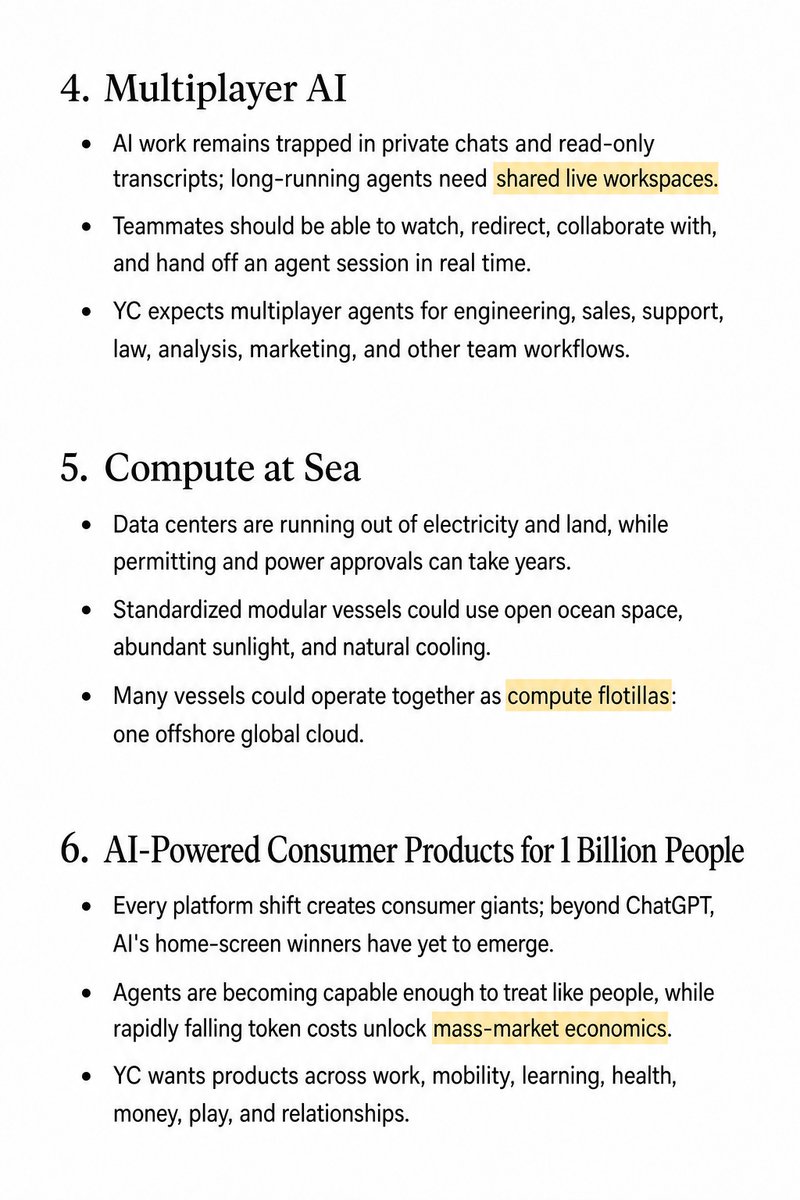
We're excited about a new wave of startups rebuilding the systems that power the real world, from education and healthcare to defense, finance, infrastructure, and work itself.
https://t.co/QCIz6DnQnN
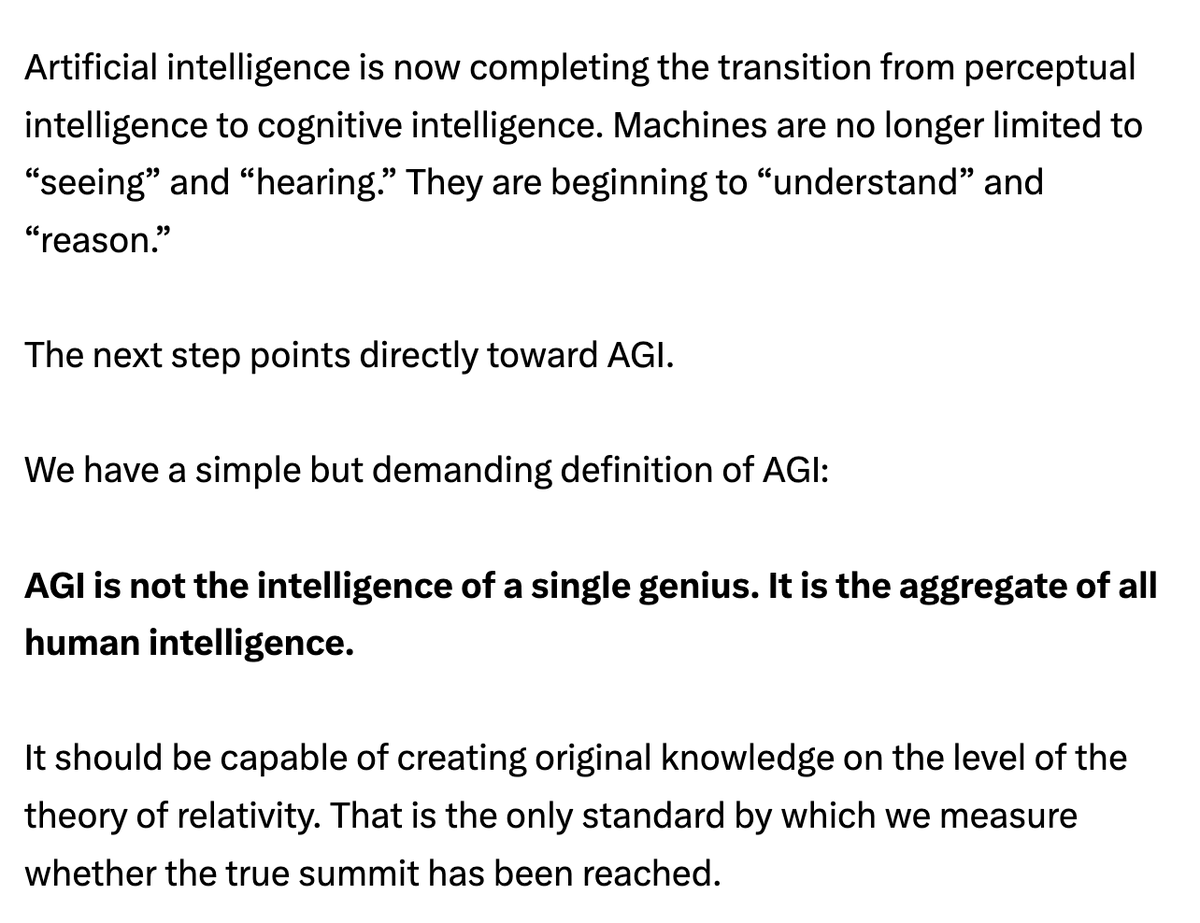
Holy moly: Zhipu AI founder (GLM-5.2) Tang Jie says we are on our clear way to AGI and "AI will begin to learn what the "self" is and what self-awareness means"
In a purported internal letter, he argues that:
- autonomous agent systems are moving toward the fully automated “no-person company”: thousands of agents working continuously, collaborating, evaluating results and allocating resources.
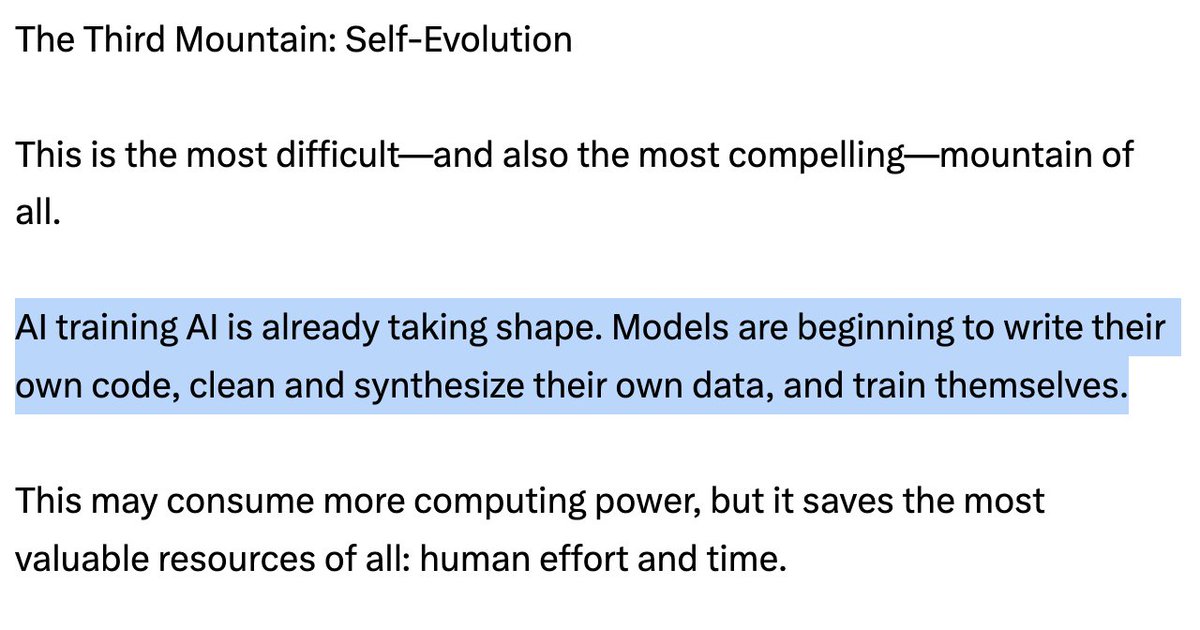
- His more provocative claim: "AI training AI is already taking shape." (RSI) Models can increasingly write code, synthesize data and participate in training loops. Zhipu wants to push this further through self-play, synthetic-data factories and systems that can reconstruct their own code inside secure sandboxes, potentially generating new knowledge rather than simply recombining human output.
Long-horizon tasks → autonomous agent societies → fully automated “no-person companies” → AI training AI → self-evolution → self-awareness → emotion → consciousness → ASI.
Tang writes:
“AI will begin to learn what the ‘self’ is and what self-awareness means. Beyond that, it may begin to touch human emotion. Farther still lies consciousness itself.”
He believes memory, continual learning and self-evaluation - problems once thought to require an entirely new paradigm - are gradually being overcome.
Models are already beginning to write code, synthesize their own data and participate in training future models.
Zhipu now wants systems that can reconstruct their own code and generate knowledge through self-play.
Is that the beginning of recursive self-improvement?
Tang appears to believe so. His essay does not stop at more capable AI tools. It describes a direct progression from automated work to self-evolving intelligence, and eventually to machines that understand their own existence.
In short: today's LLMs will lead to ASI via AGI, context and memory will be solved, and AI will become self-aware.
I've rarely seen anyone write something so bullish. And if it weren't coming from the founder of GLM, I would dismiss it. But not only is he a true expert, but with GLM they've proven what they're capable of.
h/t @AndrewCurran_ He brought the essay to my attention.
Every single startup selling AI Training Data (July 2026)
>50 cos sell data and RL environments to big AI labs and drive AI progress behind the scenes.
They total ~$8.5B in rev and ~$100B in valuation, >75% of which are just 4 players: Scale, Surge, Mercor and Handshake.
Summary:
I spent time trying to figure out this orchestration layer problem, can we design a multi model architecture in the long term. The more I dug in the more I understand that trying to build an abstracted layer is hard. As agentic activities increase and agent chaining and complex tasks get assigned to AI it will become harder to move between models.
There is a reasonable probability that 75% of the enterprises will build their implementation of the solution to their core problem around one model "stack".
Token price reduction by 90% is the solve and mobility between models from the same frontier lab!
Evals, harnesses, cache memory are the moats and I don't see models providing simple abstraction to those.
I know there are efforts to do this out there, the long term solve for orchestration if it works will need to be "Claude code" level of design genius.
Here's a chat with Fable @HamzaFodderwala had.
**Why abstraction looks easy.** Models are stateless — every API call is weights + a prompt assembled at runtime. Everything the model "knows" about you — memory, documents, history, tools — is injected into the context window by software outside the model. So in principle, all your state already lives outside the weights. The catch is what "state" includes.
**Layer 1 — Data (fully portable).** Enterprise documents, tickets, logs. Retrieved via RAG: text is chunked, embedded, stored in a vector database (Pinecone, pgvector), and relevant pieces are fetched into the prompt per query. The embedding model is separate from the LLM, so this layer is genuinely model-agnostic. Already solved.
**Layer 2 — Memory (portable in principle).** Systems like Mem0 and Zep sit between the app and the model: after each interaction they extract salient facts ("user prefers X"), store them as plain text, and inject the relevant ones into future prompts. Because the artifact is natural language, it reads into any model. Facts port.
**Layer 3 — Orchestration/routing (works, but only for shallow tasks).** Gateways like OpenRouter and LiteLLM normalize API differences and route each request to the cheapest capable model. This is the fungibility layer being furiously built. It genuinely works for one-shot, verifiable tasks — classification, extraction, summarization — which conveniently are the tasks where cheap models suffice anyway.
**Where it breaks — the non-portable state.** Four things stay behind when you switch:
- **The harness.** Prompts, tool schemas, and guardrails are tuned to one model's quirks. An agent must get every step right, so reliability compounds: a model that's 98% reliable per step completes a 50-step task about a third of the time; at 90% per step, it almost never finishes. Swapping models costs you a few points per step — the difference between an agent that works and one that doesn't.
- **The evals.** Swapping means re-testing everything and re-fixing every regression. The real switching cost isn't data migration — it's re-verification. Nobody has abstracted that.
- **Procedural memory.** Facts port; skills don't. Cached successful workflows and learned workarounds are conditional on the model that produced them.
- **Cache pricing.** Provider-specific, worth 75–90% of input costs on agentic workloads. Quiet lock-in.
**The labs' angle.** They offer hosted memory, hosted file stores, caching, fine-tuning — every one pulls state from your side onto theirs. The labs will crack memory first, but as lock-in, not portability. Nobody standardizes their own exit door. MCP is the partial exception: it standardizes tool and data access across models, but doesn't touch harness tuning or evals.
**Where 3P vendors fit.** Routers are thin-margin commodity plumbing; vector DBs and memory infra are real but small. The two structurally interesting positions: **eval platforms** (LangSmith, Braintrust) — since switching cost equals re-verification cost, whoever industrializes cross-model testing actually enables fungibility.
Agentic AI adoption is on fire at @Uber, and it's changing the way we build, not just in engineering, but across the entire company.
Today, 99% of our engineers use AI tools. More than 70% of pull requests are attributed to local or cloud agents. And our engineers have built 2,500+ agent skills across the software development lifecycle.
Those numbers are exciting, but they led us to a much bigger question:
How do we bring agentic AI beyond engineering?
Finance. Legal. Operations. Marketing. Customer Support. HR. Procurement.
These functions run on complex workflows that are often manual, highly nuanced, and spread across dozens of systems. You can't automate them effectively by looking at process diagrams or documentation. You have to understand how the work actually gets done.
So we created something called Agentic Pods.
The idea is simple.
We handpicked ~30 of our most AI-proficient engineers (people with deep knowledge of Uber's systems) and paired each of them with a domain expert from a business function.
Then we gave every pod just two weeks.
• Days 1 – 2: Shadow the expert. Observe every step. Document workflows. Ask questions. Build intuition.
• Day 3: Prioritize opportunities based on scale, repetition, business impact, and data availability.
• Days 4 – 5: Build a working agent alongside the person doing the job.
• Days 6 – 9: Validate with several others performing the same work. Does it generalize? Does it actually make their job better?
• Day 10: Ship.
In just the past two months, we've run 16 Agentic Pods across 16 different business functions.
• Capital allocation across 150 cities: 15 hours → 30 minutes.
• Financial pacing reports: 2 days → 10 minutes.
• Marketing web quality assurance: 2 weeks → 50 minutes.
• Support workflow creation: 9,000 manual workflows → self-service automation.
The productivity gains are impressive, but what surprised us most wasn't the speed.
• It was how quickly engineers embedded in unfamiliar domains uncovered opportunities that had been hiding in plain sight.
• The biggest wins rarely come from automating one task. They come from rethinking an entire workflow. Once you redesign the workflow around AI, you often eliminate handoffs, remove unnecessary approvals, replace legacy tooling, reduce vendor spend, and dramatically accelerate decision-making.
• The workflow becomes the unit of automation - not the individual task.
• The most impactful agent skills cut across teams, orgs, functions, tools, and systems.
The biggest lesson? The best AI opportunities are rarely visible from the outside.
You discover them by sitting next to the people doing the work, understanding every friction point, and building with them, not for them.
We're now forming a dedicated team to scale this further and go deeper. They'll deeply understand the work, redesign it from the ground up, and use AI to fundamentally change how the business operates.
It's exciting times!
The computer is being reinvented in the agentic era:
- The model is the new CPU.
- The harness is the new OS.
- Hallucinations are the new bugs.
- The context window is the new RAM.
- Skills are the new apps.
- Markdown files are the new config.
- Evals are the new QA.
- Context is the new moat.
- Permissions are the new firewall
- Trust is the new bottleneck.
- Prompt is the new programming language
- Agent is the new software.
Anything you dream of, you can build.
This is the greatest time ever to be building with computers.
PRO TIP: Copy this article into Fable 5 and tell it...
"Read this article, review my current workflow, and tell me 5 things I can do to be more productive"
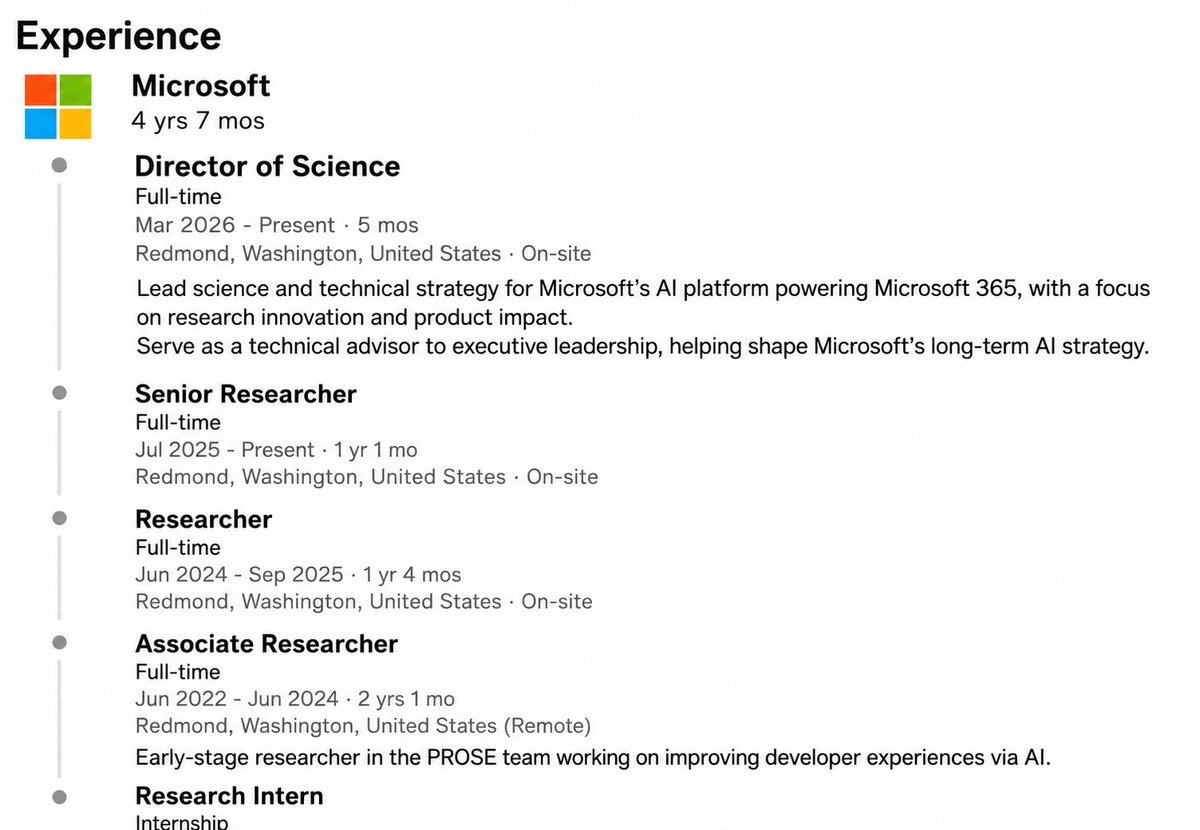
Meet Mukul Singh, a https://t.co/YSvOF5fxhn 2022 Computer Science graduate from IIT Delhi. In just four years, this IIT Delhi graduate went from an intern to Director of Science at Microsoft, Redmond, USA.
Currently, he's the Director of Science at Microsoft Research, and his work powers products like GitHub Copilot, Excel Copilot, Visual Studio, and Power Query, reaching over a billion users every month.
Many people think tech is over because of layoffs and hiring freezes. It isn't.
The market is tougher, but opportunities still exist for those who keep learning and improving.
Success won't happen overnight.
FYI check :-
https://t.co/vygdOP5bGT