Passionné de sciences et de nouvelles technologies depuis toujours, curieux de nature, je suis à l'affût de leurs derniers développements et découvertes !
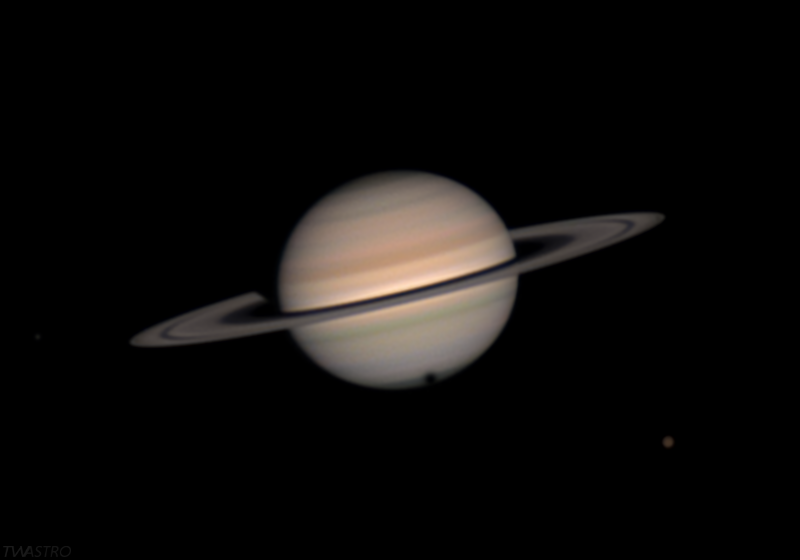
The final image from yesterday showing the shadow of #Titan falling on the cloud tops of #Saturn - the first such event in nearly 15 years.
The night started pretty terribly, but some moments of reasonable seeing conditions arrived with the high cloud. Pleased to have caught the event!
#telescope #astrophotography
C'est le même principe pour la Lune.
La nuit, dans le ciel, la Pleine Lune a l'air très brillante alors que son albedo (la quantité de lumière qu'elle réfléchit) vaut ~7%, à peine plus élevé que le charbon.
Contrairement à ce que notre œil nous fait croire, la Lune est noire.
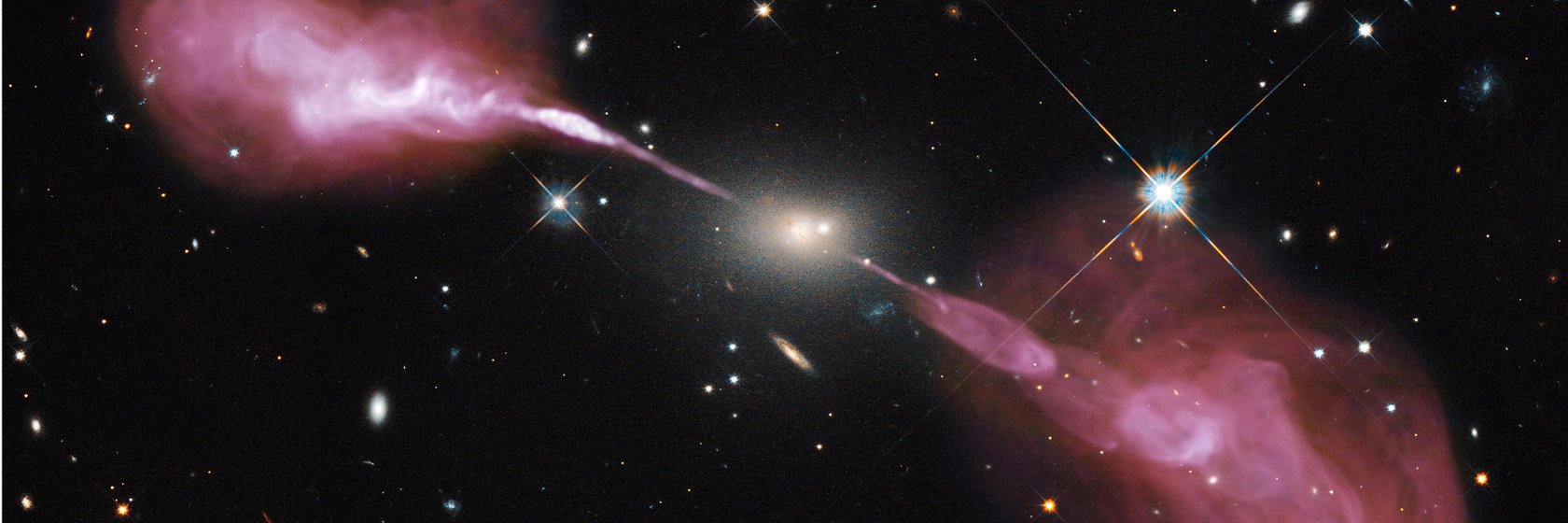
NASA's @chandraxray and @NASAHubble telescopes studied the "Guitar Nebula," a cosmic phenomenon resembling a guitar, formed by a fast-moving pulsar (a spinning neutron star).
This pulsar, emitting jets of high-energy particles, creates unique structures in the nebula. Data reveal insights into the pulsar's speed and energy, advancing our understanding of these energetic remnants of massive star explosions.
👉 https://t.co/t73s431pWh
L'examen des échantillons ramenés de la face cachée de la Lune par la mission 🇨🇳 Chang'e-6 montre que la majorité des grains récoltés provenaient de lave qui avait jailli à la surface il y a environ 2,83 milliards d’années, mais certains remontent à 4,2 milliards d'années.
1/2
The Super Beaver Moon in Pleiades 🌕🌌, captured tonight with an 8” telescope and a DSLR. This is the last super Moon this year. Mobile wallpaper in first comment 👇🏼
#supermoon2024
Astronomers used NASA's @chandraxray and #JWST telescopes to find a fast-growing black hole in a galaxy from the universe's early days, only 470 million years after the Big Bang.
This discovery, revealing one of the earliest known black holes feeding at a high rate, challenges models of black hole growth and galaxy formation. This could shed light on how massive black holes formed quickly after the Big Bang.
👉 https://t.co/fvmN2qgYWZ
New eruption in the South Equatorial Belt of #Jupiter captured on November 12th. This is likely to spread across the belt over the next few months.
#Astrophotography
Avez-vous déjà vécu votre moment "Whaaa" ?🌛 Il y a quelque chose d'extraordinaire, lorsqu'une personne observe la Lune pour la première fois à travers un télescope. Ce moment où les yeux s'écarquillent, où la bouche s'ouvre en grand, et où invariablement s'échappe ce "Whaaa" 🤩
C’est quand même fou de se dire que selon les lois de la physique, selon la distance, PERSONNE d’entre nous n’existe.
S’il y avait des observateurs à 100 années lumière de nous ou +, capables d’observer la terre de près, AUCUN d’entre nous n’existerait. PERSONNE.
Cela s’explique par le fait que la lumière ne se téléporte pas. La lumière c’est l’image ! Et donc 100 années lumière = la distance parcourue par la lumière en ligne droite pendant 100 ans. Ils nous observent avec 100 ans de décalage vers le passé.
1/2
Two prominent dark matter (DM) detection experiments, XENONnT and PandaX-4T, have reported probable observations of a neutrino background, or “fog", coming from the Sun, for the first time.
This might complicate the search for DM particles like WIMPs (Weakly Interacting Massive Particles), but might also be seen as a call to innovate beyond current methodologies to continue the hunt for dark matter effectively.
Let's go deeper.
Neutrinos are likely the most abundant particles in the universe and have an exponentially small mass, at least a million times smaller than that of the electron, which has a mass of 9.11 × 10^-31 kilograms and is in turn about 2000 times smaller than that of protons and neutrons.
Neutrinos are elusive elementary particles that typically can pass through almost anything unhindered and undetected because, having no electric charge, they are not affected by electromagnetic interaction. Furthermore, they are subject only to the weak nuclear interaction and the gravitational interaction, not even being affected by the strong interaction.
Neutrinos are created by various radioactive decays; the list, which I do not report, includes processes such as natural nuclear reactions that occur in the core of stars. Most neutrinos detected on Earth come from nuclear reactions inside the Sun.
Neutrino signals are generated by a process called coherent elastic neutrino-nucleus scattering (CEνNS), a particular interaction in which a neutrino interacts elastically with an atomic nucleus, treating it as a single object rather than the individual nucleons (protons or neutrons) inside.
However, CEνNS is difficult to observe because a neutrino can impart only a small recoil to a nucleus.
The XENONnT experiment at the Gran Sasso National Laboratory in Italy and the PandaX-4T experiment in China have both detected CEνNS-compatible events from boron-8 solar neutrinos with confidence levels of 2.73 sigma and 2.64 sigma, respectively, confirming the consistency of the observations between the two experiments.
Neutrinos from the beta decay of boron-8 are particularly useful because they have relatively high energies compared to other solar neutrinos, making them more easy to detect.
The confidence levels from both experiments are promising but not sufficient to be considered a discovery (5 sigma is the standard for a discovery in particle physics). However, they indicate that the detectors are on track for further investigation.
Indeed, while these two experiments are designed to search for dark matter directly, the ability to detect low-energy solar neutrinos is an important test of their sensitivity and prepares the ground for more sophisticated observations of rare events.
The neutrino fog represents a natural background level that dark matter detectors must overcome, prompting physicists to consider new strategies or technologies to go beyond this background.
Experiments like XENONnT and PandaX-4T highlight the evolution of detection technologies. The ability to observe these low-energy signals means the detectors are now among the most sensitive ever built, with implications for other areas of physics.
While the neutrino fog, composed primarily of solar neutrinos, can create a “noise” that could mask dark matter signals, future experiments with directionally sensitive signals could distinguish between signals coming from different directions, allowing dark matter signals to be filtered out from solar neutrinos signals.
This ability to discriminate signals could revolutionize our understanding not only of dark matter but also of the interaction of fundamental particles.
These developments could ultimately represent a turning point in the search for dark matter, where instruments designed to capture WIMP signals are now revealing new phenomena that require further study.
Let's stay positive!
Image: AI generated illustration
La sonde Europa Clipper 🇺🇸 a déployé avec succès la perche de son magnétomètre. Cet instrument permettra de confirmer l'existence d'un océan sous la croûte de glace de la lune Europe et de déterminer sa profondeur et sa salinité.