Accelerating Drug Discovery with HyperLab: An Easy-to-Use AI-Driven Platform
https://t.co/GVjVfjJCHy
この研究は、創薬プロセス全体を誰でも扱えるようにするAIプラットフォームの構築を目指しています。
タンパク質構造やリガンドとの結合を予測するだ���でなく、分子設計やスクリ���ニングなどを一体化することで、構造に基づいた創薬を効率化する考え方を採用しています。
特に、大規模な化合物ライブラリの探索や結合の強さの予測をAIで高速に行うことで、人手や専門知識への依存を減らそうとしています。
There's a shift happening. People are treating themselves and their loved ones using AI and biology. I hope the regulations form around the concept of n=1 trials.
Frustrated with irreproducible antibodies in the lab? 😔 Try AI-designed peptides! 🌟 Our new review in @BiochemistryACS maps all sequence- and structure-based models, multi-objective generators, and even includes a decision tree to pick the right tool for your application!🌲
📜: https://t.co/p4KResUVoz
We start by walking through the full pipeline of AI for peptide design, starting with representation learning and moving into binding and property prediction, followed by folding and conformational modeling. We cover structure-based design when a target structure is available, and sequence-based generative models when it is not (or even when it is)! 🌟
We then focus on newer approaches for specificity-conditioned peptide design, and conclude with multi-objective frameworks that jointly optimize binding, specificity, and physicochemical properties. 🦾 Throughout, we organize methods into tables with inputs, capabilities, outputs, and links for easy use! 🤗
We also provide a practical framework for applying these tools in the lab, covering how AI-designed peptides can be used as affinity reagents across assays such as Western blotting, flow cytometry, and live-cell measurements, as well as probes and reporters for biochemical readouts, and show how these peptides can even enable targeted degradation, stabilization, and functional control of proteins in cells! 🧪
I'm so proud of my first two PhD students, experimentalist @lauren_hong11 and computer scientist @SophieVincoff, for putting this beautiful review together! 👩🏻🔬👩🏻💻 We hope it will be your go-to guide for designing peptide reagents in your lab, as well as a resource for the AIxBio community to benchmark and build upon existing methods!🧫
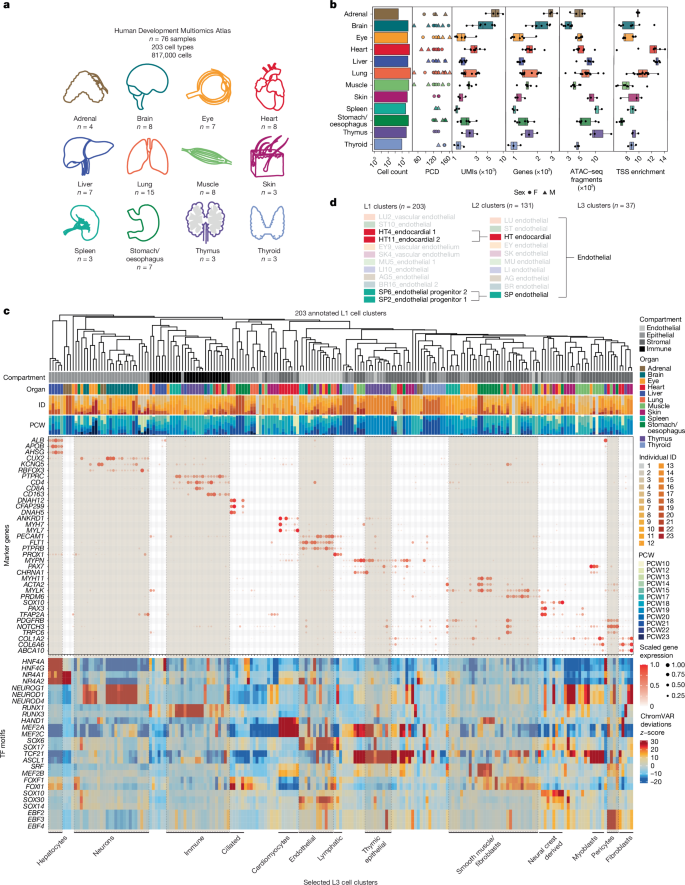
Motif syntax governs cell-type-specific chromatin accessibility and provides a foundational resource for decoding cis-regulatory logic and interpreting genetic variation during human development @Nature@anshulkundaje@WJGreenleaf@Stanford
https://t.co/kTQIhM3ImP