A Costco food court employee worked behind the counter for 4 years. She served roughly 2,000 hot dogs per week. She watched families walk in for a $1.50 hot dog combo and walk out with $340 in groceries.
She told me something most Costco shoppers have never been told:
"The $1.50 hot dog and soda combo has been $1.50 since 1984. Forty-one years. Same price. No inflation adjustment. No shrinkflation. No 'new recipe, same great value' rebranding. $1.50 in 1984. $1.50 in 2026. The inflation-adjusted price should be over $4.50 by now. Costco sells it for $1.50. And they lose money on every single one."
She said when Costco's CEO Craig Jelinek told co-founder Jim Sinegal that the hot dog was losing money and suggested raising the price to $1.75, Sinegal reportedly replied: "If you raise the price of the effing hot dog, I will kill you."
The price has never changed.
"The hot dog isn't a product. It's a promise. It's Costco telling you: 'We will lose money to keep our promise to you.' And it's not the only product they do this with. There are 9 items in the warehouse that Costco deliberately prices at or below cost not because they're charitable, but because these loss leaders are the most profitable products in the building. Just not in the way you think."
Here are the 9 products Costco deliberately loses money on and the business strategy behind each one:
A homeowner was about to pay $14,000 to replace his HVAC system.
The technician said the unit was "failing." The house was cold in spots. The energy bill had spiked 40% over the past year. The diagnosis seemed clear.
His neighbor a retired home inspector who'd used thermal cameras for 22 years knocked on his door and said:
"Before you write that check, let me look at your house for 10 minutes."
He clipped a $200 thermal camera attachment onto his iPhone. Walked through every room. Pointed at the walls. The ceiling. The windows. The ducts.
In 8 minutes, he found the problem. It wasn't the HVAC system. It was 3 sections of missing insulation behind the walls invisible to the eye, glowing bright blue on the thermal camera. Cold air was pouring through gaps the drywall hid completely.
The fix: $340 in spray foam insulation. Not $14,000 in HVAC replacement.
The homeowner stared at the thermal image on the phone: "You just saved me $13,660 with a phone attachment?"
"I saved you $13,660 with a camera that sees what your eyes can't. You can buy one for $200. And it does 9 things most homeowners pay thousands to diagnose."
Here's every use case and why every homeowner should own one 🧵
This was tilmed yesterday at the community adoption event in San Diego, California. The dog is Duke, a 10-year-old German Shepherd being showcased for adoption. The veteran is Tech Sergeant James Parker, 39, Air Force, walking through the parking lot heading into the store. Duke served with James in Afghanistan from 2011-2013. When Duke retired from military service two years ago, James couldn't adopt him immediately-rental restrictions. Duke went into the adoption system. James had been searching for months through databases.
Yesterday, James was at the pet store buying supplies. Had no idea there was an adoption event happening. Duke was sitting with volunteers at the outdoor table.
Watch what happened. James walks through the parking lot. Duke's head snaps up. Sees James. Goes completely rigid.
Staring. Then breaks into a full sprint. Rips the leash from the volunteer's hand. Runs straight across the parking lot. Launches into James's chest. Both crash to the ground. Duke frantically checking James's face with his nose. Whining. Tail going insane. James wrapping both arms around Duke. Sobbing. "I've been looking everywhere for you. Everywhere." Volunteer told us: "Duke saw James and just took off. The recognition was instant. l've never seen anything like it." James adopted Duke immediately. Took him home yesterday. Ten years after serving together. Found by complete chance in a parking lot. James told us: "I searched every database for months. Never expected to find him at a random pet store. But Duke found me." Sometimes the reunion you're desperately searching for happens when you're just buying dog food.
Dad and I were at Nebraska cattlemen��� Midyear the last two days. We are under 20 head left to calve but I got this surprising photo today from Nicci.
I was thinking she was gonna be open, which truthfully I would have preferred because at 19 she has more than done her job, and I’m going to have to think about some tough decisions.
She probably doesn’t remember that the year she was born, the first iPhone came out, Netflix started streaming, and a Senator named Barack Obama announced his presidency.
I’ve never named her as she’s nothing more than range cow but she does hold a special place in my heart.
We may pretend that we don’t get attached…but we do❤️
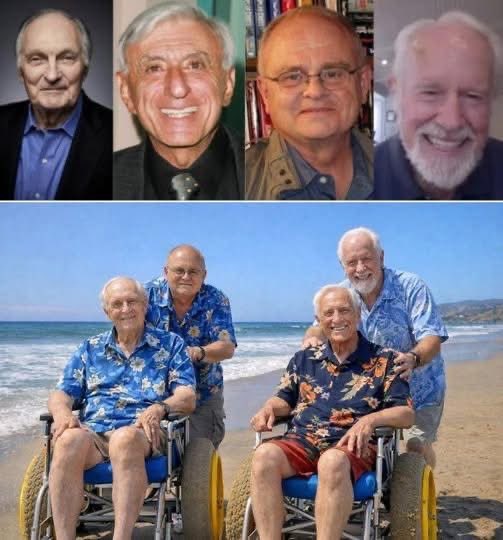
Four Old Men. Two Wheelchairs. One Beach. Alan Alda’s 90th Birthday
January 28, 2026.
Alan Alda turned 90.
His family planned a safe celebration at home.
Cake. Balloons. Grandkids.
Alan said no.
“I don’t want a party,” he said.
His daughter frowned.
“Dad… you’re turning ninety. This is a big deal.”
“I know,” Alan said.
“But I don’t want to celebrate here.”
“Then where?”
Alan didn’t hesitate.
“I want to go to the beach.”
The room went still.
“The beach?”
“Dad, you’re in a wheelchair.”
“You can barely stand.”
Alan smiled.
That smile.
The Hawkeye Pierce smile — the one that always meant something stubborn was coming.
“So?”
By that afternoon, he had already decided who was coming.
“The four of us,” he said.
“The last four.”
Gary Burghoff.
Jamie Farr.
Mike Farrell.
And himself.
The final survivors of the 4077th.
“No cameras. No interviews. No speeches,” Alan said.
“Just us.”
The phone calls began.
Gary answered first.
“Happy birthday, old man! Ninety!”
“Thanks. I need you to drive.”
“Drive where?”
“To the beach.”
A pause.
“Alan… you’re in a wheelchair.”
“So are facts. They don’t stop me either.”
Gary laughed.
That Radar laugh Alan had known for over fifty years.
“Fine. But I’m not pushing you through sand.”
“I’ll crawl if I have to.”
“You’re insane.”
“I’m Hawkeye. Same thing.”
Jamie Farr was next.
“The beach?” Jamie said.
“I’m ninety-one and in a wheelchair.”
“Then we’ll have two wheelchairs at the beach.”
“Like a parade?”
“Like a victory lap.”
Jamie laughed until his voice cracked.
“You haven’t changed since 1972.”
“And you’re still Klinger.”
“Fine. I’m in.”
Mike Farrell sighed the moment he answered.
“Let me guess,” he said.
“You want me to push your wheelchair.”
“Yes.”
“I’m eighty-six. I use a cane.”
“BJ Hunnicutt once saved a man with dental floss,” Alan said.
“You’ll manage.”
Long pause.
“…Fine.”
January 28. 6:00 a.m.
Gary arrived in a rented van.
Two wheelchair spaces.
He was wearing a Hawaiian shirt.
At Alan’s house, his daughter hovered.
“Dad, are you sure?”
“I’ve never been more sure of anything.”
“What if something happens?”
“Something is always about to happen at ninety,” Alan said.
“Might as well happen at the beach.”
Jamie was waiting outside his house.
Wheelchair. Sunglasses.
Hawaiian shirt.
“You coordinated outfits?” Gary asked.
“It’s tradition,” Jamie said.
“The 4077th always matched.”
Mike showed up next.
Also in a Hawaiian shirt.
Four old men.
One van.
Heading west.
On the drive, memories filled the air.
Harry driving too fast.
Larry bringing his own wine.
Radar making everyone cry.
Klinger never sleeping.
When the MASH* theme song came on, no one spoke.
After it ended, Alan said quietly,
“That song used to annoy me.”
“Now?”
“Now it just reminds me how lucky we were.”
At Malibu, reality hit.
Wheelchairs don’t work on sand.
Jamie grumbled.
Mike rubbed his back.
Alan stared at the ocean.
Gary disappeared.
Fifteen minutes later, he returned with two lifeguards and two beach wheelchairs.
One lifeguard whispered,
“My grandmother watched MASH* every night.”
It took time.
Transfers were slow.
Hands trembled.
Bones protested.
But they made it.
To the water.
Alan closed his eyes.
The sound of waves.
Salt in the air.
Sun on his face.
“I forgot what this felt like,” he said.
They talked about the ones who weren’t there.
McLean.
Wayne.
Larry.
Harry.
Bill.
David.
Loretta.
Jamie finally broke the silence.
“Let’s race.”
Two wheelchairs.
Two pushers.
One rock.
They raced.
They tied.
People on the beach stared.
A teenager asked, “What are those old guys doing?”
His mother said, “Living.”
As the sun set, Alan spoke.
“This might be the last time.”
No one argued.
“That’s why it matters,�� he said.
“Because we know.”
He made a wish.
“One more year.”
“One more adventure.”
“Korea. Together.”
They promised.
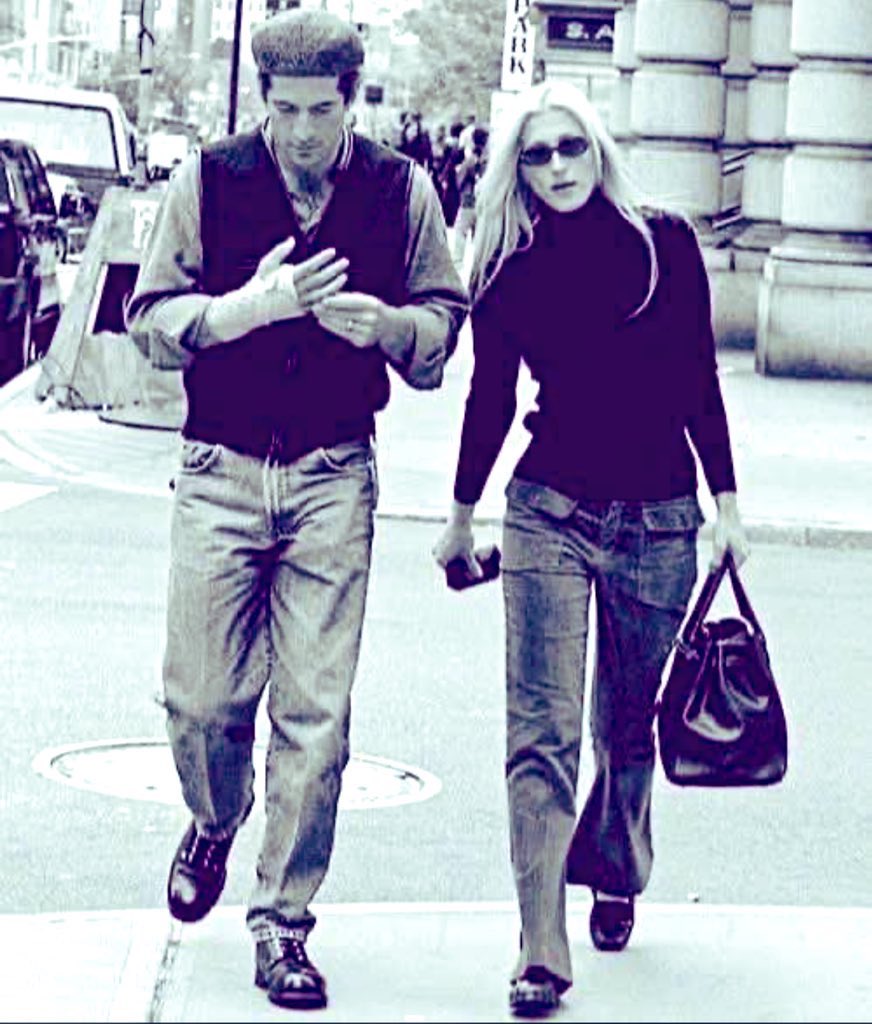
Una sera di ottobre del 1994, John F. Kennedy Jr. entrò in un piccolo ristorante italiano nel sud di Manhattan e fece qualcosa che il proprietario, Giovanni Russo, disse di non aver mai dimenticato. Vedendo che tutti i tavoli erano occupati e che una giovane cameriera, alla sua prima sera di lavoro, era sopraffatta e sull’orlo delle lacrime, John chiese con discrezione se potesse aiutare a sparecchiare finché la situazione non si fosse calmata.
Giovanni raccontò in seguito al New York Times di aver provato a rifiutare con gentilezza:
“Signor Kennedy, lei è un ospite, si accomodi e le troverò un tavolo.”
Ma John sorrise, si rimboccò le maniche e rispose:
“Ho lavorato in un ristorante durante la facoltà di legge e ricordo quanto possa essere spaventosa la prima sera. Lasci che aiuti.”
Per i successivi quarantacinque minuti sparecchiò tavoli, riempì bicchieri d’acqua e fece battute per tranquillizzare la cameriera, Maria Sanchez. Quando il momento di punta finì, rifiutò il pasto gratuito offertogli da Giovanni e lasciò invece una mancia di cento dollari con un biglietto:
“Per Maria — stai andando benissimo, e diventa più facile, te lo prometto.”
Maria, che in seguito divenne direttrice di ristorante, tenne quel biglietto incorniciato in ogni locale in cui lavorò per venticinque anni. Nel 2004 disse a un giornalista:
“Quella sera il signor Kennedy mi ha insegnato che la vera classe non riguarda dove ti siedi, ma accanto a chi scegli di stare quando le cose si fanno difficili.”
Giovanni ricordava soprattutto una frase di John, detta mentre usciva:
“Mia madre mi ha sempre detto che il modo in cui tratti le persone quando nessuno di importante ti sta guardando dice tutto su chi sei davvero.”
Un promemoria che il vero carattere emerge nei piccoli gesti invisibili, quando scegliamo il servizio invece dello status.
As a parent, I think this video has taught me something useful.
I recommend that you should try it on your kids, too.
I have also shared it with my wife.
Credit: joe_drummer_boy on IG.