NASA certified Duane Graveline's brain for spaceflight. Pfizer's best-selling pill erased it twice, and when the astronaut and the pill told different stories, his profession believed the pill.
Understand what his mind had already been through before anyone doubted it. Flight surgeon. Aerospace research physician who studied what weightlessness does to the human body before anyone had spent a week up there. In 1965 he was picked as one of just 6 scientist-astronauts for the Apollo era, out of every qualified brain in America. There are Swiss watches that have passed fewer inspections than this man's head.
In 1999, at his annual astronaut physical, his cholesterol came back high and he left with Lipitor. 6 weeks later he returned from his morning walk unable to say where he was. His wife of decades walked out to him and he treated her with the polite reserve you'd offer a woman you had never met. 6 hours, gone. The hospital wrote transient global amnesia on the file and could not tell him why a fit 68-year-old's memory had simply switched off.
He suspected the tablet. He was assured, by doctors, that statins do not do that. A year on, they talked him back onto it at half the dose.
12 hours, this time. He came back as a 13-year-old. Knew his schoolmates, knew his homework, and laughed out loud at the strangers insisting he was a married father with a medical degree. A man qualified to treat astronauts could not, for half a day, have been trusted with a splinter.
Now, the part that should embarrass cardiology forever. Drug safety has a formal gold-standard test for whether a medicine causes a harm: take it and the harm appears, stop it and the harm stops, take it again and the harm returns. Challenge, dechallenge, rechallenge. Graveline ran the entire protocol on himself, by accident, at a lower dose, on a brain with 30 years of NASA documentation behind it, and the result came back positive in front of medical witnesses.
The profession filed it under anecdote. The harm hadn't appeared in the approval trials, and the approval trials hadn't looked.
So he did what a research physician does with a finding: he published. Book after book, starting with one titled Lipitor, Thief of Memory. He built a site where the letters arrived in their thousands, from ordinary people whose fog and vanished words had been waved off as age by the same men who waved him off. He logged it all, for 17 years, until his death in 2016. The establishment had handed the world's most prescribed drug to millions of pensioners, and the pensioners' complaints about their memory were being answered with a shrug and a repeat prescription. He made the shrug expensive.
In 2012, 13 years after his first erasure, the FDA quietly ordered memory loss and confusion onto every statin label in America. No press conference. No apology to the letters.
Today the same drug is offered to healthy people on the strength of one number crossing a line, under the same 2 words: safe, proven.
Graveline's memory came back both times, complete.
Medicine's never has. It still can't recall ever being wrong.
Listen up America:
1. More government always means less freedom. Always.
2. You cannot tax a nation into prosperity. It is fraudulent and theft.
3. You are not entitled to someone else’s hard earned money. Ever.
4. Free never means free.
5. You have never been a victim, stop acting like it.
6. The rich are not responsible for your financial situation, you are.
7. There are only two genders and over 170 mental illnesses.
Hope this helps.
Seed oils go rancid inside you at body temperature, and every place that reaction lands gets a different name, a different specialist and a different waiting list.
It is one reaction. Oxygen tears a hydrogen off a polyunsaturated fat, the molecule breaks apart, and what is left behind is aldehydes.
It goes off in skin under strong sun, fast enough to watch. We call that sunburn.
It goes off in an artery wall and the oxidised linoleic acid packs itself into the lesion. We call that plaque.
It goes off in cartilage and malondialdehyde and 4-hydroxynonenal take the joint surface apart. We call that wear and tear.
It goes off in the lens of the eye, which never replaces its own material, and the membranes stop being transparent. We call that a cataract.
It goes off in brain tissue, 60 per cent fat by dry weight, and the aldehydes are measurable before anybody has a diagnosis. We call that Alzheimer's.
It goes off in the gum and the peroxidation markers climb in step with the pocket depth. We call that poor brushing.
It goes off in the oil your own skin pumps onto its surface all day and the aldehydes lift off into the room. We call that body odour.
Seven conditions, seven departments, seven consultants who have never met one another, and one reaction underneath the lot of it, going rancid in whatever tissue it was stored in.
The fuel is soybean, rapeseed, sunflower, corn and cottonseed oil, and it is in the mayonnaise, the bread, the crisps and every fryer on the high street.
Butter cannot start any of it. The reaction needs a hydrogen sitting between two double bonds, and saturated fat has not got one to give.
It goes off in all seven at once. We call that getting old.
Many Texans long ago rejected John Cornyn as a traitor, surrounded himself with the type of people trying to capture this state for the globalists & their Democrat proxies. Anyone choosing/working to support the fake campaign for Baby Beto aka little Satan does not represent the heart & soul of this state - they represent those who wish to fundamentally turn this state & this country into something no one will recognize. The insane people are trying to take over the asylum. It will not work.
A vulture's stomach runs at a pH of around 1. That is roughly battery acid. It dissolves bone and sterilises the anthrax, botulism and cholera in a rotting carcass on the way down. The bird eats three-day-old roadkill for breakfast and feels nothing, because its gut is a furnace built to handle death.
Here comes the uncomfortable bit for the salad crowd.
Your stomach runs at about 1.5. Not quite vulture grade, but in the same brutal postcode. It is roughly level with a possum and a hawk. Meanwhile a gorilla, an actual dedicated plant-eater, sits far higher, up around 4 to 5, and a chimp, your nearest living cousin, has a gut noticeably gentler than yours.
You did not evolve that acid to break down spinach. Spinach does not fight back. That savage, flesh-melting pH is the calling card of an animal that ate meat, often meat well past its best, and needed to kill whatever was living in it first.
Scientists have a polite phrase for this. They reckon scavenging carcasses mattered far more in human evolution than the tidy nut-and-berry story admits, because only a viciously acidic gut lets you raid a kill and survive the bacteria that come with it.
So you wander about with the stomach of a scavenger and the dietary advice of a rabbit. The stomach was issued by two million years of evolution. The advice was issued by a committee in the seventies.
Me driving home knowing there won’t be a second date, but at least she knows that her evidence-based mediterranean diet was what peasants were forced to eat to keep them weak and compliant.
Standard American fat intake, 1900. Per person, per year.
Butter: 18 pounds
Lard: 12 pounds
Beef tallow: 8 pounds
Seed oils: 0 pounds
That is thirty-eight pounds of animal fat per person per year, and a round zero of the stuff extracted from seeds using hexane solvent in an industrial plant, for the simple reason that the industrial plant had not been built yet.
Disease rates at the time, in the same population, on that diet:
Obesity: about 1.2%
Diabetes: under 0.5%
Heart disease: so rare before seventy that cardiology did not yet exist as a medical speciality
Standard American fat intake, 2026. Per person, per year.
Butter: 4 pounds
Lard: under 1 pound
Beef tallow: essentially none
Seed oils: 80+ pounds
That is about five pounds of animal fat a year against eighty pounds of something your great-grandmother would not have recognised as food.
Disease rates in the same population, on the new diet:
Obesity: 42%
Diabetes: 11.6%
Heart disease: the leading cause of death in the country
And the official position, held by the dietary guidelines, the heart associations, and almost every doctor under fifty, is that the problem is the four pounds of butter.
Not the eighty pounds of industrial seed oil that did not exist before 1911 and now makes up roughly a fifth of the total calories in the average American diet.
The four pounds. That's the one.
The thing that has fallen by seventy-seven per cent is somehow driving the diseases that have risen in lockstep with its decline. The thing that has gone from zero to eighty pounds is innocent, because it says "heart healthy" on the bottle.
This is not how causation works. This is not how anything works. A twelve-year-old with a pencil and a sheet of paper could look at those two columns and identify the variable that changed.
The grandmother with the crock of bacon grease on the windowsill could have told you, without any data at all, which of those two fats was the food and which one was the lubricant. She would have laughed at the question. She would have cooked your breakfast in the correct one and served it to you hot.
She is no longer here to ask.
Her grandchildren are pouring her grease down the sink and buying the lubricant in a plastic bottle, and wondering, very sincerely, why they feel unwell.
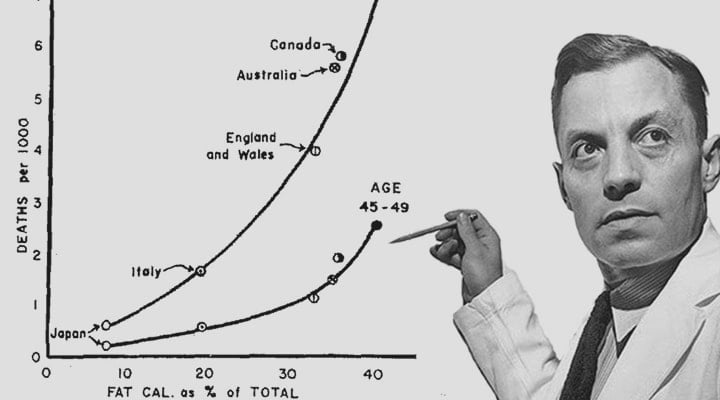
In 1953 an American physiologist called Ancel Keys stood up at a World Health Organization conference in Geneva and presented a graph.
The graph plotted fat consumption against heart disease mortality in six countries. The United States at the top. Japan at the bottom. A smooth upward curve in between. The room was convinced. The graph would go on to define global nutrition policy for the next seventy years.
There was one small problem with the graph.
Keys had data from twenty-two countries. He chose six.
The other sixteen, which included France and Switzerland eating vast quantities of butter and cheese with low heart disease, and countries like Chile eating almost no animal fat and having high heart disease, did not produce the line he wanted. So they were not on the graph.
When this was pointed out, in print, at the time, Keys did not engage with the science. He launched a career.
He became chair of the American Heart Association's nutrition committee. He got himself on the cover of Time magazine. He organised the Seven Countries Study, a sequel to the cherry-picked six, which selected populations and time points that would confirm his hypothesis and excluded those that would not. Crete was measured during Lent. The comparisons were, by design, not fair.
Then he did the thing that turned him from a scientist into a politician.
He went after the opposition.
Dr John Yudkin, a British physiologist, published a book in 1972 called Pure, White and Deadly, arguing that sugar was a better fit for the heart disease data than fat. His data covered more populations, more years, and more accurately matched the rise in cardiovascular mortality across the twentieth century.
Keys called him, in print, a charlatan. He used his position at the AHA to block Yudkin's research from conferences. He pressured editors. He lobbied funders. Yudkin's grants dried up. His reputation was systematically dismantled by a man who was, at this point, not doing science but running a protection racket for a hypothesis.
Yudkin died in 1995 in obscurity. His work has since been quietly vindicated. Nobody has apologised.
Meanwhile the American Heart Association, funded since 1948 by a $1.7 million donation from Procter and Gamble (makers of Crisco, a product that urgently needed a reason for Americans to stop cooking with lard), adopted Keys's recommendations and issued them as medical advice.
The American public complied. Butter consumption collapsed. Margarine tripled. Seed oils, negligible in 1950, became the dominant cooking fat. The food industry reformulated thousands of products to remove fat and replace it with sugar, because the fat was the enemy and the sugar was not.
American obesity rates, stable for fifty years, began to climb in 1977, the year the McGovern committee translated Keys's hypothesis into federal guidelines.
They have not stopped climbing since.
Type 2 diabetes followed. Metabolic syndrome followed. Fatty liver disease, which barely existed in 1950, became endemic. The entire constellation of chronic metabolic disease now occupying every doctor surgery in the developed world tracks, almost perfectly, onto the adoption curve of the guidance Keys spent his career promoting.
He retired to Italy, drank olive oil, ate cheese, lived to 100, and described himself in interviews as a pioneer.
He was a pioneer.
He pioneered the practice of producing a predetermined conclusion from selective data, destroying the reputations of anyone who noticed, and using institutional capture to convert the conclusion into policy.
Ancel Keys was not wrong the way scientists are sometimes wrong.
Ancel Keys was wrong the way politicians are wrong.
Deliberately. Profitably. Without consequence.
You are still eating the consequences now.
Your grandmother vs you.
Same genes. Different food. One generation apart.
She rendered lard. You buy a cooking spray with dimethylpolysiloxane listed third.
She boiled the bones for eight hours. You buy a collagen sachet with a picture of someone doing yoga on it.
She ate the egg yolk. You bought the low-fat version that quietly removed it.
She fermented because preservation required it. You buy a probiotic because the sterilised packaging doesn't contain what the fermented food did.
She went outside because life required it. You have a vitamin D capsule and a SAD lamp for the depression that arrived when the outside stopped.
She put tallow on dry skin. You have a seventeen-step skincare routine and a ceramide serum.
She sat at a table with other people. You have a delivery app and a government Minister for Loneliness.
She was hungry and ate. You have a calorie tracker with haptic feedback.
She had none of the products.
She had none of the deficiencies the products address.
The deficiencies arrived with the products.
The products arrived after the advice removed what she had.
The Midwestern United States was, until relatively recently, sitting on top of some of the deepest topsoil on earth.
Ten thousand years of prairie. Bison, fire, deep-rooted grasses, the slow accumulation of organic matter into a layer of black soil sometimes two feet thick. Soil that farmers in other parts of the world would have wept at the sight of.
Then the plough arrived.
In 2021, a team from the University of Massachusetts used satellite imagery and LiDAR to measure what was left. Their finding: roughly a third of the Corn Belt, around 30 million acres, has completely lost its A-horizon. The carbon-rich topsoil is simply gone. Scraped off the hilltops by a hundred and fifty years of tilling and rain, washed downslope, into rivers, into the Gulf.
The USDA had previously estimated that none of those same fields had lost their topsoil.
None.
The satellites disagreed.
Every year, the United States loses around five tons of soil per acre. Ten times the rate at which it forms. A layer as thick as a dime, peeled off every twelve months, across tens of millions of acres, and sent downhill.
The crops being grown on this land, the corn and soy that replaced the prairie, are in large part used for ethanol, high fructose corn syrup, and livestock feed. The livestock feed portion is the only one that gets criticised in polite company.
The prairie took ten thousand years to build.
We scraped a third of it off in under two hundred.
The people currently telling us to grow more crops instead of raising cattle are, presumably, unaware that the crops are already eating the ground they stand on.
"The science is settled."
They said that about lobotomies. Drilled into the skull, severed the frontal lobe, sent the patient home quieter. Twenty thousand performed in the US alone. The surgeon got a Nobel Prize.
They said it about radium. Sold in toothpaste. In face cream. In water tonics for "vitality." The factories that made it left a radioactive legacy that required federal cleanup eighty years later. The women who painted the watch dials were told to lick the brush to keep a fine point.
They said it about smoking during pregnancy. Doctors endorsed specific brands. Camel ran ads with physician testimonials. "More doctors smoke Camels than any other cigarette." The settled science of the 1940s.
They said it about mercury for syphilis. Rub it on the skin. Inhale the vapour. The cure was frequently worse than the disease. The disease, at least, took years. The mercury took weeks.
They said it about bloodletting. For two thousand years. Every major illness. Every fever. Every infection. Open the vein, release the corruption. George Washington was bled of roughly forty percent of his blood in twelve hours on his deathbed. By doctors. Who were certain.
They said it about margarine. Heart-healthy. Scientifically proven. Cardiologist-approved. The trans fat content was not discussed, because the people funding the studies were not in the business of discussing trans fat content.
They are now saying it about red meat. About saturated fat. About cholesterol. About the LDL hypothesis that has never survived a randomised controlled trial with all-cause mortality as the endpoint.
Settled science is where investigation stops.
It is also, reliably, where the funding starts.
Carnivore is not a purity cult.
Nobody is monitoring your plate. There is no tribunal for the person who had potatoes at Christmas or fruit on holiday or a glass of wine because it was their anniversary and life is long.
The strictness serves a purpose in the beginning. Remove all variables. Find the baseline. Understand what the body is like without interference. This is methodology, not morality.
After the baseline is established, you make choices with information behind them.
Coffee comes back for most people because coffee is good and the trade-off is negligible.
Dairy comes back because butter and cream are animal products with genuine nutritional value.
The occasional deviation happens because you're a person living a life.
None of this undoes the metabolic foundation.
None of this requires an apology.
The diet is the tool. You are not the diet.
Use it. Don't become it.