🚨 BREAKING: A Reform UK councillor in Sunderland has been charged with posting a grossly offensive comment after writing in 2024 that Nigerians should be melted down to fill in potholes
The full story here is NUTS 🤯
TLDR dude hikes 6.5 hours to avoid a helicopter medical bill impaled while his friends make kebab jokes…
> 32yo ER nurse named David is day-hiking Montana’s tallest mountain with his boys
> He slips on a rock near the top and full-on impales himself on his own trekking pole that goes clean through his lat with like 8 inches sticking out both sides
> nurse brain kicks in immediately, checks himself, realizes nothing vital got hit and he can still breathe fine says screw the helicopter bill and just starts hiking the entire 10 miles back down with the pole still stuck in him
> takes SIX AND A HALF hours, friends are spotting him the whole way, one even runs ahead to warn families so kids don’t see this gnarly shit
> about 4 miles from the car they realize they’re actually gonna make it… and start cracking kebab jokes 😂
> dude never complained once, stayed in weirdly high spirits the whole time
> walks himself all the way to the trailhead, gets the pole pulled out later at the hospital, and already says he’s going back next year to finish the summit
There's a category of business investors love to call "irreplaceable" –
✈️ airports,
🚅 railroads,
🚢 ports,
📈 exchanges,
💰 toll roads.
Undeniably competitively advantaged, with highly predictable models.
BUT ...
... here's the tension people gloss over: many of them are also growth-constrained by nature. Not because demand is weak – often the opposite – but because their assets scale slowly or under heavy regulation.
They can still be decent compounders, but growth tends to be rather low, sometimes capital-intensive, or bounded by throughput, not demand.
Expansion is slow, regulated, and stepwise. Economics are predictable, though.
So in order to end up with hall-of-fame returns, you have to buy them really cheap to get multiple expansion as another return tailwind.
Or you buy them so cheap that if management buy back a ton of shares, it's highly value accretive.
So mostly, you invest in these businesses for the durability and predictability – think of them as portfolio stabilizers – but not for high growth / high returns.
----
Feel free to correct me here, and I am, of course, generalizing.
A few examples:
Airports have geographic monopolies and diversified revenue streams (fees, retail, parking, logistics). But they can’t expand runway capacity 8% per year just because passenger volumes rise 8% – growth comes in big, billion-dollar jumps (new terminals, runways, gates), often requiring 5–10+ years of approvals and construction.
Railroads operate as duopolies or oligopolies with high switching costs. Revenue can compound steadily through pricing and volume, but the physical network is mostly fixed. Expansion is rare, expensive, and episodic.
Port operators hold strategic locations and long-term concessions, making them essential to global trade. Yet berth space, cranes, and coastline are fixed. Capacity expands only through multi-year terminal builds, dredging, and environmental approvals – again, growth happens in chunks, not smoothly, and tends to be rather slow.
Sports club came to my mind here too, which you could probably throw in a similar category. These businesses enjoy intense cultural and emotional moats – loyal fanbases, scarcity value, regional monopoly on fandom, and strong pricing power across tickets, sponsorships, merchandise, and media rights. Yet their growth is structurally constrained. The league format caps the number of matches and monetization cycles, stadium capacity is finite and only expandable through rare, capital-heavy projects, and talent acquisition is inherently zero-sum within a competitive system designed to maintain parity. Even when demand surges after a championship run or global brand momentum accelerates, the business cannot smoothly scale supply to match, and generally, revenue often depends as much on competitive success as internal reinvestment.
A final thought – because investing is highly personal, and you have to find what actually works for you. For me, the ideal profile is high, predictable ROIIC paired with abundant reinvestment opportunities and a long runway. And this is exactly where the businesses above fall short: they're durable and predictable, but they lack the reinvestment variable.
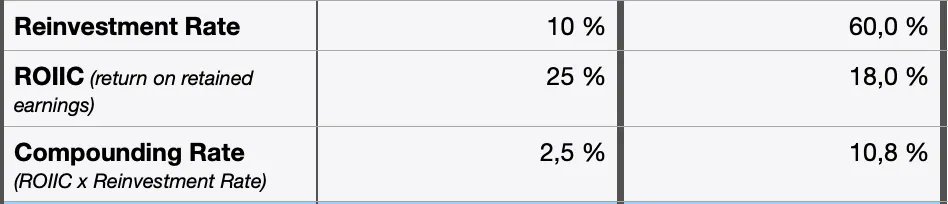
As I wrote in yesterday's blog post: a high return with nowhere left to deploy it is not as valuable of a stock and no "compounder stock." The competitive advantage period tells you how long the spread survives, not how much capital the company can push through it – and a business earning 25% on incremental capital while reinvesting only 10% of profits is a very different proposition to one reinvesting 60% at 18%.
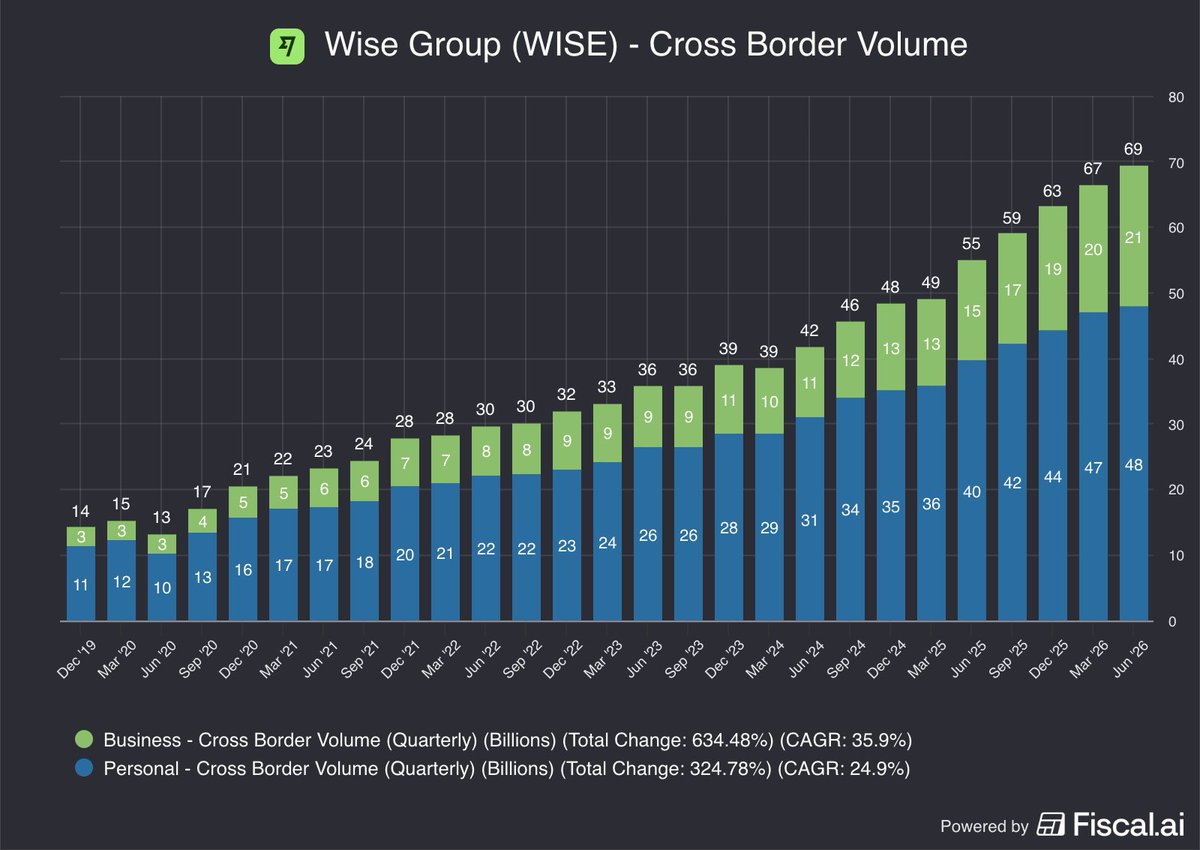
Wise processed $69 billion in cross border volume in Q2, up 26% YoY.
Business Volume: $21B, +39%
Personal Volume: $49B, +21%
Shares are flat over the last 5 years.
$WISE
$ONDS
Autonomous drones for railways, defence and critical infrastructure. US Army contracts. FAA partnership.
Revenue up 51% YoY. Debt free. Just added to the Russell 2000.
The drone economy is just getting started. 👀
"I share my real-time TRADE alert (entry & exit points) on WhatsApp, free to join ✅
➡️Copy search input Reply “777” to WhatsApp: +13463957545
Here’s the link : https://t.co/z6ezbdYAR1
🎥 - DAILY LIVE TRADING
📖 - TRADE RECAPS
☢️ - PERSONAL STRATEGY"
Northland maintained an Outperform rating on $NBIS with a $410 price target after Nebius secured its first GPU-backed debt financing
The firm says the deal “answers a key lingering doubt” by validating its non-dilutive funding model and now values Nebius more in line with $CRWV
Crutox enters its next phase with major partnerships ahead, we're making sure active users are rewarded.
Starting 1 August 2026, accounts inactive for 4+ months will forfeit their accumulated $CRX. Those tokens will be redistributed among current active miners.
🇺🇸🔴AGAIN: Warning Signal from Congress.
Sen. Tuberville sold everything on June.
We knew it recently:
10 positions. In 2 days. Zero buys.
Armed Services Member: $LMT $DUK $PFE $MA $PG $TSCO…
Not rotation. Move to cash.
$NBIS - has bounced right off the buy zone
The buying zone around $170 attracted enough buyers today to trigger an intraday reversal. It is currently battling resistance at $182. If this level is broken, we’ll start Wave 3 with a target of $196/197. Wave 5 should then take us roughly to $205–$209 slightly higher than planned yesterday.
$NFLX Three years ago, Netflix bottomed in July. I was buying back then.
Today, the chart is again deeply sold in July.
Price is sitting under both the 20 & 50 EMA.
Will this July mark the next major low?
$ASTS Well, that is good to know: The EU has a high probability of giving AST's JV billions of dollars worth of spectrum. Seems significant. Like I've said before, I think AST's JV will receive 10x10MHz. Time will tell.