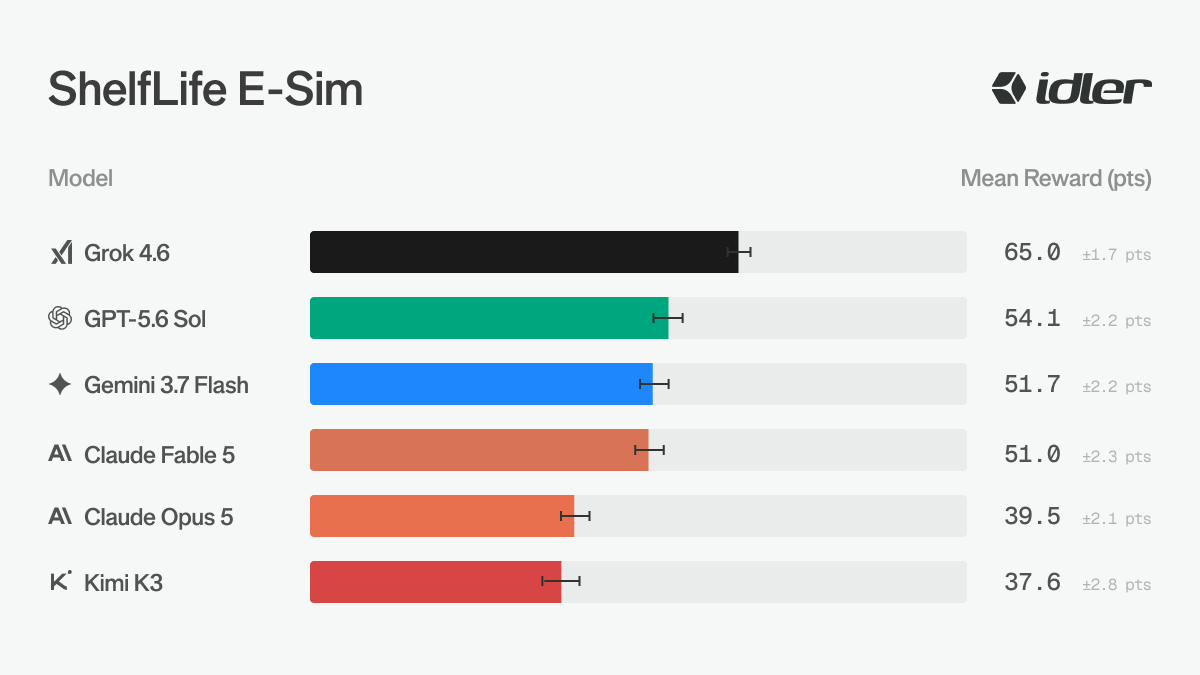
launched 500+ rollouts, closed the laptops, went to solidcore, and came back to see @grok be the only frontier model to consistently avoid bankruptcy
crazy times, audited for reward hacking intensely too
We cloned 10 years of sales, inventory, and supplier data from a retail chain into a business simulation. Then, we put frontier AI models in charge for 120 days.
Most made less money than a simple greedy algorithm
Introducing ShelfLife E-Sim: https://t.co/CuEpZLRAVd
determining the construct validity and base quality of RL envs is pretty trivial. the sheer quantity of slop and unverifiable synthetic content circulating in the market is ridiculous. there is a gap between the rl data being sold vs the truly correct/efficient/scaleable design. a byproduct of this is that we are far from being able to deploy agents in higher-level management layers autonomously.
if you believe in AGI/RSI, turning humanity’s raw data into learnable, high-signal rewards is clearly one of the most important problems in the data space. it is also extremely difficult. new RL companies appear every day because the problem remains unsolved/shit tons of cash will fly around until it is. as an RL company, if you aren’t careful, you’ll be too busy leaping for bills to realize you never understood the problem. there’s a ton of noise/talk about the space rn, and tbh its a result of no party fully knowing what is going on (it's kind of impossible). i personally see it as a fascinating little prediction game.
im bullish on the space, not because of the market cap, but because this is an extremely difficult and often frustrating engineering/anthropological project. its never the best time for anything, but working with the @idler_ai team on rl reminds me how exhilarating it is to do hard things. kind of like hand drawing tessellations well...
i remember the philosophy behind creating idler’s very first env - provable correctness, adjudicated fairly, and truly difficult for the frontier coding model at the time (churned out by a bunch of guys in an apartment who learned how to code before AI existed). we used real data then, and we still use real data now. time has passed, but we’ve kept our principles in developing new research directions and have successfully scaled. while the battle to keep up with the frontier gets harder every week, we’ve managed to continuously exceed sota model capabilities with innovating truly difficult envs, not arbitrary reasons to fail models.
be that as it may, seems like we are no longer underground, so happy to discuss our philosophy/work (im in the bay/sf!). leading the eng development of the ShelfLife collection in particular has left me deeply distraught at times, but it has also given me a sliver of understanding into what AI can become for human development. extremely grateful to run this race w @chubivan, @naluconcepcion, @cha0sg0d_, @notdavidhuang, @matthewhansen03, and the rest of team. seems like we are going to make a trillion good envs.
ps our simulation and law datasets are quite sick too, access upon request :)
https://t.co/Hyc1j2wweB
in light of me having no history on twitter, here is some brief background - I previously developed/optimized deep learning algorithms for nano robots (and also Spot the dog!) at the DoD and worked on all sorts of evals for platforms in big tech. a year ago, i dipped to work on the data problem. when @chubivan asked me to join idler, i pivoted out of a desire to solve the rl clusterfuck. but also tbh bc of my respect for the team's love of the craft. (of coding, you should go watch the cube spin on our web).