Gender researcher. Traveller. Interested in human behaviour and human nature; Genetic and Cultural evolution; Household Economics; Labour and Marriage Market.
Many Groups including the Cockroach Janta Party got FULL permission to protest at Jantar Mantar. Infact the CJP rightfully got it the SECOND their boy landed at the airport.
So why the discrimination againt the General Category students & youth? Why are they DENIED permission even after applying properly, waiting, begging? One can agree or disagree with them but this is BS!
This is not democracy.
This is open discrimination.
One can absolutely disagree with the #21AugReservationHataoAndolan but they have a right to protest.
@neha_laldas@talk2anuradha@ajeetbharti
She surrendered one of the greatest achievements of her life to help save a baby she had never met.
In 2021, Polish javelin thrower Maria Andrejczyk, a cancer survivor and Tokyo Olympic silver medalist, auctioned her medal to raise funds for life-saving heart surgery for eight-month-old Miłoszek Małysa.
The medal sold for approximately $125,000, covering the remaining cost of the child’s treatment in the United States.
Then came an extraordinary turn of events.
The winning bidder, the Polish supermarket chain Żabka, paid the full amount and immediately returned the medal to Maria, stating that she deserved to keep the symbol of everything she had achieved.
Maria later explained her willingness to part with it: “A medal is only an object, but it can save lives instead of collecting dust in a closet.”
In that moment she transformed a personal symbol of victory into something far more meaningful, a second chance at life for a young child.
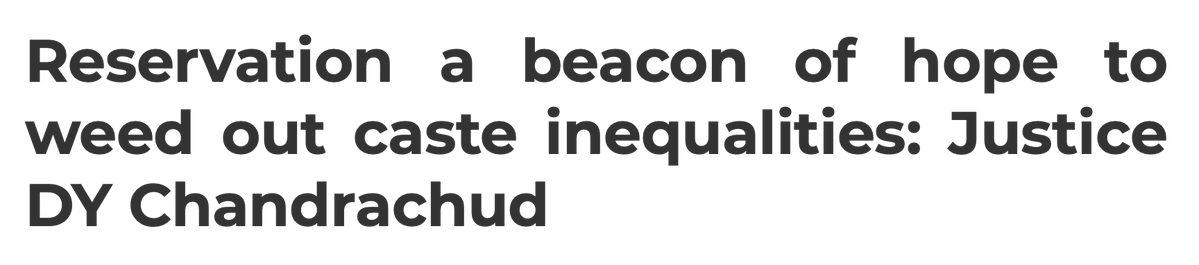
If reservation is a beacon of hope, why exclude higher judiciary from it? Only 3% of High court and Supreme court judges are Dalits, only 12% are women. When it comes to your own jobs, you want merit not quotas.
We are tired of your hypocrisy milords. Practice what you preach.
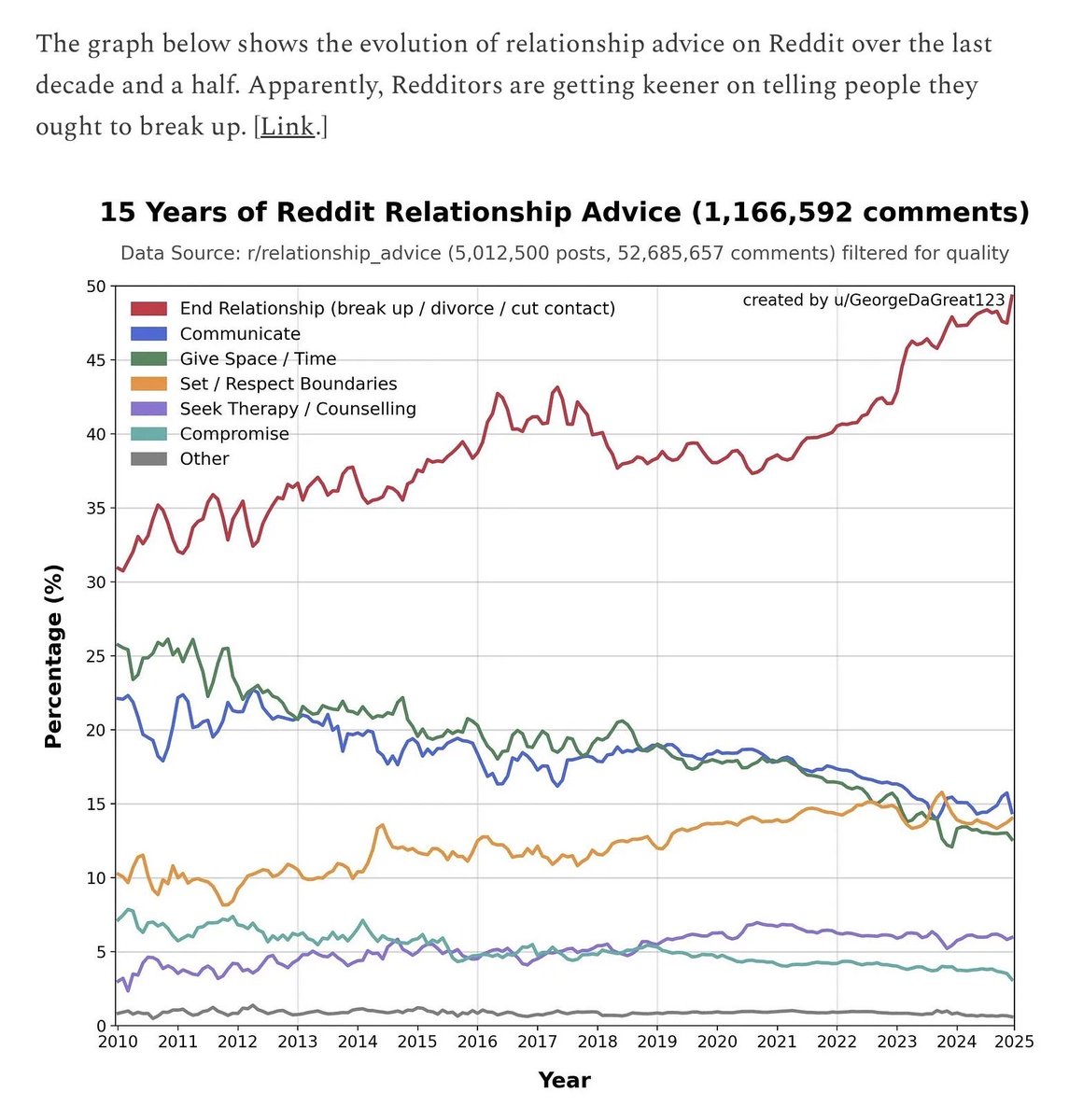
Relationship advice on Reddit is increasingly focused on telling people to break up or divorce and ignoring the need to compromise and communicate.
Is it just me or does this seem like a recipe for lonliness.
Over the last two days, I have been estimating statistical models to account for the evolution of total fertility rates (TFRs) worldwide since 1950.
Since I want to cover all countries and territories for several decades, I have little alternative but to use the UN World Population Prospects 2024. I have criticized this database in the past, and I will return to those criticisms at the bottom of this post.
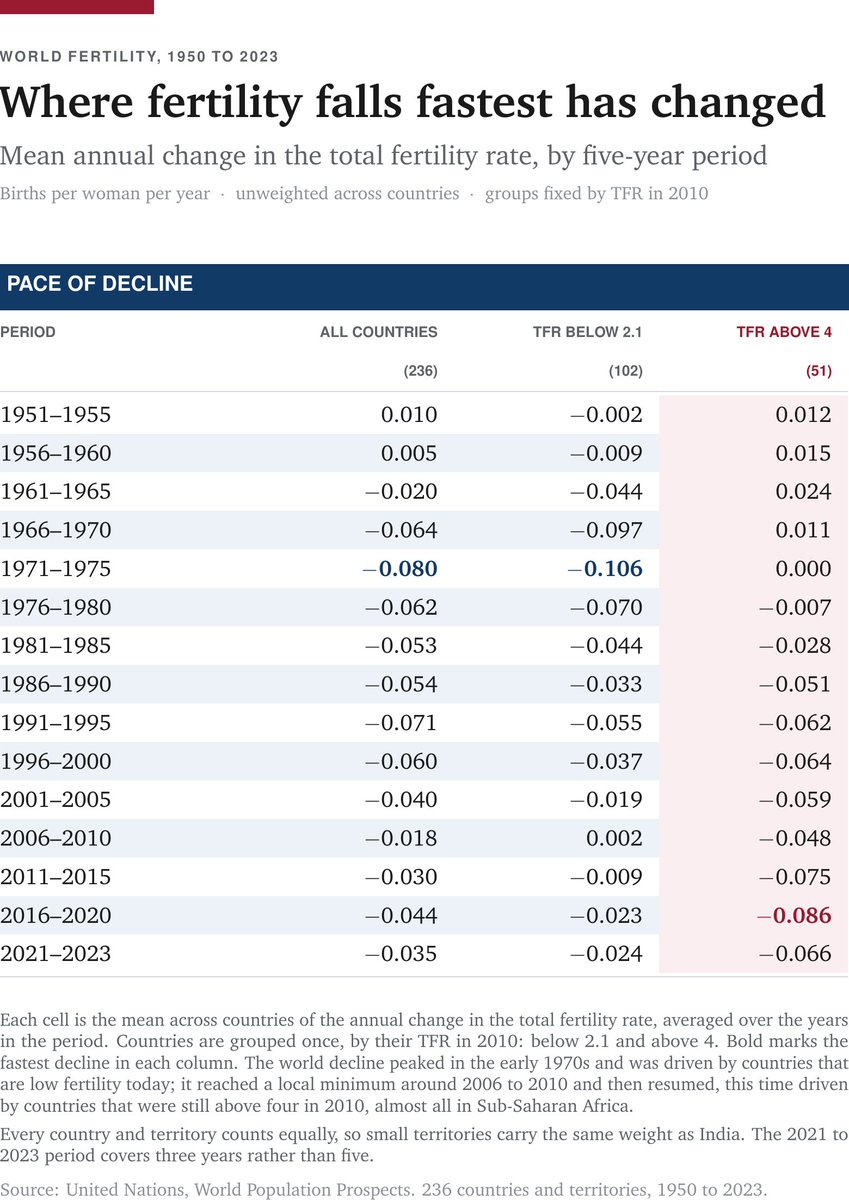
I compute the average fall of TFRs in all 236 countries and territories every five years, as well as the fall in countries that, according to the dataset, were below 2.1 (roughly the replacement rate) and above 4 in 2010. That gives us an indication of how TFRs are moving in low- and high-fertility countries.
For all countries and territories, the average TFR has been falling by 0.062 children per woman per year from 1950 to 2023 (the last year for which the database reports historical data rather than future scenarios). That is amazing, in particular because there was no drop to speak of before 1960. Interestingly, there is no acceleration in the last 10-15 years: the most recent drops follow historical patterns.
In low fertility countries, the interesting thing is that 2006-2015 were years of pause in the fall of fertility. 2016-2023 is not so much an acceleration as the resumption of a trend that had stopped momentarily. In high-fertility countries, we do see an acceleration of the fall since 2010. An annual drop of 0.086 children per woman, as we observed in 2016-2020, is truly exceptional. At that speed, you move from 4 to 3 children per woman in one decade.
Where do these observations leave us?
Two non-competing possibilities. First, that the UN World Population Prospects 2024 has missed part of the worldwide decline in fertility and that the new release will support the acceleration story more clearly.
Second, that the fall of fertility is an unrelenting consequence of modernity, that is, of the increasing rational organization of society, with higher degrees of division of labor and individualistic aspirations. I emphasize modernity, not capitalism: fertility fell earlier and faster in socialist economies than in comparable capitalist countries. So no, this is not about capitalism. Sometimes the fall is faster, perhaps aided by new technologies such as smartphones. Sometimes the fall is slower, perhaps because of economic booms as in the 1950s. But reading too much into transitory phenomena, as important as they are for understanding short-term dynamics, risks missing the main point: modernity means, sooner or later, ultra-low fertility nearly everywhere (yes, no need to mention Israel).
Humanity entered a whole new historical era in the late 18th century. We have not even started to see its first-round consequences.
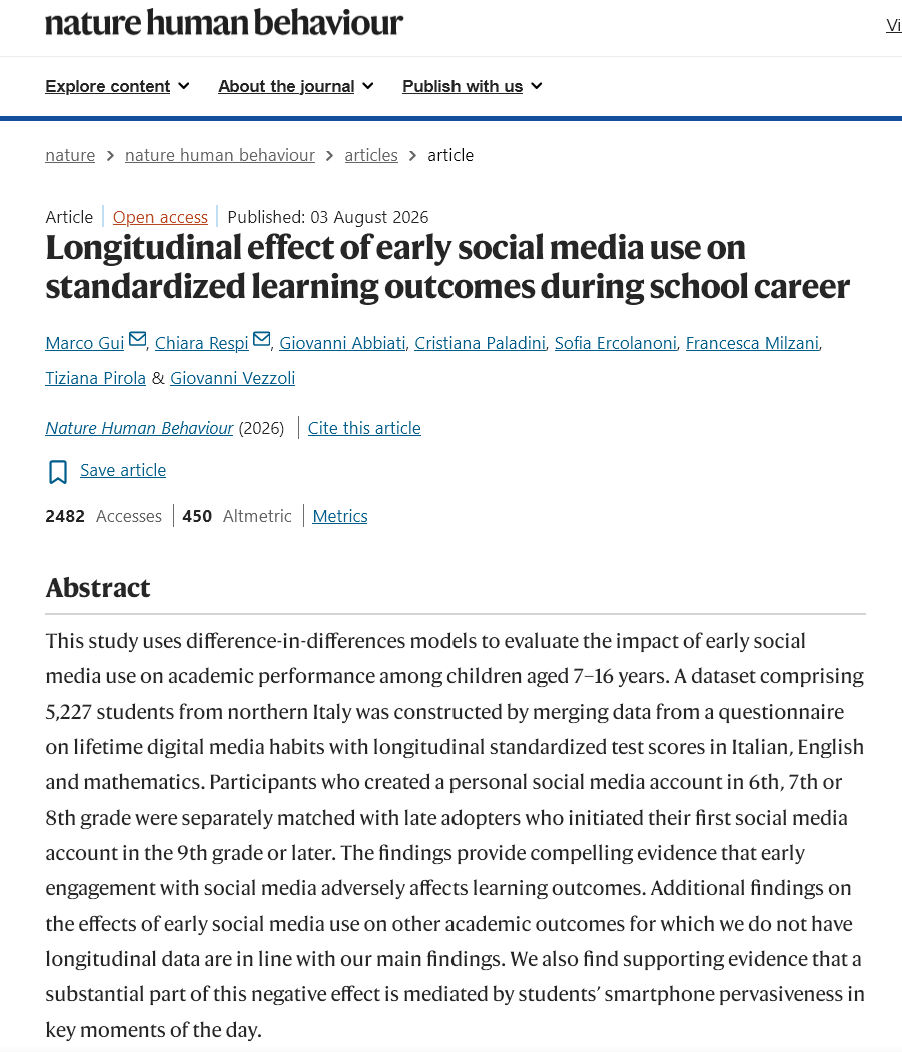
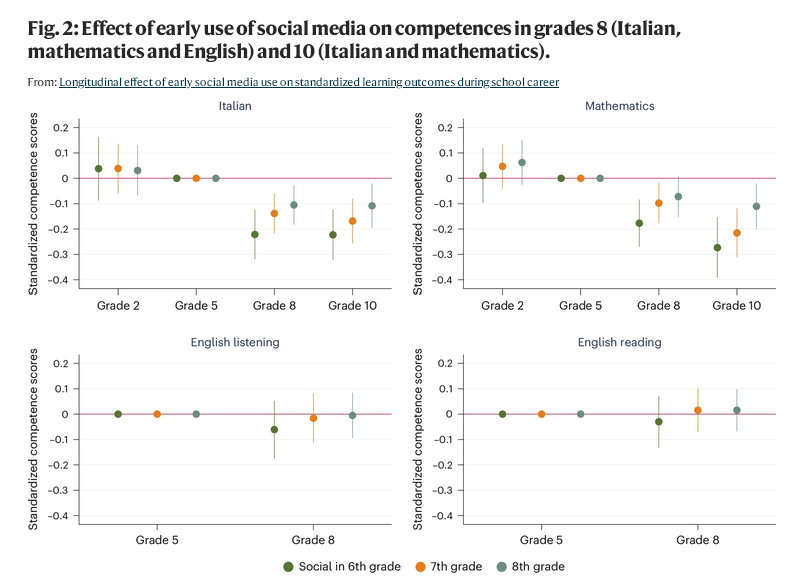
Using social media in middle school predicts lower standardized test scores in high school.
10th graders who started social media before 9th grade are ~6 months behind their peers on math & reading. They're more distracted by their phones.
No child should have access to social media.
New research reveals a negative impact of social media on academic performance.
Early social media use among teens has a significant negative effect on competence scores in both Italian and mathematics. And the earlier the social media account was created, the more pronounced the negative effect.
This provide clear evidence in favor of delaying access to social media for teens.
https://t.co/Xwfarxd8r0
Dealing with difficult people may be hazardous to your health.
Data: Each additional "hassler" in your network predicts 1.5% faster biological aging—and worse health a year later. Non-spouse family hasslers are the most problematic.
Some ties aren't worth the toll they take.
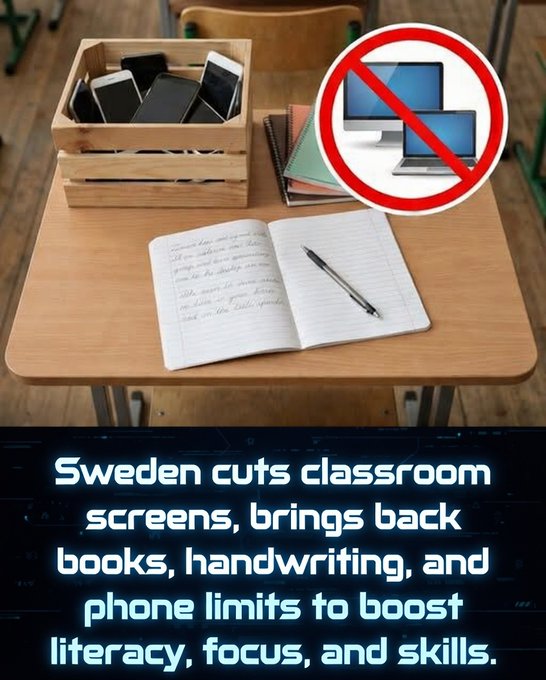
Sweden is committing more than €100 million to a sweeping classroom overhaul: replacing tablets and screens with traditional printed textbooks to help reverse falling student performance and sharpen focus.
After more than a decade of embracing digital-first education, Swedish authorities are now pivoting back to paper-based learning. Official data and recent studies cited by the Ministry of Education show that prolonged screen use in class has been linked to shorter attention spans, weaker reading comprehension, and reduced critical-thinking abilities.
Research consistently finds that reading on illuminated screens requires greater mental effort and invites more distractions compared to the calm, linear experience of physical books—factors believed to have contributed to declining academic outcomes in recent years.
Under the new plan, every student will receive printed textbooks for all core subjects, restoring books as the central learning tool. Digital devices and online resources will remain available as supportive tools, but they will no longer dominate daily instruction.
This bold €100+ million investment signals Sweden’s leadership in rethinking the role of technology in education. It underscores a broader, growing recognition worldwide: while screens provide speed and access, the hands-on, distraction-free engagement of physical books supports deeper concentration, stronger memory retention, and more effective long-term learning.
By choosing paper over pixels, Sweden is charting a path toward a more balanced, evidence-informed classroom future—one that puts proven pedagogical principles ahead of unchecked digital trends.
How have humans reshaped the world’s land over the last 12,000 years?
Over thousands of years, humans have gradually transformed the Earth’s surface — clearing land for agriculture (crops and grazing animals) and building settlements.
For most of that history, agriculture used little land from a global perspective. Today, cropland and grazing land together cover around 4.8 billion hectares — almost half of the world’s habitable land. Built-up area is comparatively tiny, at 86 million hectares. You can see this in the chart.
This insight comes from the History Database of the Global Environment (HYDE), the primary window we have into humanity’s land use and population over the very long run.
It’s built and maintained by researchers in the Netherlands, at the government’s Environmental Assessment Agency (PBL) and Utrecht University. The dataset covers 213 countries and regions and reaches back to 10,000 BCE.
Because it stretches so far into the past, its earliest figures are necessarily modeled reconstructions rather than direct measurements, so the uncertainty grows the further back in time you look.
Our colleague @lucasrodesg recently updated our charts with the latest release, HYDE 3.5, which extends the data to 2025.
We have a new Economic Inequality topic page—
Public attention to economic inequality has grown a lot over the last twenty years. At the same time, the available data has greatly improved too: it now covers many more countries and longer time periods, and is more comparable and accessible than ever.
But the wide range of sources and metrics can be hard to navigate. Each has its own strengths and weaknesses, and they cover many different definitions of inequality.
We’ve just published a new topic page on economic inequality to help make the data easier to understand.
It covers three key international datasets, each offering a different perspective: the World Inequality Database, the Luxembourg Income Study, and the World Bank’s Poverty and Inequality Platform.
The World Bank data, for example, is a crucial source that allows us to compare income inequalities both within and between countries around the world.
In the chart we show this for a selection of countries. We see that in the United States, there’s a 7-fold gap between the incomes of the poorest and the richest 10%. But even the poorest 10% in the US live on much more than the "rich" in a poor country like Madagascar.
In 1950:
SC list had 607 castes, today it has ~1200
ST list had 241 tribes, today it has 744
So where these castes are coming from?
If even after 70+ yrs, not a single caste has been uplifted via reservation, that itself shows "Reservation is a failed policy".
#EndReservation
As the buzz around the Jantar Mantar protest dies down, Madhya Pradesh is back in the news.
SDM Ram Niwas of Panna district ordered two mobile covers worth ₹120 from Flipkart.
When the delivery boy arrived with the sealed package, the SDM opened it and found only one mobile cover instead of two. Rather than raising a complaint with Flipkart, he allegedly abused the delivery boy and demanded an immediate refund.
The delivery boy dared to tell His Lordship that that's not how e-commerce works. He explained that the parcel was sealed, that it was likely a packing or logistics error, and that the proper course was to raise a complaint with Flipkart, which would handle the resolution through its return process.
His Lordship took offense at being told how the process worked. He allegedly called the police, and the delivery boy was reportedly arrested under Section 151 of the BNSS.
(Source: Aaj Tak)
If you're talking about "fair education system," start with Reservation.
It is one of the biggest issues affecting hardworking students.
Hats off to Harsh Dubey. We need more such voices at student protests.
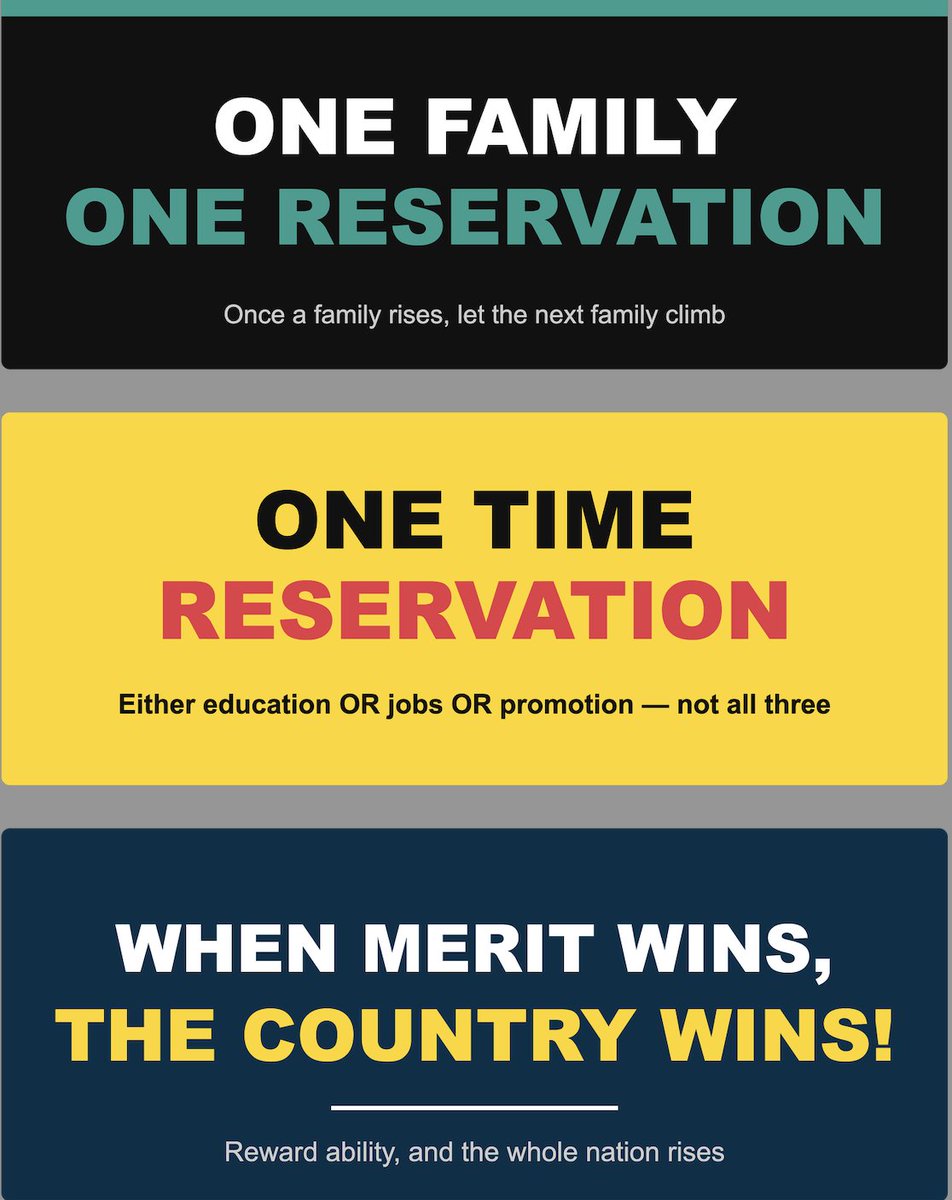
General Category attending tomorrow's student protests- use these banners.
Reservation is one of the biggest issues affecting your future. Raise your voice.
Talk to the media. Share photos & videos on social media. Tag me- I will amplify them.
This is your moment. Use it.
This is probably the clearest example of an actual academic collapse.
Weiss entered MIT in 1950, initially studied electrical engineering and then transferred to physics. During his third year, a painful romantic breakup overwhelmed him.
In his own Nobel autobiography, he states plainly;
“I failed all my courses at MIT and had to leave as a student.”
He was no longer progressing toward a degree. He returned to MIT not as a student but as an hourly electronics technician in Jerrold Zacharias’s atomic-beam laboratory. He punched a time clock and worked alongside machinists and laboratory technicians.
That apparent demotion became his real education. Weiss learned machining, sheet-metal work, soldering, welding, electronic design and the improvisational craft of experimental physics.
Instead of merely solving prepared textbook problems, he helped graduate students construct the instruments required for their research and worked on an early caesium atomic clock. With Zacharias’s support, he eventually completed his undergraduate degree and entered graduate school.
Decades later, Weiss became the central experimental architect behind laser-interferometric gravitational-wave detection.
He shared the 2017 Nobel Prize in Physics with Kip Thorne and Barry Barish for decisive contributions to LIGO and the observation of gravitational waves.
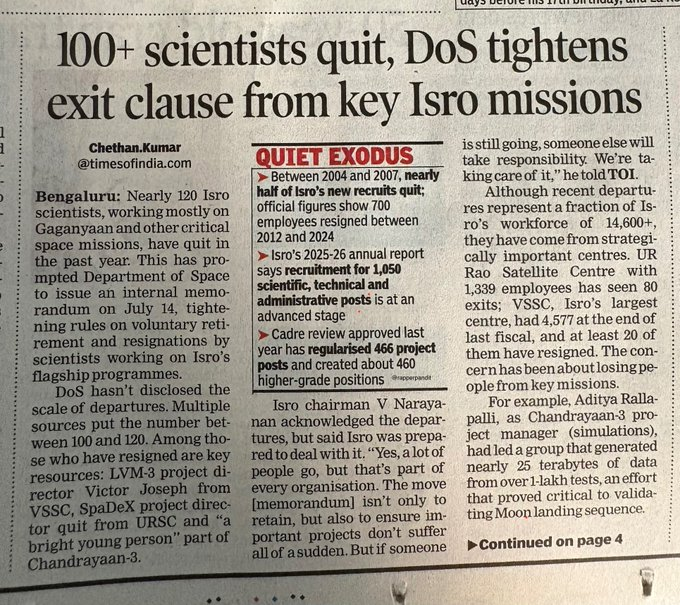
India opened space to private companies in 2020, Government promoted startups, gave them access to ISRO infrastructure, transferred SSLV rocket technology to HAL
Private space companies went from 11 in 2019 to over 400 by 2024, Space startup funding crossed 147 million dollars in FY2025-26 alone. Now same government issues memo saying scientists cannot resign from Gaganyaan till mission is done.
You created competing market, funded it, celebrated it Then try to trap people from joining it, Fix is not restriction, Fix is better pay.
Meanwhile around 120 scientists working on key missions walked out in past year. ISRO has 1,050 vacant scientific positions it cannot fill fast enough.
When people who held deep mission specific knowledge leave and replacements do not come in at same rate, missions start failing
ISRO pays entry level scientist about 72,000 rupees per month in hand. Senior scientist with 20 years maxes around 2 lakh with all allowances. Aditya Rallapalli ran simulation team that generated 25 terabytes of data validating Chandrayaan 3 moon landing, He quit.
Skyroot founders who left ISRO in 2018 hold combined 2,440 crore in billion dollar company. Startup employees with stock options can earn more in one IPO or buyout than ISRO pays over full career.
Cadre review added 460 posts, Changes nothing when private pay runs multiples higher.
Honest feedback for the GoI to consider, offered as a well-wisher:
1. E20 is a massive issue. Just because people aren't protesting in the streets doesn't mean it isn't. There is a simmering anger everywhere.
2. The root cause of this mess is singular: someone decided it was acceptable to ignore the National Policy on Biofuels 2018's plan to introduce E20 in 2030, which would have allowed older, non-compliant vehicles to phase out naturally. Instead, E20 was rolled out despite the fact that most vehicles on the road are not calibrated to run on it.
3. There is no "lobby" behind this public frustration. If the govt believes there is, they should expose the nexus and let citizens decide for themselves. Otherwise, ministers and spokespersons are only making things worse by using "lobbies" and "deep states" as defensive arguments.
4. Vehicle performance is suffering. Drivers are experiencing a drop in mileage and damage to parts. After months of denial, even Nitin Gadkari and Hardeep Puri have acknowledged "some issues" with Ethanol.
5. If the goal is true energy security, the focus and push must shift toward EVs, alongside exploring nuclear energy as a primary power source. The govt should encourage and incentivize EV adoption through subsidies and a robust infrastructure network. Ethanol, in the way it is currently being implemented, is doing more harm than good.
6. The solution is to provide a choice between E0 and E20. If the current fuel infrastructure cannot support both, E20 should be rolled back to E10 until 2030. This will allow older cars and bikes to be phased out naturally before moving forward. And also, do not introduce E27 or whatever is next till the new fleet is E27 compliant and all E20 cars are phased out, unless there is an infrastructure in place to dispense both in future.
@Nithin0dha Neither the South nor the North is economically uniform. While declining fertility is driven by the second demographic transition, the timeline varies wildly: this shift is just emerging in Bihar and UP, but it began as early as the 1970s in Eastern and Southern India.