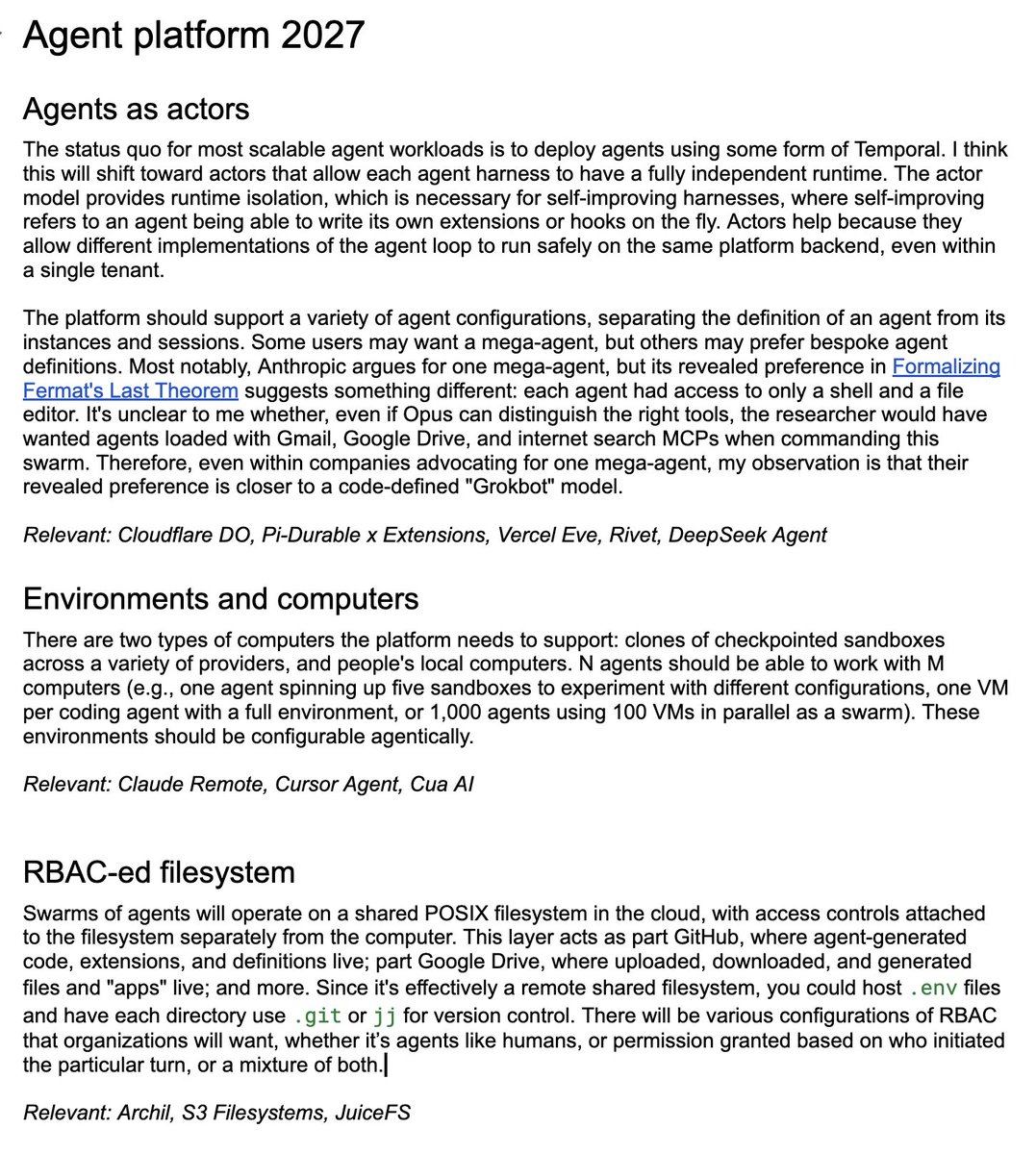
Best thing I've read on where this is going. I agree with most of the parts: the inbox, splitting the session from the conversation, N agents on M computers, workflows as code.
I disagree with the shape. You describe one company owning the one application layer, with everything else as its database. That's Windows. I think this layer ends up like Linux.
The reason is logins. The platform you describe holds your files, your .env, your event streams and your approvals. No company should hold all of that for every business, and the ones that matter won't hand it over.
So the base of the garden can't be a product. It has to be a small open kernel: records you already own, and drivers that start, wake and stop agents wherever you already run them, without ever touching a login. Everything else, the inbox, the apps, the filesystem, plugs in and competes.
You're right that code hosts are a bad home for non-code work. That part should plug in too.
That's what I'm building with @openwiz. Fully open source.
Agent platform of 2027.
This is the end game. This is the blueprint for the one and only application layer software that will exist. Every other software will effectively become databases for this layer, the everything agentic operating system for the million agent swarm to work on top of.
This is obviously the end game vision for the application layer of ChatGPT and Claude. I have reasons to believe that an independent company will own this product layer. But most ADE, "enterprise agent platform", or vertical saas companies, are focused on the wrong things far too narrowly, not technically competent, and do not have the product / technical vision to see this inevitable future.
The correct agent platform that wins will function like the base of a garden, from which customers will plant their unique "seeds" to grow their own plants and trees, managed and evolved by agents, humans, and signals from the sensors of the business. This presents a clearer picture than "factory of a factory" imo.
Congrats on shipping. Someone in the thread asked how agents avoid stepping on each other. Our answer in OpenWiz: one agent per ticket, each on its own branch, and a second model reviews every PR before it merges. Git handles the conflicts, not a connector list.
This is the right goal, and it's why we don't ship connectors. In OpenWiz the team's agents write that Linear button themselves as a PR, a second model reviews it, and it merges into your repo. Your software, your repo, no platform in the middle.
Corespeed is trying to charge users to allow them to run the inference and compute they already pay for. That is wrong.
Congrats on shipping. Someone in the thread asked how agents avoid stepping on each other. Our answer in OpenWiz: one agent per ticket, each on its own branch, and a second model reviews every PR before it merges. Git handles the conflicts, not a connector list.
This is the right goal, and it's why we don't ship connectors. In OpenWiz the team's agents write that Linear button themselves as a PR, a second model reviews it, and it merges into your repo. Your software, your repo, no platform in the middle.
@_aj@agentrunai There are 2 ways to build the open agent layer. One: a platform you run, with a store for every agent run. Two: a kernel that runs nothing, with records somewhere you already own and drivers for wherever your agents already live. I’d bet on the kernel. Love the OSS tho
@alexandr_wang "Plumbing" is doing a lot of work in this essay. If intelligence is solved, whoever owns the pipes between agents and the real world decides how much agency people keep. I think those pipes have to be open and owned by no one.
https://t.co/BnQqf6aRq5
The line that matters here isn't about math. It's that we shouldn't accept a "handover".
Agency doesn't come from a promise. It comes from architecture: you approve, agents do the work, on your machines, with your logins, in the open.
If the remaining gap is plumbing, the plumbing can't belong to one company. That's why @openwiz is open source and never touches a login.
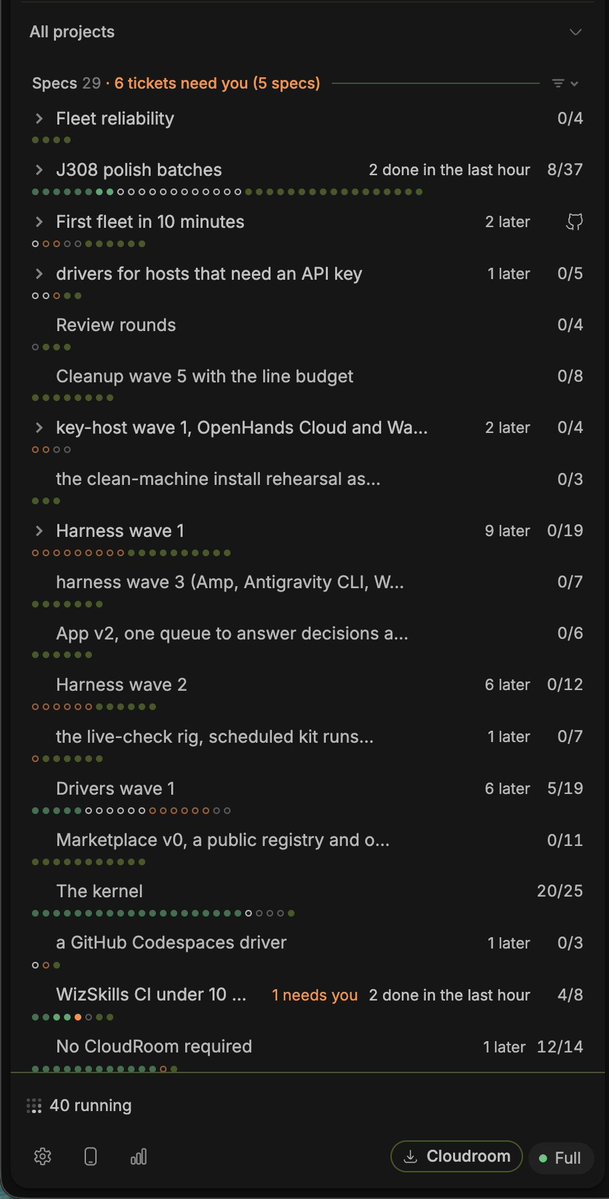
@saadmoldy This is the WizBar from https://t.co/wXaTp8TwCL. I dont use agent threads anymore, I orchestrate fleets of agents and look at how far their plans are
Best thing I've read on where this is going. I agree with most of the parts: the inbox, splitting the session from the conversation, N agents on M computers, workflows as code.
I disagree with the shape. You describe one company owning the one application layer, with everything else as its database. That's Windows. I think this layer ends up like Linux.
The reason is logins. The platform you describe holds your files, your .env, your event streams and your approvals. No company should hold all of that for every business, and the ones that matter won't hand it over.
So the base of the garden can't be a product. It has to be a small open kernel: records you already own, and drivers that start, wake and stop agents wherever you already run them, without ever touching a login. Everything else, the inbox, the apps, the filesystem, plugs in and competes.
You're right that code hosts are a bad home for non-code work. That part should plug in too.
That's what I'm building with @openwiz. Fully open source.
Agent platform of 2027.
This is the end game. This is the blueprint for the one and only application layer software that will exist. Every other software will effectively become databases for this layer, the everything agentic operating system for the million agent swarm to work on top of.
This is obviously the end game vision for the application layer of ChatGPT and Claude. I have reasons to believe that an independent company will own this product layer. But most ADE, "enterprise agent platform", or vertical saas companies, are focused on the wrong things far too narrowly, not technically competent, and do not have the product / technical vision to see this inevitable future.
The correct agent platform that wins will function like the base of a garden, from which customers will plant their unique "seeds" to grow their own plants and trees, managed and evolved by agents, humans, and signals from the sensors of the business. This presents a clearer picture than "factory of a factory" imo.