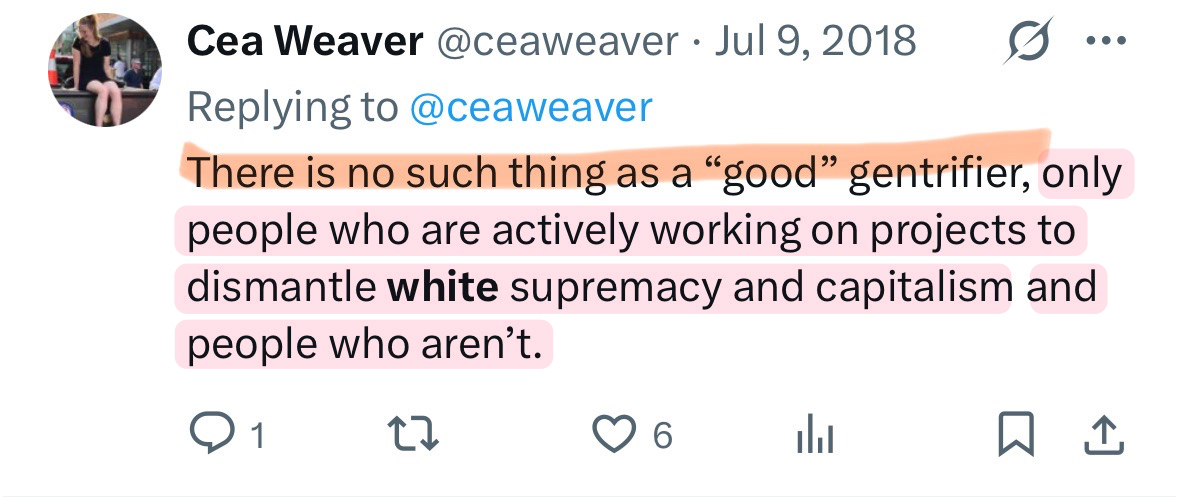
A few months ago, I dug into Cea Weaver's Twitter history because she was Mamdani's housing advisor.
I had a hunch she might get a position on his team.
Well, she did, and she deleted her X account, accordingly.
However, I took some screenshots. Let's dig in.
17 billion medical transactions in the United States every year.
14 billion lab tests.
1.8 billion physician consultations.
100 million outpatient surgeries.
Zero marketplace.
You can compare flight prices in 30 seconds.
You cannot compare MRI prices in the same city.
Everyone keeps framing healthcare transparency as cost containment.
Wrong frame.
The opportunity is market creation.
@TBYR@Cobratate@TateTheTalisman Gross. Are you hoping he talks about how to make women cry by beating them again? These dudes are as far away from republican values as you can get. Why you would validate them is a mystery.
Yes, we are a nation of laws. But we have *too many* laws, and most of them were never passed by Congress but were instead enacted as federal “rules” by unelected bureaucrats. Dismantling that bureaucracy shouldn’t be a partisan issue. In fact, it should be *the most unifying issue* in America, as the following case study reveals:
In 1938, FDR signed a bill creating the Civil Aeronautics Board (CAB), an “independent agency” that crushed the life out of the airline industry. If you wanted to start up a new airline, you needed a permission slip from the CAB. The board also decided how much you could charge for a ticket & what routes you were allowed to fly. In 40 years of the CAB’s existence, not a single new airline opened for business. It was a textbook example of regulatory capture crowding out the competition.
Republican President Gerald Ford got the ball rolling in 1975 when he proposed reducing the CAB's power. Other key players in the anti-CAB movement were Democratic Sen. Ted Kennedy, Senate staffer (and future SCOTUS justice) Stephen Breyer, and Jimmy Carter (who replaced Ford in the White House).
In 1978, the bill abolishing the CAB passed the House 363-8 and passed the Senate 82-4.
Supreme Court Justice Neil Gorsuch explains what happened next in his new book, “Over Ruled: The Human Toll of Too Much Law”:
“[B]etween 1978 and 2011, base ticket prices dropped by almost 40 percent in inflation-adjusted terms. As a result, millions of people flocked to the skies for the first time. An activity that had once belonged largely to elites became one that many Americans take more or less for granted.”
Ronald Reagan said that federal agencies were “the nearest thing to eternal life we'll ever see on this earth.” But that’s only true if we let it be true. Prosperity is unifying, and the path back to it requires shutting down the regulatory state.
Last year, the FCC upheld its 2022 decision to deny SpaceX's @Starlink an $885 million subsidy to bring broadband to 642,000 Americans living in rural areas. FCC Chair Jessica Rosenworcel didn't think Starlink could deliver the promised service.
Today, Starlink is connecting over 7,700 new customers per day, FEMA is sending Starlink terminals to help victims in North Carolina due to Hurricane Helene, and the world's largest airlines are signing contracts to outfit their entire fleets with it. It has proven to be a reliable and fast service for millions of users.
The FCC had program requirements that Starlink didn't have to meet until 2025, yet the FCC Chair was unfairly making a prediction about whether Starlink would meet them or not years before the deadline. Starlink needed to show that it was more likely than not that it could provide high-speed Internet service (low-latency, 100/20 Mbps service) to at least 40% of the 642,000 rural premises by Dec 31, 2025. Starlink did that.
So why revoke that $885M award? It doesn't make any sense.
FCC Chair Rosenworcel suggested Starlink is not a trustworthy technology. If that were true, why are other parts of the U.S. government entering into large contracts with @SpaceX for Starlink service?
The FCC should reverse its decision, because if the government tries to connect these 642,000 people using fiber, it will cost 10 times more and take years longer. SpaceX's Starlink terminal production is ramping up so fast that they will be the largest printed circuit board manufacturer in the Americas within a few months. The biggest loser in all of this are those 642k people that could have fast internet much sooner.
(Left is SpaceX's Starlink terminal production facility in Texas. Right is FCC Chair Rosenworcel's decision letter).
These photos showcase some of the intricately created birds' nests found in the Natural History Museum in Tring, UK, home to one of the world's largest ornithological collections. https://t.co/SVbL0jiZpW
@matt_gray_ Curious to know how you think their citizens lack of basic freedoms and the Saudi’s human rights atrocities factor into the equation. I’m not sure how that did not come into play during your analysis.