Grateful for @Cornell_Tech’s new article on IMPRINT!
@BeckBrachman was a fellow in Cornell Tech’s Runway Program, which supplied crucial support for the earliest stages of IMPRINT’s development. The Runway program is a NYC-based deep-tech incubator and provides substantial funding and resources to scientist-founders.
IMPRINT’s work is also made possible by a grant from the @NYCEDC’s Expansion Fund, an initiative of LifeSci NYC, which aims to establish NYC as an innovative global leader in the life sciences.
Thank you to @gracealastanley for the article, and thanks of course to Cornell Tech, @FerGomezBaquero, and NYCEDC!
https://t.co/qXFE2vKtcW
🎉 Excited to be welcoming our sibling FRO @IMPRINTlabs today! Their mission is to create scalable, cost-efficient forensic immunology research tools.
➡️ Learn more about FROs and how @Convergent_FROs accelerates scientific progress here: https://t.co/YQmzuijsBh
🧵 Today, IMPRINT, a pioneering new nonprofit initiative, is announcing $15 million in philanthropic funding to advance our work to decode the body's immune memory and uncover the causes of chronic diseases.
https://t.co/oVFhaCjZAR
With teams in Europe and North America, we are building experimental and machine learning tools to identify the hidden causes of and cures for chronic diseases that affect hundreds of millions of people worldwide.
The immune system is not just an army — it’s also an archive. IMPRINT aims to decode that archive using an innovative forensic immunology approach, enabling new diagnostics, treatments, and cures for conditions ranging from autoimmune disorders to mental illness.
#Immunology #Biotech #Biotechresearch
🚨Looking for a job in immunology and biotech research? IMPRINT is #hiring! Join us to help revolutionize how we decode the body’s immune memory, uncover the causes of chronic diseases, and drive breakthroughs in autoimmunity and neuropsychiatric research.
IMPRINT is seeking passionate individuals for the following roles:
🔹Experimental Director (NYC)
🔹Scientist, Molecular Biology & Immunology (NYC)
🔹Computational Immunologist / Machine Learning Scientist / Biostatistician (ideally based in Germany, but open to outstanding candidates across the EU, Canada, and the US)
✨ Full role descriptions here: https://t.co/HH9EKCIoXY
@Convergent_FROs #hiring #BiotechJobs #ScientificResearch #Immunology #HiringNow #nycjobs #sciencejobs #FRO
Massive effort by @kerry_mullan to recontextualize
data is now out in Science Advances! We developed a new system STEGO to do a TCR-first analysis, and reanalyzed 12 studies and more than 500 000 individual T-cells. Supported by @cziscience@ELIXIRnodeBE
https://t.co/KvGNC6GyNF
At least 143 people in DR Congo have died from an unidentified illness, according to local officials.
Victims reported flu-like symptoms, including high fever, severe headaches, cough and anaemia.
Samples are being taken to identify the illness.
We have an open 2-year postdoc position focusing on computational approaches to identify antigen-specific immune receptors from adaptive immune repertoire data. Application deadline: Nov 6. https://t.co/cyIvlclfeU
Happy to share our latest work by @YYexin et al. on antibody-mediated control of endogenous retroviruses in mice. In the process, we found “natural antibodies” with broad reactivity against enveloped viruses. Here is how “panviral” antibodies work 🧵(1/)
https://t.co/kU8NBK5KF9
Our paper on the linguistics-based formalization of antibody language is out in @NatComputSci. Work led by @MaiSpaceHa Rahmad Akbar and @PRobertImmodels . Summary thread: https://t.co/5QGruT3T2o.
.@NEJM paper: H5N1 bird flu virus can survive pasteurization
The more virus there is in milk, the longer/hotter pasteurization needs to be to kill all the virus.
We don't know what % of dairy cows have no/minimal symptoms from bird flu & whose milk is entering the milk supply.
Imagine growing a miniature version of the human intestine in the lab to study gut biology in great detail and test medicines before clinical trials? We are happy to share our latest publication on bioengineered human mini-intestines: https://t.co/0AvDkk9R3S Let’s dive in!
Have you ever wondered why there are so many subtypes of immune cells? In our work published today at @Nature, we offer one possible reason – the capacity to evolve. 1/n https://t.co/oSFlSRhv59
#snakemake 8.14 has been released. It supports setting the shell to use per rule if needed (e.g. if your analysis step runs in a container that does not have bash shell).
#sciworkflows#reproducibility
https://t.co/WwE4GKpZow
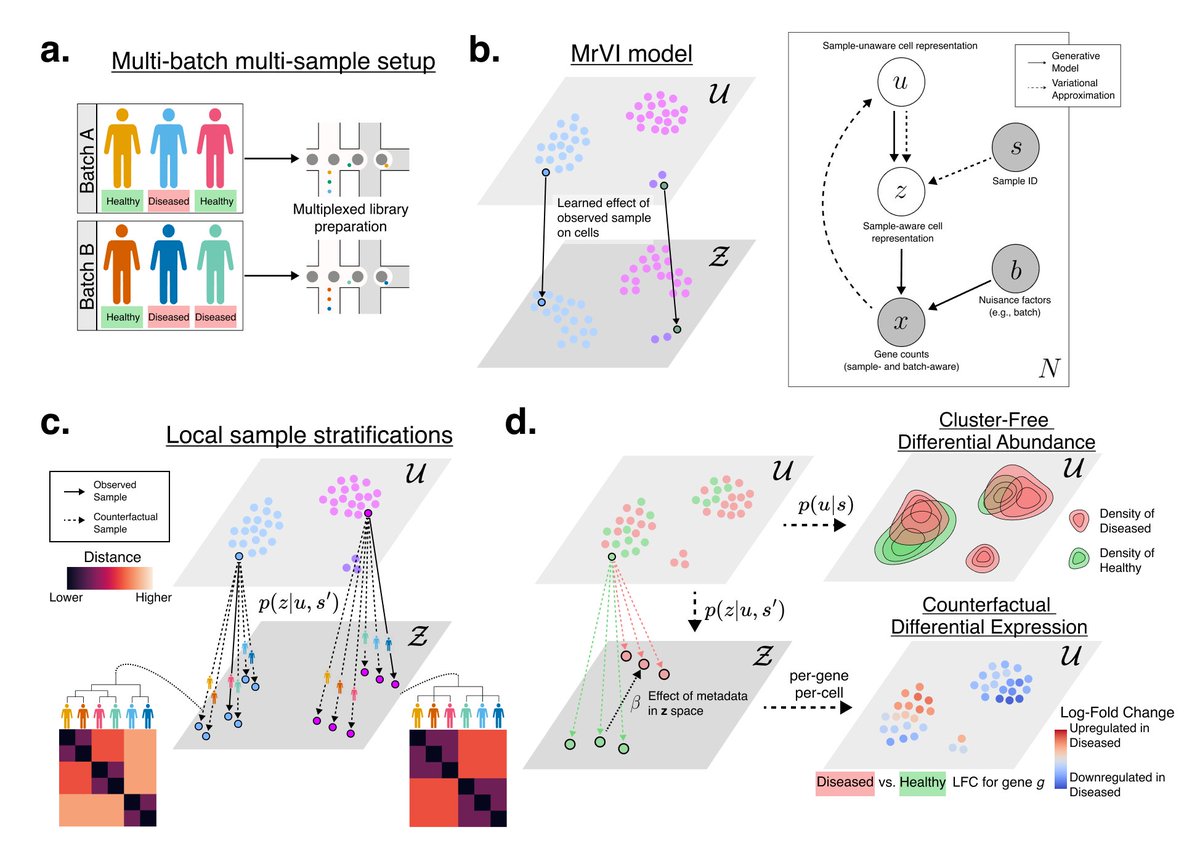
How can we better reveal cellular 🦠and sample🧍variation from large-scale scRNA-seq studies? We have released a new and improved deep generative model, #MrVI, in scvi-tools and on bioRxiv, accompanied by real-world use cases. A thread... 🧵1/
https://t.co/l1ArpNVHWV
Exciting News! Registrations for the #scverse2024 Conference at the Technical University of Munich, Sep 10-12, 2024 are OPEN! 🎉Join us to advance methods for single-cell omics research.
👉 Register now: https://t.co/IkJbvcEQCR
Follow us for more on Zulip: https://t.co/jOT8LwnY9k
Papers from our Space Omics and Medical Atlas (SOMA) package, built upon the extraordinary data from the @inspiration4x mission with @SpaceX are now coming online. With more civilian crews going to space, this is truly the opening of the Second Space Age: https://t.co/qkvBmTcaZv
The Space Omics and Medical Atlas (SOMA) package, published across Nature Portfolio journals, provides insights into how spaceflight affects human biology. It represents the largest compendium of data for aerospace medicine and space biology to date. https://t.co/CEGiszNJuw