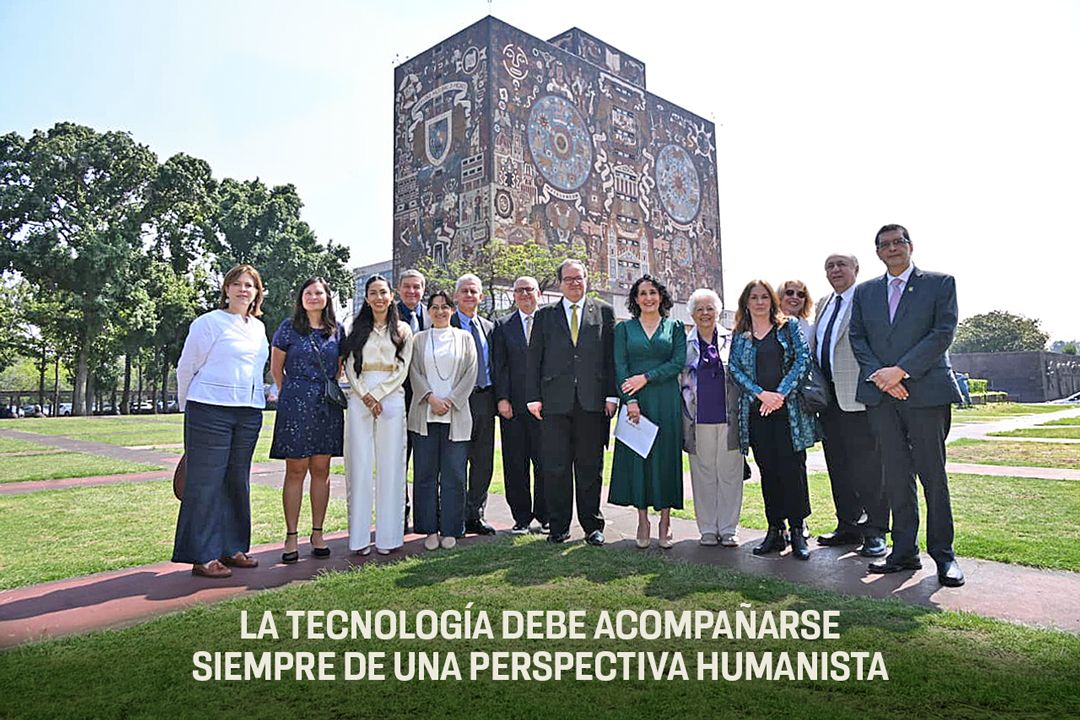
La UNAM no sólo debe acompañar el avance de la inteligencia artificial, sino conducir su evolución y su uso conforme a los principios universitarios, con innovación pedagógica, trabajo colegiado y criterios compartidos que fortalezcan la enseñanza y el aprendizaje, afirmó el #RectorLomelí durante la instalación del Consejo Coordinador de Inteligencia Artificial.
@Secihti_Mx@CCOIAUNAM@Proyectos_UNAM
The AI Scientist: Towards Fully Automated AI Research, Now Published in Nature
Nature: https://t.co/nNfpSV5e5I
Blog: https://t.co/i6h8LVQOdl
When we first introduced The AI Scientist, we shared an ambitious vision of an agent powered by foundation models capable of executing the entire machine learning research lifecycle.
From inventing ideas and writing code to executing experiments and drafting the manuscript, the system demonstrated that end-to-end automation of the scientific process is possible.
Soon after, we shared a historic update: the improved AI Scientist-v2 produced the first fully AI-generated paper to pass a rigorous human peer-review process.
Today, we are happy to announce that “The AI Scientist: Towards Fully Automated AI Research,” our paper describing all of this work, along with fresh new insights, has been published in @Nature!
This Nature publication consolidates these milestones and details the underlying foundation model orchestration. It also introduces our Automated Reviewer, which matches human review judgments and actually exceeds standard inter-human agreement.
Crucially, by using this reviewer to grade papers generated by different foundation models, we discovered a clear scaling law of science. As the underlying foundation models improve, the quality of the generated scientific papers increases correspondingly. This implies that as compute costs decrease and model capabilities continue to exponentially increase, future versions of The AI Scientist will be substantially more capable.
Building upon our previous open-source releases (https://t.co/H1tBT14Yx8), this open-access Nature publication comprehensively details our system's architecture, outlines several new scaling results, and discusses the promise and challenges of AI-generated science.
This substantial milestone is the result of a close and fruitful collaboration between researchers at Sakana AI, the University of British Columbia (UBC) and the Vector Institute, and the University of Oxford. Congrats to the team!
@_chris_lu_@cong_ml@RobertTLange@_yutaroyamada@shengranhu@j_foerst@hardmaru@jeffclune
GPT-5.2 derived a new result in theoretical physics.
We’re releasing the result in a preprint with researchers from @the_IAS, @VanderbiltU, @Cambridge_Uni, and @Harvard. It shows that a gluon interaction many physicists expected would not occur can arise under specific conditions.
https://t.co/EAZhKWacsG
@mathelirium Einstein, already in 1905, was thinking as a Statistical Physicist, coming from the 19th century Statistical Mechanics of Boltzmann and others.
Este semestre 2026-1 daré el curso de posgrado en el @IF_UNAM sobre Redes Complejas. Iniciando el 11 agosto 2025. Reunión para fijar horario: 13 agosto 2025, 12:00 hrs, en mi oficina del @IF_UNAM en @UNAM_MX Estudiantes de @Ciencia_UNAM@fciencias@C3UNAM y oyentes, bienvenidos
@ElFinancieroTv@LKourchenko@julio_frenk Estimado @julio_frenk Aprovecho este medio para felicitarlo por su nombramiento a cargo de @UCLA Yo, como académico e investigador científico en la UNAM me enorgullece mucho. Un saludo afectuoso