I organized an intervention to stop Elon from starting SpaceX. Here is the story...
Twenty five years ago, Elon and I sat in a car on a dark stretch of Long Island highway, two neurodiverse geeks staring at the night sky and wondering what came next. We had both experienced substantial exits and felt the weight of possibility ahead of us.
When I joked about 'space' while gazing upward, neither of us imagined we were planting the seed for what would become the largest IPO in history. We spent the next two hours debating why space was so hard. In the end, rockets are fuel and metal. We also debated where to go, and it was crystal clear that Mars was the only real destination.
Upon returning to NYC, we embarked on a global tour of space, meeting space agencies and luminaries worldwide. This opened our eyes to an industry stuck in bureaucratic thinking. If things continued at that pace, it was clear that we would never explore space in our lifetime.
So, we launched Life to Mars to show the world that two ambitious young men (29 and 30 years old), could send life to Mars without any government backing or support. We planned to send and grow plants on Mars, though some were pushing us to send mice.
We had a $50 MM budget that rested on our purchase of two Russian ICBMs for $7 MM each. We assumed one ICBM would fail, and we would learn and fix everything before launching again. When Elon went back to actually buy the ICBMs, the Russians tripled the price, bringing out launch costs from a total of $14 MM to $42 MM.
Our ambitious Life to Mars plan was no longer viable.
As you might imagine, Elon was not pleased. So, he decided to start SpaceX and create his own Mars rockets. Now, this is a crazy idea, both now and at the time, so I organized a large panel of top space experts, and we ambushed him at the Georgian Hotel one morning. It was set up like an intervention for an alcoholic, but for space.
Elon looked me in the eye when leaving the room and said, "I am going to do this." The intervention failed. Elon was committed. The rest is history.
I am excited to see this IPO after 25 years of hard work. What SpaceX has done is a testament to human will and overcoming insurmountable obstacles. It's nothing short of amazing.
Congratulations, E. Amazing.
In the 1980s, the US produced 80% of global enriched uranium.
Today that number is zero -- and we rely on Russia instead!
@ScottNolan & @GeneralMatter are solving this crisis; he’s jumpstarting America's nuclear renaissance, and makes us all more bullish on its scale & speed.
A ruling this week from a federal judge in Chicago exempting national banks and payment card networks from an Illinois law barring “swipe fees” on retail taxes and tips is already putting similar measures around the country on ice. https://t.co/xcJsj0lYYN
Everyone is arguing about what AI will replace.
And forgetting it’s very good at helping you find the one thing you’re uniquely good at.
Then compressing 10,000 hours of expertise into weeks.
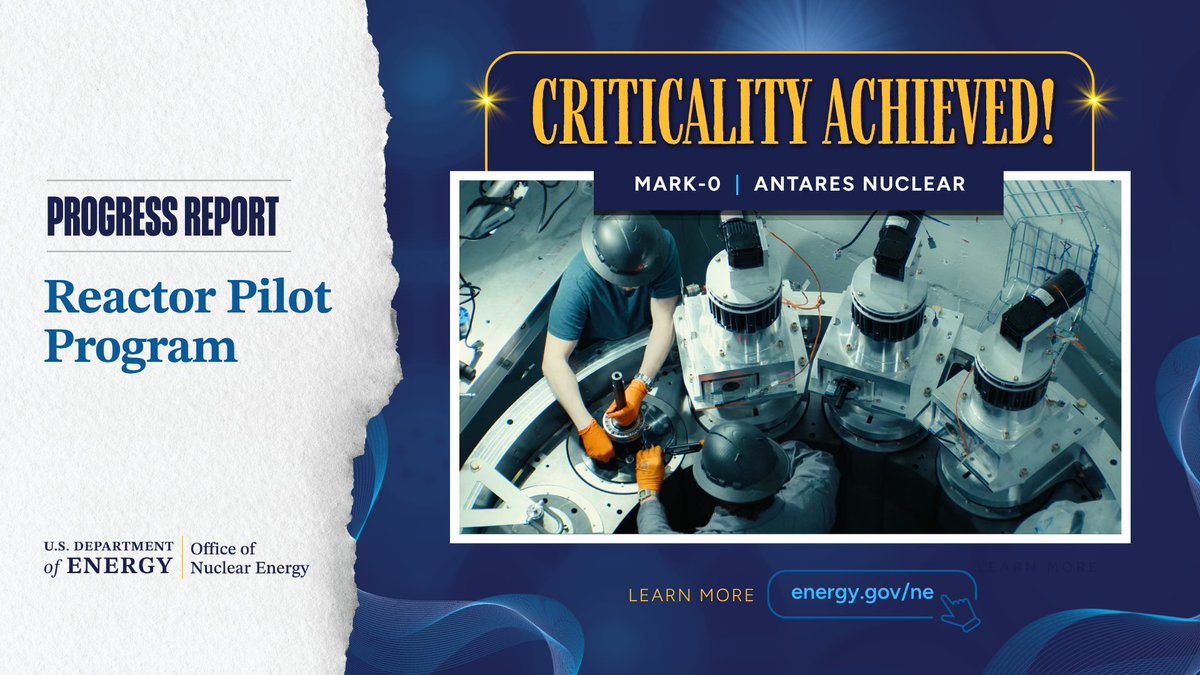
Today marks a historic moment for Antares and for nuclear energy — we reached criticality with our Mark-0 test reactor.
One year ago, President Trump issued an Executive Order directing the Department of Energy to accelerate advanced reactor testing, with a goal of bringing at least three reactors online by July 4, 2026.
We are proud to be the first team to reach this milestone, and are grateful for the support of the administration, @ENERGY and @INL in getting us here today.
America's nuclear renaissance is underway — onward!
🎉 WE HAVE CRITICALITY! 🎉
On June 4, 2026, at around 12:30 MDT, @AntaresNuclear’s Mark-0 microreactor achieved initial criticality at @INL.
It is the first nuclear test reactor to go critical under @ENERGY’s Reactor Pilot Program. Congratulations to Antares on reaching this historic milestone!
Economics of AGI episode w Alex Imas and Phil Trammell.
There's a bunch of important questions about how we deal with AI that only economics can answer.
What is the optimal way to tax and redistribute the wealth that will be generated? How should countries not in the AI supply chain index into the gains? Is there any world where inequality doesn't explode?
It might seem like these questions have obvious answers, but the first thing economics teaches you is that your intuitions can often be entirely wrong.
It was very helpful to chat through these things with Alex and Phil.
Look up Dwarkesh Podcast on Apple Podcasts, YouTube, or Spotify. Enjoy!
00:00:00 – Will capital share increase?
00:19:36 – Messy Middle scenario
00:25:57 – How to tax and redistribute AI wealth
00:30:02 – Why demand collapse is unlikely
00:39:26 – Human employees would be hard to integrate into the machine economy
00:43:08 – What if some humans (or AIs) value wealth accumulation intrinsically?
01:01:28 – What should developing countries do?
first legislative proposal to essentially make AIs into legal persons with limited liability, like corporations
watershed moment
imo it should have happened with smart contracts/blockchains as well but maybe we can learn form AI!
One of the most useful podcasts I've heard this year!
"Ashley Finan and Amy Roma on Speed, Safety, and Reforming Nuclear Energy" with Jason Bordoff on the Columbia Energy Exchange podcast from @ColumbiaUEnergy.
Amy Roma (@AmyRomaVA) and Ashley Finan (@AshleyFinan1) are two of the world's most knowledgeable and credible experts in the field of advanced nuclear energy. Between the two of them they cover legal, regulation, politics, government enablement efforts and technology development.
Their resumes speak loudly, while their confident, well-informed conversation and responses to penetrating questions provides the kind of valuable information that can spread both comfort and excitement about the prospects for nuclear energy.
They tell us how guidance from Congress and the President during the last decade or so have shaped new approaches to oversight and regulation while the important technical details have been implemented by real technical and legal experts. They explain how the last year's worth of implementation efforts for President Trump's May 23, 2025 executive orders has gone a long way towards alleviating initial concerns.
@JasonBordoff asked them a number of hard questions that indicated both open skepticism and a willingness to adjust his position with good information.
One of my favorite parts of the conversation was Amy's description of the process that redirected NRC efforts to create Part 57, the new regulatory framework for low consequence reactors – a term of art that roughly means micro reactors.
Before the NRC's 2025 mission revision, the staff was moving down a path that was involved each vendor requesting exemptions from specific rules that were initially created to apply to large light water reactors. This was a path that they had trodden before and that was considered to be adequately safe, but with no consideration for the benefits that the new technologies could provide.
Representatives of the oil and gas industry told the NRC leadership that they wanted to deploy hundreds of small, clean and safe nuclear fission generators in fleets to replace the large arrays of diesel generators used at drilling sites. The replacement would be part of their long term decarbonization efforts.
They also told the NRC leaders that the structure being proposed was unworkable. They helped the agency recognize the cost and schedule challenge of requiring each vendor to work with the regulators to devise what would amount to their own customized framework. The NRC listened to the customers/future operators and revised its approach to factory fabrication and deployment of various series of identical low consequence reactors.
Customers and vendors seem to agree that the final Part 57, still 500+ pages long, can be implemented safely, effectively and in a cost effective manner.
(I'm paraphrasing. Amy's version of the story can be heard starting at 39:30 in the show's audio file. Or you can read the comments via the show transcript that is on the page linked below.)
Now, why isn’t this simply Germany’s business? That argument would be cleaner if European courts had not repeatedly claimed the prerogative to censor the entire, worldwide internet (sometimes on grounds like, “somebody might use a VPN”). The truth is these issues of extraterritorial enforcement are still being worked out. We won’t let foreign governments compromise our First Amendment.
“But Paper, if this is true, why does $1 at Wells Fargo = $1 at Bank of America?”
This is a great question! After all, a bank deposit is just a CDP stablecoin. The quality of the backing between any two banks is not going to be exactly the same.
And in fact, banknotes (physical stablecoins) would trade at a discount if they were unfamiliar, far from a redemption point, or a bank with a shaky reputation.
You could be forgiven for assuming this was solved by the advent of deposit insurance, but it was actually a much earlier solution they led to the equilibrium we have today of all bank stablecoins being accepted at par.
Beginning in 1874, the Treasury required banks to leave treasury bills equal to 5% of their outstanding notes in the custody of the government. In exchange, the Treasury would redeem at par any bank’s notes anywhere in the country.
Ever since, banknotes and deposits have all been fungible.
Today, it’s the Federal Reserve holding all bank deposits as fungible, since they’re all treated 1:1 there.
Canada's AI strategy is coming and I argue it's set to fail, given the government’s digital self-sabotage. Bill C-22 has tech firms threatening to leave, the CRTC's streaming ruling will lead to trade retaliation, and age verification adds new AI barriers.
https://t.co/LENknFmIBt
As America approaches its 250th birthday, @BHGreeley tells the untold 500-year history of the dollar!
Brendan and @DavidBeckworth discuss why he went for a PhD after being a journalist for 20 years, why the dollar’s history goes far beyond America’s founding, when America actually achieved a currency union, the untold origins of the dollar, how Herbert and Lou Hoover’s date nights played a role in the history of the dollar, the crucial importance of Milton Friedman and Anna Schwartz in understanding the dollar’s history, the happy accident of Eurodollars, what the future of dollars looks like, and much more.
Over a trillion dollars worth of perps are traded every month, yet 99% people have never heard of them.
This @LawofCodeFM episode is a multi-hour deep dive on perps, starting from the history of grain futures in Chicago to Friday's historic @CFTC announcements. It took me months to put this together.
My goal: the internet's most comprehensive explainer on perps.
You'll hear from the world's leading experts on the legal layer of perps; @jchervinsky and @BradBourque of @HyperliquidPC, @BrettHarrison of @Architect_Fi, @kkirkbos, @_Ryne_Miller, @mdf2000 and David Shafer of @coinbase.
By the end of this episode, I promise you'll be in the top percentile for understanding perps, regardless of where you're starting from.
(You just might need to listen twice. There's a lot here.)
Timestamps:
0:00 Intro
4:04 What is a perp @BrettHarrison
7:18 Why futures contracts exist
8:15 Liquidity fragmentation
11:01 History of U.S. futures @_Ryne_Miller
17:08 Richard Nixon, the gold standard and financial futures
21:27 Birth of the CFTC
24:27 Robert Shiller's 1992 paper @kkirkbos
30:09 Price convergence
32:00 The funding rate
43:41 Oracles and manipulation risk
47:39 Are perps swaps or futures?
52:44 A @ChairmanSelig clip on perps
54:02 The DCM framework
59:16 DCMs, DCOs and FCMs explained
1:04:55 History of crypto perps (BitMEX)
1:13:00 How Hyperliquid works
1:25:41 CFTC's historic announcements on May 29, 2026
1:35:00 Fireside with @jchervinsky and @BradBourque of @HyperliquidPC
Nothing in this podcast is legal or investment advice.
Lazy and inaccurate reporting from @NYT on this policy. The EO creates a process for frontier labs to voluntarily share cutting-edge cyber models in order to secure critical infrastructure and strengthen the government’s own cyber defenses. We are NOT conducting oversight of all new models, as that level of government overreach would have chilling effects on free speech and innovation.