Call for Papers | Empirical Macro Working Group Meeting
Empirical Macroeconomics Policy Center of Texas (EMPCT) is hosting the Empirical Macro Working Group Meeting on 30 October, 2026 in Austin (TX).
See the attached CfP for more details.
The University of Oxford is advertising a Professorship of Economic History, which will be held in the Department of Economics in association with Nuffield College. Closing date 25 May 2026, interviews 26 June. https://t.co/zhBjo2pXRZ.
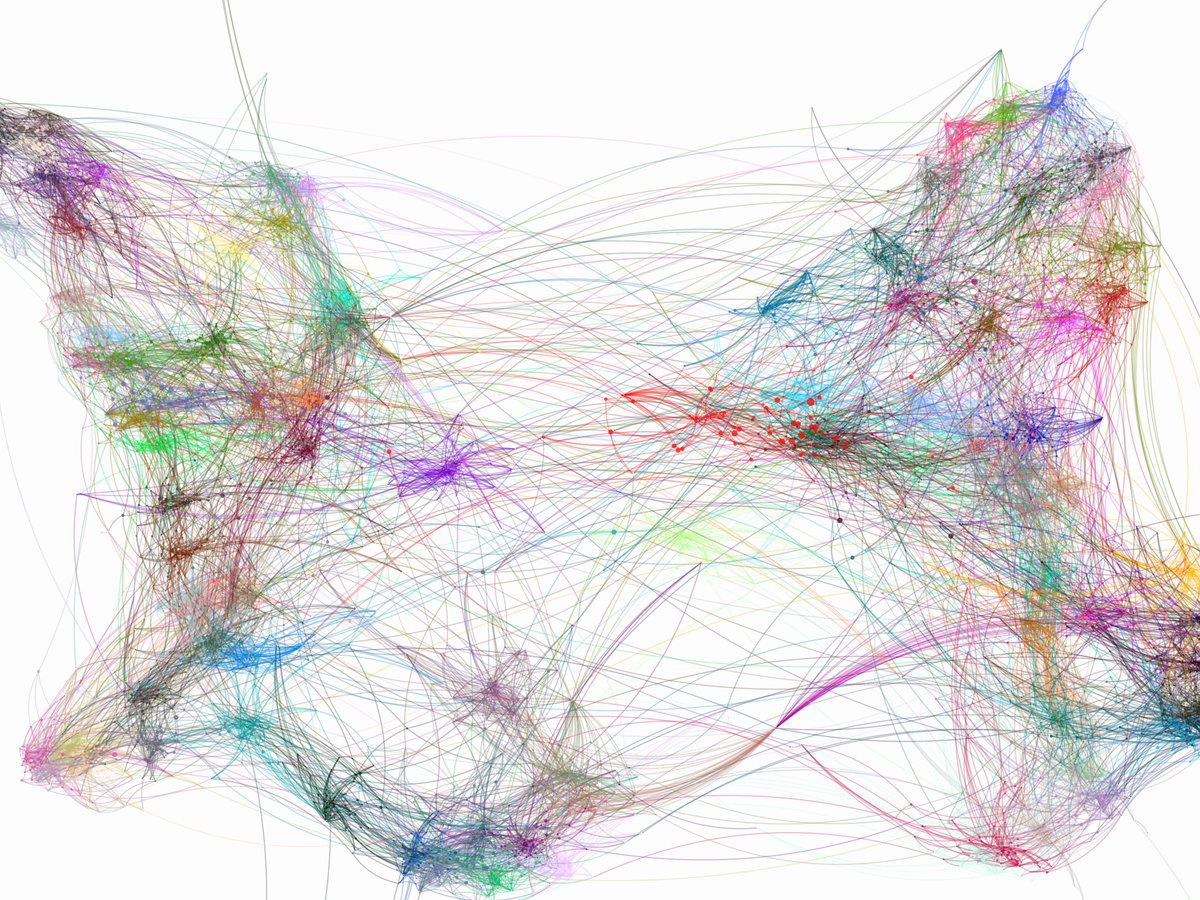
We measure spending flows between thousands of small groups of consumers and thousands of small groups of producers to study how exactly shocks propagate through an economy. It matters for understanding policy. Check it out!👇
I really want to recommend this @Macro_Musings Podcast with @JesusFerna7026 and @DavidBeckworth on a whole gamut of topics: Fertility, AI, Dollardominanz.
https://t.co/oQOD7rah5R
Highly recommended! This was a super interesting highlight in 2025.
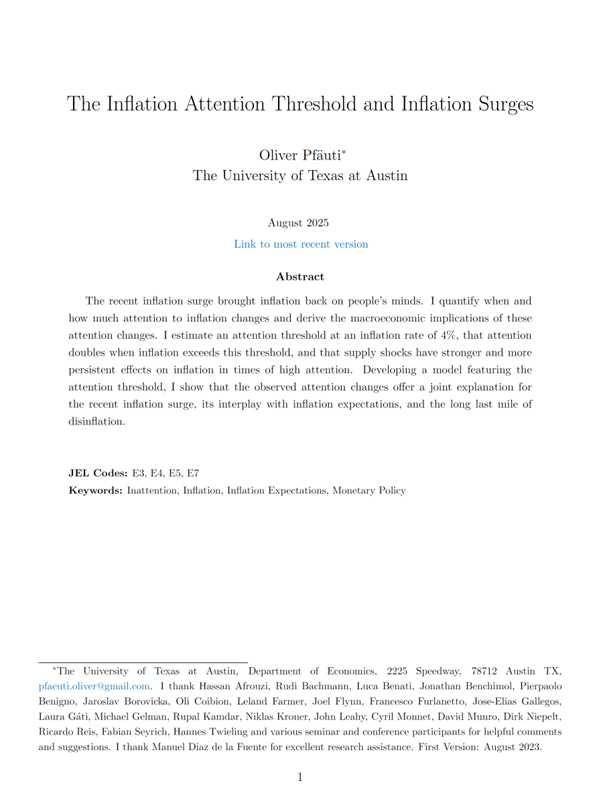
"The Inflation Attention Threshold and Inflation Surges" by Oliver Pfäuti.
"The recent inflation surge brought inflation back on people’s minds. I quantify when and how much attention to inflation changes and derive the macroeconomic implications of these attention changes. I estimate an attention threshold at an inflation rate of 4%, that attention doubles when inflation exceeds this threshold, and that supply shocks have stronger and more persistent effects on inflation in times of high attention. Developing a model featuring the attention threshold, I show that the observed attention changes offer a joint explanation for the recent inflation surge, its interplay with inflation expectations, and the long last mile of disinflation."
https://t.co/KZTfvxIDWW
Super interesting!
"How Monetary Policy Is Made: Lessons from Historical FOMC Discussions" by Cooper Howes,Marc Dordal i Carreras, Olivier Coibion, and Yuriy Gorodnichenko.
"We construct a new dataset of FOMC meeting transcripts from 1966 to 1990 to analyze the sources of heterogeneity in individual monetary policy preferences and study how this heterogeneity shapes policy decisions. Using these detailed discussions, we manually quantify and characterize each FOMC participants’ preferred policies along with their reasoning and justification. We show that participants’ beliefs about the effects of monetary policy—specifically, their perceived slope of the Phillips Curve—play a central role. Participants who believe monetary policy has stronger effects on real activity are more likely to cite output as a justification for easing, while those perceiving stronger price effects emphasize inflation as a reason for tightening. We then show that the Chair plays a unique and powerful role in reconciling these views, not just in setting policy rates, but also in minimizing dissent."
https://t.co/wHw7Wk0DU3
Rearmament today, higher taxes tomorrow. New analysis by @JohannesMarzian & @Ch_Trebesch using 150 years of data finds military spending is initially debt-financed, but tax hikes usually follow—and rarely fully roll back 👉 https://t.co/6OvIrRkxLx
🚀 Applications now open! Become part of Next-Geo, the first pan-European Junior Research Training Program focusing exclusively on Geoeconomics. We’re recruiting ~10 PhD candidates & early Postdocs in Europe for a 1-year add-on fellowship.
All details 👉https://t.co/oYGIDLBgmM
@cepr_org@OxfordEconDept@MercatorDE
Great news! I like this in particular because economic history has decisively left the ghetto -- with the Acemoglu/Robinson/Johnson price last year and this one, it's clearly recognized as an equally valid domain in which to play, not this weird subfield nobody cares about.
It is 6 months since "Liberation day" tariffs. What have US tariffs accomplished?
1. Raise revenue for government? Yes. Quite substantially. Borne almost entirely by US firms and passed on some to US consumers. So it has worked like a tax on US firms/consumers.
2. Raise inflation? Yes, by small amounts overall. More substantially for household appliances, furniture, coffee.
3. Improve trade balance? No sign yet of that.
4. Improve US manufacturing? No sign yet of that.
Overall, the score card is negative.
So, if you want me to come do a workshop at your school or location in Europe, send me an email! And fingers crossed I can get the books out by then. 6/6
There are now so many papers in the thread — 73 of them! — that it’s become entirely unmanageable. I am starting a new thread here. Please consider sharing if you find economics interesting.
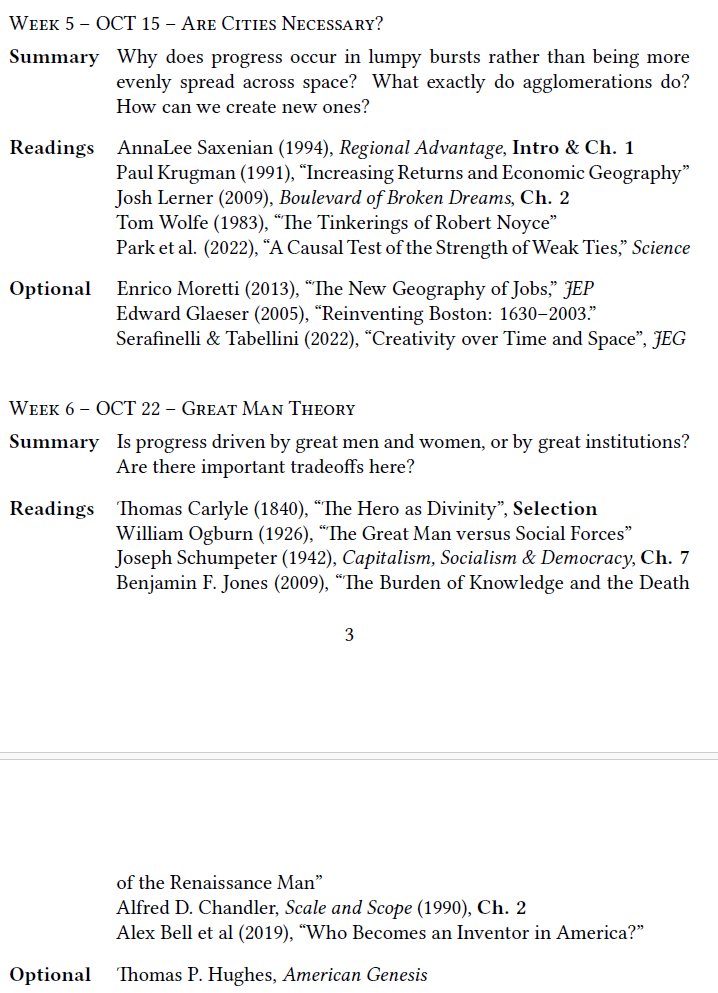
Incredibly excited for my brand new class at Toronto Rotman this fall: Progress! Econ history + theory + history of tech/thought + philosophy on why rare orgs at rare times in rare places accomplish new things. Trying to put rigor onto an idea that is very much in the air. 1/3
📢 Internship opportunity in our Berlin office:
Join our Macroeconomics Research Center as a research intern on the Jordà–Schularick–Taylor Macrohistory Database project.
Apply by September 10, 2025 - start asap ➡️ https://t.co/YOYBTW9HA2
@MSchularick
@jayvanbavel This looks like we are more and more approaching a hypersensitive, anxious but opinionated (and possibly passive-aggressive or polarized) society