Cog neuroscientist @MPI_CBS @doellerlab; (laminar) fMRI; exploring vis cognition in the lab, and creative problem-solving & neuromotor interactions in the wild
@layerfMRI was faster than me 😅 so retweeting his post now.
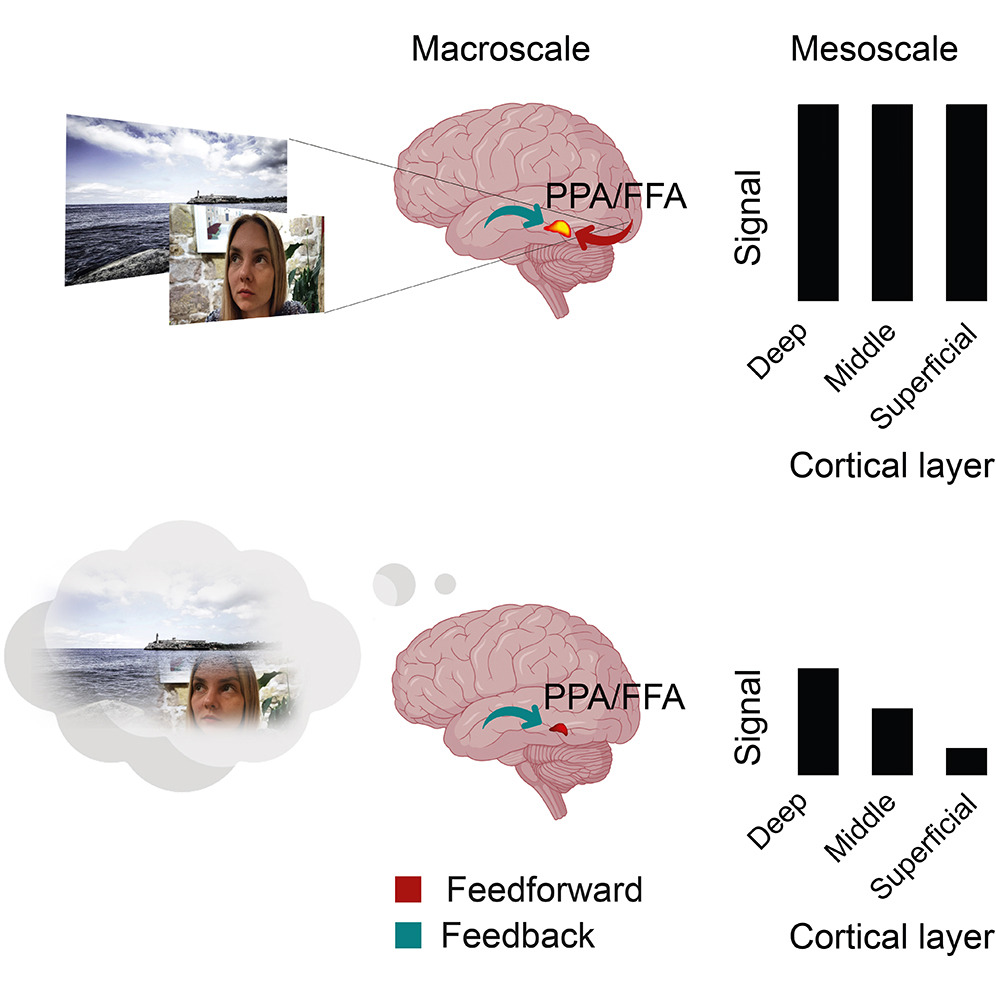
It only took ages (because life..) but our laminar fMRI paper is finally out in @NatureComms! With @LarsMuckli, Lucy S. Petro, @atyler_morgan, Clement Abbatecola & @susan_m_li
New layer-fMRI showing how high-resulution imaging can capture different types of feedback:
Mental imaginary and optical illusory experiences are represented in different feedback layers (deeper and superficial).
https://t.co/fDI5m6WnWc
By @jo_bergmann et al.
How much does occipitotemporal cortex "care" about individual object categories? In a study led by @MarcoBadwal we addressed this question using multisession fMRI with a very homogenous stimulus class: land mammals.
Paper: https://t.co/4diu3RnkJZ
Preprint: https://t.co/bsV0hoJuus
Happy to have been part of this project led by @BelenMMontabes on the processing of auditory feedback in early cortical areas in aphantasic participants, now out in @CurrentBiology
Freshly out in @CurrentBiology! Aphantasic participants, who report a blind imagination, show reduced decoding of auditory scenes in early visual areas. With C.Abbatecola, R.Luciani, @AngusPaton@jo_bergmann@petravetter1 L.Petro @LarsMuckli 👁️👁️: https://t.co/2QUMuy0Cgj 1/2
Ahoy Psych and CogNeuro community! We have openings for PhD and Postdocs. Are you interested in the impact of semantic congruity in (visual) cognition? Find more about my new ERC project and the positions at: https://t.co/SoNbmVxr1W. Spread the word!
The ground truth about the human fMRI occlusion paradigm revealed by rodent 🐁2P imaging - Super excited about this @HumanBrainProj collaboration with @kseignet at @CN_Levelt lab multispecies multiscale @CCNi_UofG. Preprint and Tweetorial below: spoiler: L2/3 are contributing!
This is published now as journal article: https://t.co/uqARQE5Siz
Congratulations @emilyrthomas27, @PeterKokNeuro, @ClarePress et al.
There is also a commentary that comes along with it: https://t.co/xmlxQkztKN
Excited that our paper "Brightness illusions drive a neuronal response in the primary visual cortex under top-down modulation" is now published @NatureComms!
https://t.co/rmjUloTsT3
🎉 Great thanks to my coauthors.
@watanabemasata,@NelsonTotah,@BartelsAndreas
@nadine_dijkstra @ortiztudelaJ This makes me think of Matthew Larkum's lab's work and the idea that such a 'switch'/threshold mechanism might already be implemented at the single cell level in L5 pyramidal neurons
Javier @ortiztudelaJ and I wrote a short opinion paper in which we hypothesize that rather than being an ‘episodic memory disorder’, #aphantasia might be due to differences in the ‘what’ stream of visual processing. You can find it here: https://t.co/WXgydoTP42
@nadine_dijkstra @ortiztudelaJ ...and I would think that aphantasics also have higher-order reps, but somehow these cannot take on a (consciously perceivable) sensory form? Tough questions!
@nadine_dijkstra @ortiztudelaJ I reckon expectations become conscious when a certain threshold is exceeded, even in the absence of governing higher-order reps? As seems to be the case in illusions like Kanizsa & neon colour spreading...
@nadine_dijkstra @ortiztudelaJ ...and that the 'where' stream might be less/not affected) - So the decoder might pick up on these spatial information differences of the audio-induced representations in V1?
What are your hypotheses on this?
@nadine_dijkstra @ortiztudelaJ ...Secondly, the sounds they use (such as a cat meowing, traffic noise etc) may also trigger different spatial sensory representations...which might not be affected in aphantasia (we argue that it is cortical feedback in the 'what' stream that works differently...
@layerfMRI was faster than me 😅 so retweeting his post now.
It only took ages (because life..) but our laminar fMRI paper is finally out in @NatureComms! With @LarsMuckli, Lucy S. Petro, @atyler_morgan, Clement Abbatecola & @susan_m_li
New layer-fMRI showing how high-resulution imaging can capture different types of feedback:
Mental imaginary and optical illusory experiences are represented in different feedback layers (deeper and superficial).
https://t.co/fDI5m6WnWc
By @jo_bergmann et al.