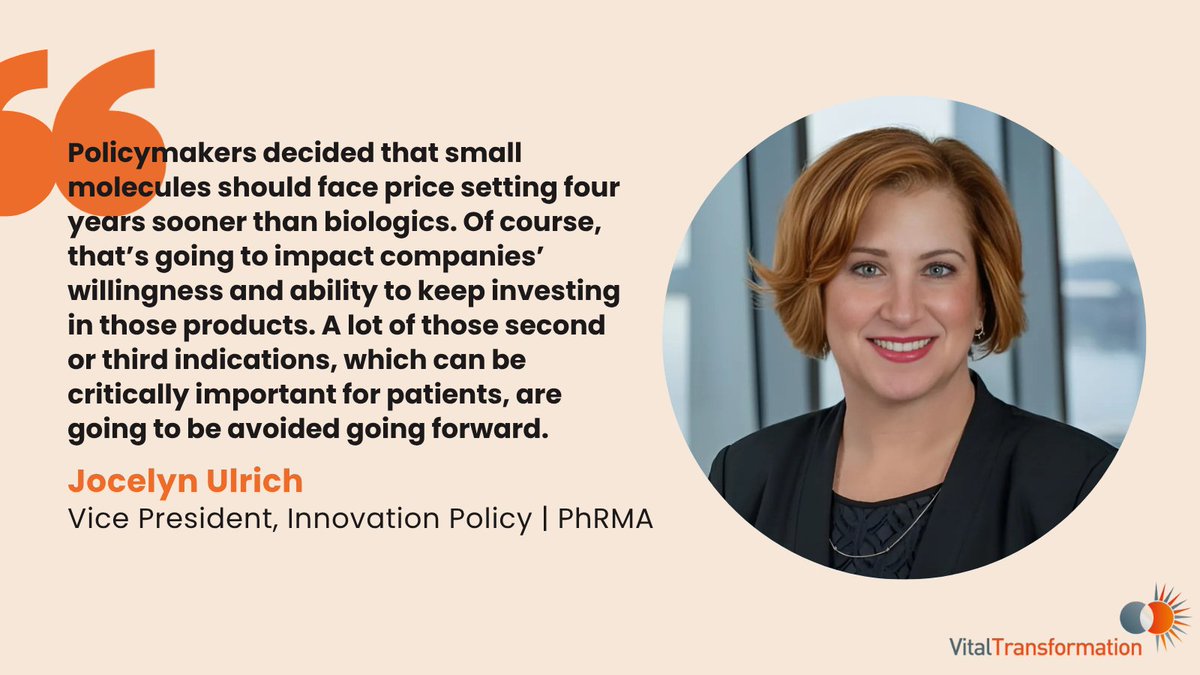
Under the IRA, small molecules now face price negotiation at year 9 instead of year 13, shrinking the window companies need to sell exclusively and recoup the hundreds of millions they invest in each new therapy.
@jocelynulrich (Vice President, Innovation Policy at @PhRMA) explains that these exclusivity periods are critical not just for breakthrough cures but also for funding second and third indications that can transform patient care. Our peer-reviewed analysis shows that money is shifting away from small molecules under these different exclusivity windows, especially for therapies targeting seniors.
We sat down with Jocelyn to unpack how PBM consolidation, biosimilar vertical integration, and looming tariff threats are reshaping biopharma’s incentive structure - and why realigning drug pricing with patient access is essential to biotech innovation.
Listen now on the Vital Health Podcast to learn more: https://t.co/wBiucZvuIW
#IRA #DrugPricing #PatientAccess #Biopharma #HealthPolicy #PBM #Biosimilars #Innovation
The IRA’s price-setting policies and PBM efforts to block biosimilar competition jeopardize the market's progress in increasing patients’ treatment options.
Our VP of Policy and Research, @jocelynulrich, recently discussed alongside @Amgen how we can protect this vital market. https://t.co/C0puNQEppF
We’re live at the inaugural @PhRMA Forum, where we’re unveiling critical initiatives, including our latest Innovation Report, and engaging in meaningful discussions with industry leaders and patient advocates. This is an important moment as we work together to shape the future of health care. Learn more here: https://t.co/SUWTQQ8u3C
FIVE polling places in Fulton County, GA have extended their polling hours. If you live in Fulton County, find your polling place at https://t.co/FIQvhGCwCS and go VOTE! 🗳️ 🏃
The biopharmaceutical research industry depends on a highly skilled workforce with knowledge and experience in STEM yet 90% of surveyed research companies experience difficulties recruiting the qualified talent they need. That's why the industry is making a sustained investment.
A new report by @TEConomyP_LLC finds #STEM education programs supported by America’s biopharma research companies have supported 111 million students and nearly 183,000 teachers advance their education and professional development. https://t.co/GhCUzj0rE7
As @WSJopinion points out, the administration's recent proposal to abuse "march-in" rights — and upend America's longstanding system of public-private partnerships — is fundamentally at odds with initiatives like the Cancer Moonshot.
Newly approved gene therapies represent monumental breakthroughs for patients. Unfortunately, @POTUS is celebrating these innovations just days after proposing policies that undermine the very IP framework that made these life-changing treatments possible. https://t.co/gHaFl9628Y
.@C_Garthwaite spoke to @nytimes about the cost of new weight-loss drugs. "We spent 15 years talking about the soaring cost of obesity" to healthcare but the attitude of some insurers seems to be, “we don’t want you to come up with a fix that costs money.”
https://t.co/S1ht5XW11x
Given what we *know* about size of rebates in this space -- it's irresponsible to write articles or tables that lead with list price and put in a caveat that there "may" be rebates.
Even having a table with only list prices is writing click bait and not careful analysis.
“In residency, I saw firsthand how #antibiotics were integral to so many different medical specialties–and also how these drugs were no longer working the way they used to.” – @uoflmedschool’s Dr. Bethany Wattles. https://t.co/Db35o9e68l
“We have seen the number of companies, especially the larger companies, decline from 20 or so down to just a handful who are still even in the [#antibiotic development] space,” @jocelynulrich says of the market failure for new antibiotics. @JaimieSeaton https://t.co/XABhqiz04p