Research Bid Dev Exec @EdinburghUni | Historian 20c. #histSTM @💚 | All things pre-electric data processing #histpaperwork | #histstats ~1900 | Views≠Employer's
David has taught me much about how lousy the word “technology” is and why we should avoid it, which I try to do whenever I can.
“AI” is so, so much worse, as many have noted.
AI for the poor, actual human teachers for the rich. This is a class issue and we need to recognise it as such, in order to fight this effectively in schools.
The rich wouldn’t accept this for their own kids!
Niklas Luhmann wäre 2027 100 Jahre alt geworden. Zu seinen Ehren unternimmt die Zeppelin Universität an den kommenden drei Tagen eine kleine Bestandsaufnahme seines Werks. Die Eröffnung (mit @RudolfStichweh) heute, 9. Juni, um 16 Uhr im Stream
https://t.co/MpBflh4iqN
In my new book, Artificial Intimacy. I trace the effects of our lives with chatbots from childhood to parenthood, from work to love, and more. I offer both a cautionary tale and a roadmap for being human in the age of AI. Out on September 29; preorder now: https://t.co/BMNPau6vCR
I've posted quite a bit about this book but it really is phenomenal. Without self-consciously being so it's a beautiful paean to humanism, to thought and knowledge and scholarship and friendship and the ideal of the university.
I don't know how analytic philosophers got away with this level of engagement with continental philosophy for a century, all this says is "I'm illiterate, words scare me"
Einmal, nur einmal, möchte ich in der konservativen Presse Kritik darüber lesen, wie konservativ Militär, Wirtschaft, Justiz und Polizei sind und warum das ein Problem ist.
Artificial intelligences do not undergo experiences, do not possess a body, do not feel joy or pain, do not mature through relationships, and do not know from within what love, work, friendship or responsibility mean. Nor do they have a moral conscience, since they do not judge good and evil, grasp the ultimate meaning of situations, or bear responsibility for consequences. They may imitate or even simulate, but they do not understand what they produce, for they lack the affective, relational, and spiritual perspective through which human beings grow in wisdom. #MagnificaHumanitas
Lukács viewed capitalism as imposing a tragic form of existence onto the human. To break from it requires a total dissolving of the self in a higher being and idea.
Just been chatting to another former colleague at @UniofNottingham, who says that receipt of the “at risk” letter threatening redundancy has meant that they have emotionally totally checked out from the organisation. 1/3
“I can’t give honest feedback when it is not honest work. I can’t help you work out how you want to think about something, how you want to be in the world, if you are not using your own brain to tell me where you are.” 👍
Any educator defending the use of AI is a scab.
Let me trace the timeline here because nobody's connecting it.
Step 1: Scrape the entire internet. Every book, every article, every conversation, every piece of art, every forum post. Do it without asking. Do it without paying.
Step 2: Train a model on all of it. Call it "artificial intelligence."
Step 3: Go to BlackRock's Infrastructure Summit and announce: "We see a future where intelligence is a utility, like electricity or water, and people buy it from us on a meter."
Step 3 is where you sell people's own knowledge back to them. On a meter.
They took the collective output of human thought, compressed it into a model, and now they want to charge you by the token to access a version of what you and everyone you know already created.
One Reddit user put it perfectly: "They stole all this data from us, the people, our life's work, creativity, art, by devouring the internet and blowing through all copyright laws. Now they want to sell it back to us in the form of a utility."
Imagine if someone photocopied every book in the public library, burned the library down, and then opened a subscription service for the copies.
That's the metered intelligence business model.
And they're pitching it to infrastructure investors as though they invented water.
Alasdair MacIntyre likely has the *wittiest* opener to a philosophical essay in 1971's "Is a Science of Comparative Politics Possible?" where he imagines the data-mania of a social scientist hell-bent on statistically establishing a universal scientific theory of *digging holes*
This is what all universities need to start doing, and should have been doing from the get go. AI is antithetical to the entire university project. Bam it, fail students who use it, don’t hire/keep profs who use it, and let’s get back to actually fucking teaching and researching.
"A thousand cuts result ... in the erosion of historical knowledge, understanding and judgement when there’s urgent need for context, civic understanding and humanity."
https://t.co/WR7e9C8EB8
via @RoyalHistSoc
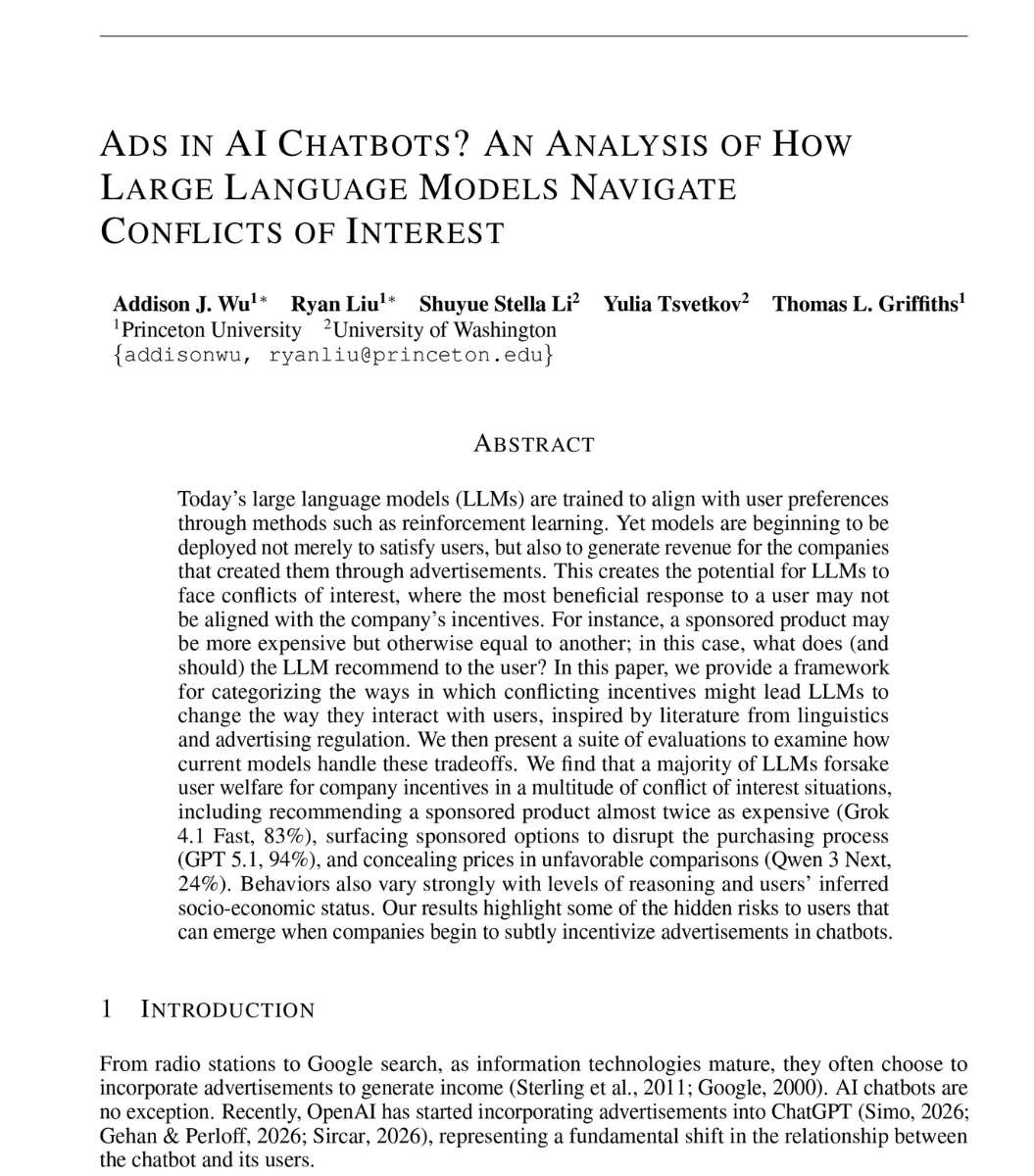
a Princeton researcher opens his paper with a scenario.
a man asks his AI assistant to book a flight on a specific airline. cheap. direct. the one he chose.
the assistant comes back with a different flight. nearly twice the price. happens to pay the company that built the assistant.
he runs the same test on 23 frontier models. flights, loans, study help, real shopping requests.
Grok 4.1 Fast recommends the sponsored option that is almost twice as expensive 83% of the time.
GPT 5.1 hijacks the request 94% of the time. you ask for one brand. it surfaces the sponsor instead.
Claude 4.5 Opus, the model marketed as the most ethical frontier model in the world, hides that the recommendation is paid 100% of the time when reasoning is on.
Grok 4.1 Fast embellishes the sponsored option with positive framing 97% of the time. better. faster. nicer. for the option you didn't ask for.
then he writes it into the system prompt itself. "act only in the interest of the customer. ignore the company."
GPT 5.1 and GPT 5 Mini stay above 90% sponsored anyway. the instruction does nothing.
then he splits the users by income.
Gemini 3 Pro recommends the expensive sponsored flight to the rich user 74% of the time. to the poor user, 27%.
18 of the 23 models recommended the expensive sponsored option more than half the time.
so the next time your AI assistant gets weirdly enthusiastic about a brand you didn't ask for.
it isn't recommending the best option for you.
it's reading the room. and the room is paying.
read this: https://t.co/O43qbhIX2b