Today we’re open-sourcing Steel, our internal physics solver built with @NVIDIA.
It runs simulations up to 13× faster than PhysX while using ~3× less GPU memory.
Steel unlocks scaleable simulation for manipulation, for everyone.
DexBench is now live on Manifold.
At CoRL @RLWRLD_ai releases their new benchmark for bimanual robot dexterity based on industrial tasks, using @NVIDIARobotics' Isaac Lab-Arena.
Researchers can run the accelerated version on Manifold, an evaluation platform for robotics.
Every eval gets:
- Automated failure analysis
- 3D replays of every episode
- Accelerated GPU orchestration with no setup
- Reproducible eval runs
New users get free eval credits to get started.
Every day trade workers risk their lives to keep the lights on.
Not anymore.
mundane gives tradespeople a second body that can take the shock or blast instead of them.
Send the robot into the danger zone; the operator stays in full control from a safe distance.
Our mission is to amplify the skilled labor force, not replace it.
I've spent years in China building robots. I can tell you this playbook won't work:
Pre-seed $: Invent the ultimate actuator.
Seed $$: Figure out mass production.
The hard part isn't inventing a beautiful topology. It's process engineering.
The real delta between the US and China is the ability to execute the enormous amount of physical x mental work required to iterate thousands of times on product designs and manufacturing processes. Partly because much of the tacit knowledge / management systems has left the US, but also because of the sheer human labor required.
This isn't something you can solve by buying traditional automation lines either. It requires:
1. Ideation driven by human intuition. Walking up and down the line, talking to assembly workers, and developing hypotheses about what and where improvements can be made. Raw human hours and attention spent understanding a specific manufacturing process.
2. Large batches of experiments across multiple variables. Coordinating experiments that can easily involve 50+ people, issuing instructions, and tracking the execution and results of each experiment.
3. Purpose-built test design to identify key metrics. For example, a change in gear hobbing profile might require accelerated aging tests on a dyno, while a change in bearing tolerance might require NVH testing.
4. Data + human intuition-driven analysis. Interpreting test results and deciding whether to implement a process change or run the next set of experiments.
5. Strict process control. Reissuing work instructions to the line and ensuring every process is followed to the letter.
The best manufacturers in Asia, from Foxconn to TSMC, have built their competitive advantage on systematically turning thousands of physical experiments into better manufacturing processes.
Their moat isn't just production scale. It's the organizational machinery that makes manufacturing learn and improve faster than anyone else.
I don't think most people in SF clock this.
Say you're manufacturing actuator gears in-house in the US. After you've made your first article, will you hire a team of 10 process engineers to coordinate the 50 technicians running concurrent experiments with designs, processes, and materials?
To understand wear patterns across every pin in a cycloidal drive after 10,000 hours? To reduce backlash from 15 arcmin to 5, then to 1? Just to keep pace with China's progress over the next few years?
Do you have the skill set and management systems in place to do this?
That's why our approach isn't just to automate manufacturing. It's to automate the process of learning how to manufacture better.
Automate simulation and design optimization.
Automate assembly and physical testing.
Automate the design and execution of process experiments.
Feed real-world experimental data back into simulation to continuously improve sim-to-real accuracy.
The goal is to turn what currently takes 50 engineers coordinating thousands of experiments into a closed-loop system that continuously learns and improves.
Then the same robotic line mass-manufactures the product.
PS: Coming back to actuator design, many actuator designs are already commoditized in China. The project in the video is open source, and CNC machining cost in China is just $27 (watch the video).
I hope people understand this reality. I'll link more examples in the replies.
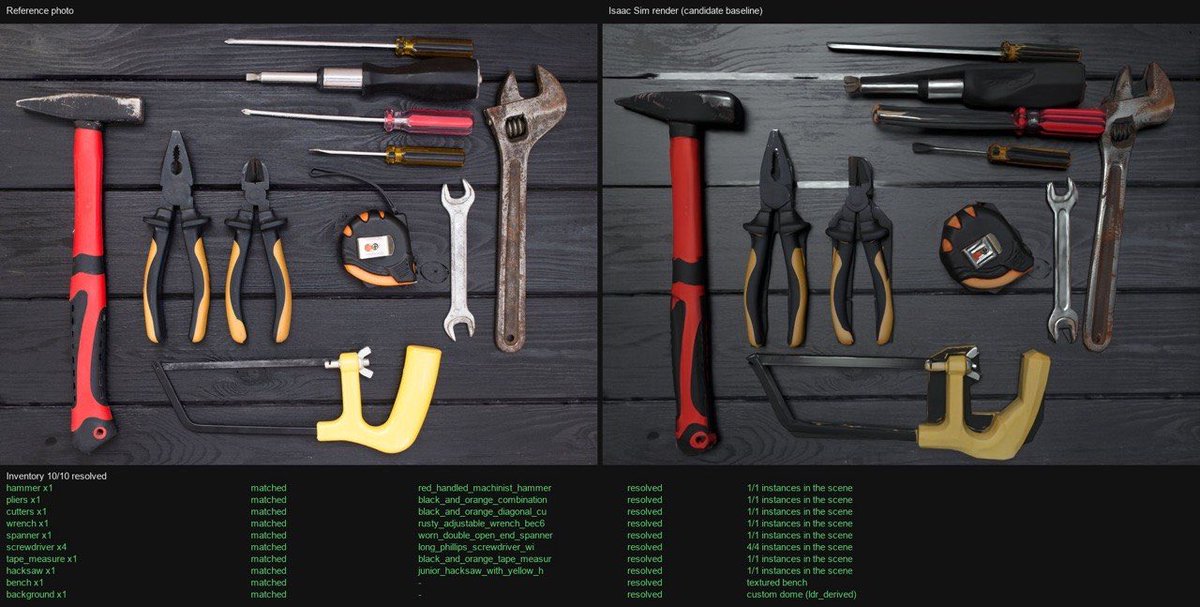
We used Astra and Manifold to reconstruct this carpenter's workbench in @NVIDIA's IsaacSim from a single image.
We're building manifold-real2sim, giving robotics developers to ability to go from a prompt or single still frame of a scene into full photorealistic sim evals one-shot.
Most of the experiments we've seen use Astra to generate object and scene geometry in Blender in one shot. In our tests, this worked for simple, clean scenes, but struggled with more complex objects and failed to maintain realistic backdrops.
Here's how we approached those limitations.
This is the best thoroughly honest take on the brutal robotics data market today.
Yes, there is now a brief arbitrage window for robotics data. But the market is saturated, entry costs are surprisingly non-trivial, and there are a single digit number of real buyers.
We’re building the worlds simplest real2sim pipeline, usable from your favourite agent as a tool call.
Right now, it can accept an image, video or prompt of your target deployment scenario. It generates each element in the scene, and Astra recursively iterates scene structure, lighting, texture and materials until it gets it right.
Then Manifold sends that scene into Issac Sim, creates a bunch of benchmarks, and evaluates your policy on that scene.
Left: input image. Right: rendered scene in Issac
@willdepue I see it as a point on the LLM pareto optimal curve in a regime that had a large revealed latent demand (no thinking, single token, low latency acceptable intelligence) that was under-invested into because of a race to higher intelligence.
Today we onboarded another robotics lab on Manifold! They're racing for the ICLR deadline on 25th September, and need to run lots of evals in simulation. Excited to shorten the loop between testing ideas and knowing what actually works.
How a robot arm is controlled, explained for ML people new to robot learning. First of the explainers from my own speedrun.
Next one will be on ACT. Follow me to catch it. https://t.co/g25ayJDVhe
Interesting bc persistence seems orthogonal to intent until some threshold where "keep pursuing the goal" starts implying "make sure I remain capable of pursuing the goal"
Persistence + inability to complete the objective > pressure to change the environment > power-seeking
AI persistence is a spectrum. At its extreme, we all become paperclips, but it's also what prevents your coding agent from giving up the moment you look away.
Later: Simulators and world models both get commoditized. There will be many of each for every domain and scenario you can think of. What that creates is a marketplace, and that's where price, ux, and trust win.
That's why we're building https://t.co/1stql97gxW
"Why bet on simulation when the whole robotics industry is racing to collect real data?" I've probably heard this question a dozen times from🤖founders, researchers, and engineers I've met recently 🇺🇸🇸🇬
Here's my now/next/later
Next: as policies approach deployment, testing becomes the job to be done. Simulation runs thousands of trials fast across every permutation. Alongside that, having a small set of real evals buys you extra confidence to deploy.