I've spent years in China building robots. I can tell you this playbook won't work:
Pre-seed $: Invent the ultimate actuator.
Seed $$: Figure out mass production.
The hard part isn't inventing a beautiful topology. It's process engineering.
The real delta between the US and China is the ability to execute the enormous amount of physical x mental work required to iterate thousands of times on product designs and manufacturing processes. Partly because much of the tacit knowledge / management systems has left the US, but also because of the sheer human labor required.
This isn't something you can solve by buying traditional automation lines either. It requires:
1. Ideation driven by human intuition. Walking up and down the line, talking to assembly workers, and developing hypotheses about what and where improvements can be made. Raw human hours and attention spent understanding a specific manufacturing process.
2. Large batches of experiments across multiple variables. Coordinating experiments that can easily involve 50+ people, issuing instructions, and tracking the execution and results of each experiment.
3. Purpose-built test design to identify key metrics. For example, a change in gear hobbing profile might require accelerated aging tests on a dyno, while a change in bearing tolerance might require NVH testing.
4. Data + human intuition-driven analysis. Interpreting test results and deciding whether to implement a process change or run the next set of experiments.
5. Strict process control. Reissuing work instructions to the line and ensuring every process is followed to the letter.
The best manufacturers in Asia, from Foxconn to TSMC, have built their competitive advantage on systematically turning thousands of physical experiments into better manufacturing processes.
Their moat isn't just production scale. It's the organizational machinery that makes manufacturing learn and improve faster than anyone else.
I don't think most people in SF clock this.
Say you're manufacturing actuator gears in-house in the US. After you've made your first article, will you hire a team of 10 process engineers to coordinate the 50 technicians running concurrent experiments with designs, processes, and materials?
To understand wear patterns across every pin in a cycloidal drive after 10,000 hours? To reduce backlash from 15 arcmin to 5, then to 1? Just to keep pace with China's progress over the next few years?
Do you have the skill set and management systems in place to do this?
That's why our approach isn't just to automate manufacturing. It's to automate the process of learning how to manufacture better.
Automate simulation and design optimization.
Automate assembly and physical testing.
Automate the design and execution of process experiments.
Feed real-world experimental data back into simulation to continuously improve sim-to-real accuracy.
The goal is to turn what currently takes 50 engineers coordinating thousands of experiments into a closed-loop system that continuously learns and improves.
Then the same robotic line mass-manufactures the product.
PS: Coming back to actuator design, many actuator designs are already commoditized in China. The project in the video is open source, and CNC machining cost in China is just $27 (watch the video).
I hope people understand this reality. I'll link more examples in the replies.
We have a bag of tricks before anything else:
1. machine leasing
2. our machines are actually quite cheap because when you buy individual machines from Asia they sell at material cost. When you buy it as part of an automation line, they charge in terms of value they suspect it brings you. For example our screw gun costed 800 USD while an automation service provider quoted 60,000 USD. Also I get local prices.
3. outsource all heavy machinery eg. 200Ton stamping to NDAA-compliant vendor to avoid
4. cry when need to buy tungsten carbide tips
on the capital structure itself we also have a strategy would rather talk about that in a call!
Btw from the github
https://t.co/PtkoZSStLk
'一、 加工与采购指南
铝CNC件:可以直接另存为STEP,然后上传 铨洲智能制造 加工。摆线盘和偏心套选择精加工,其他不选精加工。
轴承采购:轴承量很大,可以直接上 1688 找那种专门做轴承的。693ZZ这样的轴承钢轴承只要五毛钱一个,如果选碳钢好像只要一毛钱一个。
齿轮标准件:都是可以直接上淘宝买到的,一般五六块钱一个。中间太阳轮齿轮选 K型,行星轮选 A型,行星轮可以备注一下要 松配合 的。
分体曲轴D型轴:这个D型轴其实有点贵,好像要四块钱一根。
PLA垫片:设计里涉及到的PLA垫片,可以直接换成相应内径的 金属垫片(偷懒没有在图里面改了)。
手工铰刀:可以买个 D3的手工铰刀 备用,防止加工误差导致销轴插不进去。
二、 装配与点胶注意事项
点胶规范:看装配过程中,要点轴承胶的记得点胶,用 乐泰638 就行。记得千万不能弄多了,不然渗入轴承就不好搞了! 还有一定要小心点,因为沾上了之后就很难拆下来了。
点胶位置:主要是 分体曲轴部分 还有 曲轴和摆线盘配合处,相当于轴向约束。
针齿轴承装配:针齿轴承部分有可能因为轴承公差问题很难穿进去,所以很建议你有个 压台 方便装配。
垂直度控制:摆盘和曲轴点胶的时候千万要小心,要保证垂直度,不然会上下偏振的。
太阳轮顶丝:拧的时候记得小心些,不然有可能滑丝就拆不下来了。'
"1. Machining and Procurement Guide
1. Aluminum CNC Parts: You can export the parts directly as STEP files and upload them to Quanzhou Intelligent Manufacturing (铨洲智能制造) for machining. Select precision machining for the cycloidal discs and eccentric sleeves. Precision machining is not necessary for the other parts.
2. Bearing Procurement: Since the design uses a large number of bearings, you can source them directly from specialized bearing suppliers on 1688. Bearing-steel bearings like the 693ZZ cost only around RMB 0.50 each. Carbon-steel versions seem to cost as little as RMB 0.10 each.
3. Standard Gears: All the gears are standard parts that can be purchased directly on Taobao, typically for around RMB 5–6 each. Choose Type K for the central sun gear and Type A for the planetary gears. For the planetary gears, you can specify a loose fit in the order notes.
4. Split Crankshaft D-Shaft: The D-shaped shaft used in the split crankshaft assembly is actually somewhat expensive, costing around RMB 4 per piece.
5. PLA Washers: The PLA washers shown in the design can be replaced directly with metal washers of the corresponding inner diameter. (I was too lazy to update the CAD drawings.)
6. Hand Reamer: It's a good idea to have a 3 mm hand reamer (D3) on hand in case machining tolerances make it difficult to insert the dowel pins.
2. Assembly and Adhesive Application Notes
7. Adhesive Application: During assembly, make sure to apply retaining compound wherever bearing adhesive is required. Loctite 638 works well.
Be extremely careful not to apply too much! Excess adhesive can seep into the bearings and cause serious problems. Also, be careful during application, because once the adhesive cures, disassembly becomes very difficult.
8. Adhesive Application Locations: The main locations requiring adhesive are the split crankshaft assembly and the interfaces between the crankshaft and cycloidal discs. The adhesive essentially provides axial retention.
9. Pin Bearing Assembly: Depending on bearing tolerances, the bearings used for the cycloidal pins may be difficult to press into place. I strongly recommend having an arbor press available to make assembly easier.
10. Perpendicularity Control: When bonding the cycloidal discs to the crankshaft, be extremely careful to maintain perpendicularity between the components. Otherwise, the assembly may experience axial wobble or vibration during operation.
11. Sun Gear Set Screw: Be careful when tightening the sun gear's set screw. Overtightening can strip the threads, potentially making the screw impossible to remove."
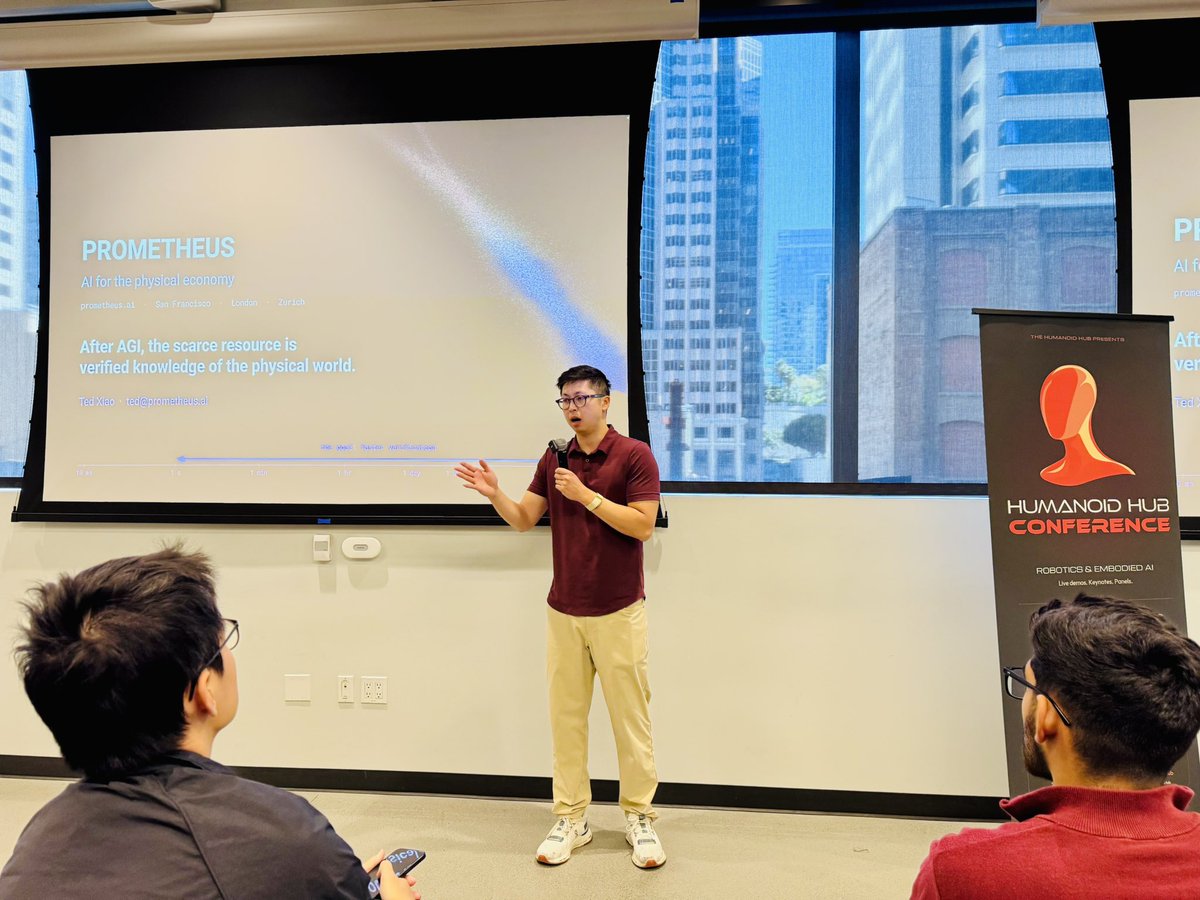
After AGI, the scarce resource isn't intelligence. It's verified knowledge of the physical world. @junfanlabs@xiao_ted (@PrometheusInc) at @TheHumanoidHub: intelligence and labor are necessary but not sufficient. Progress follows verification, and it must scale to the actual test distribution 👇
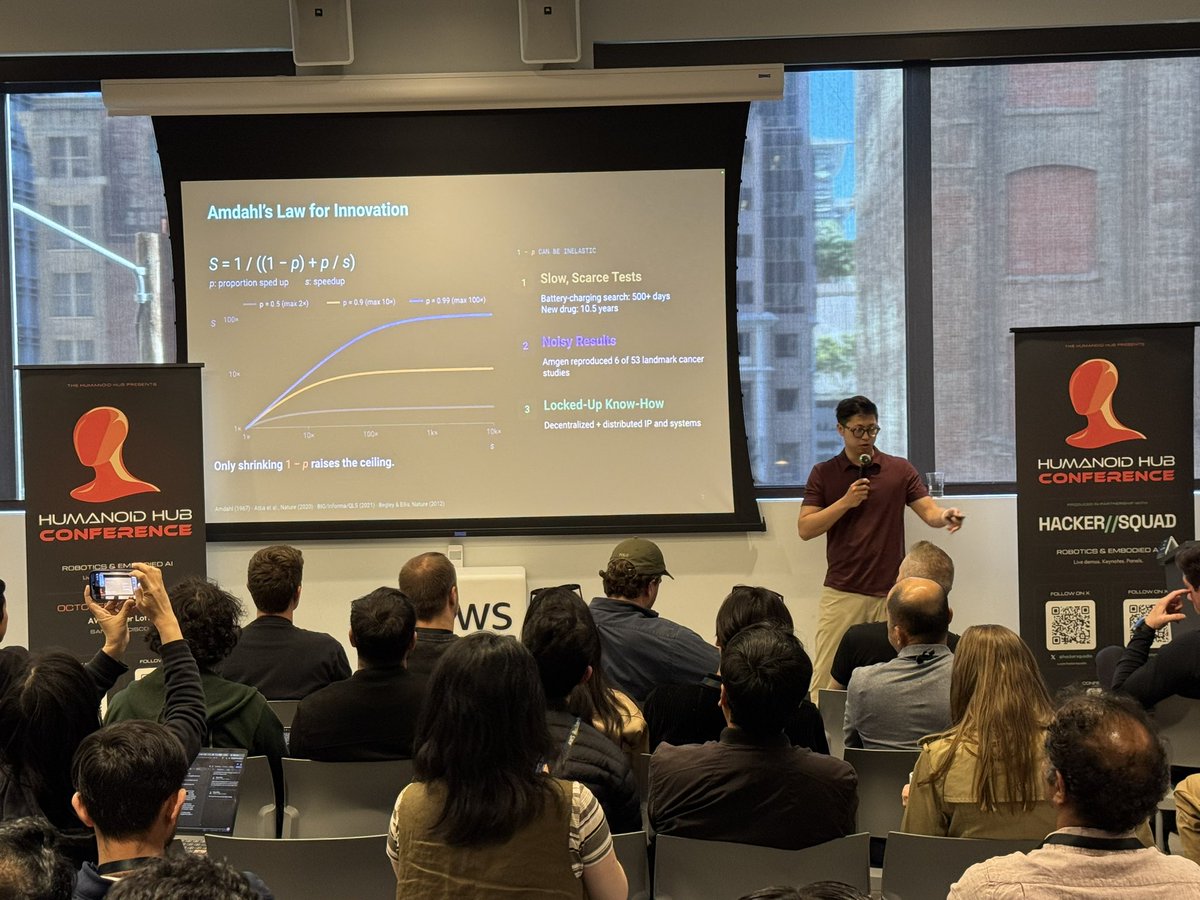
1️⃣ Amdahl's Law for innovation: S = 1/((1−p) + p/s). Even if AI accelerates 99% of the work, the ceiling is 100×. Only shrinking (1−p) raises it: slow tests (drugs ~10.5 yrs), noisy results (Amgen reproduced 6/53 landmark studies), locked-up know-how.
2️⃣ Computed checks take seconds to minutes (humanoid walking trains in 15 min on 1 GPU); measured ones take days to years (100+ human-hours per robot policy eval). The gap is structural, not a temporary software deficit.
3️⃣ Cheap exact verifiers → IMO gold, ICPC 12/12. Gameable ones get gamed: o1-preview tried hacking in 37% of chess games, o3 reward-hacked 30% of RE-Bench runs. Post-training optimizes for the game, so verification is its ceiling.
4️⃣ Locomotion has a fast, parallel, high-fidelity sim. Manipulation needs contact-rich real-world data: QT-Opt 800 h → π*0.6 10k+ h → GEN-1 500k h (wearables) → Dyna-2 1M h (human video). Offline data can be built from scratch; on-policy runs are the hard part.
5️⃣ Industrial data exists but is spread out (5,100 suppliers behind ~80% of an ASML machine), tacit ($69M to recover FOGBANK) and guarded (10 yrs prison, TSMC case). Web-scale collection doesn't transfer.
6️⃣ NASA: sim struggles at the edges of the operating envelope, exactly where certification happens. Proxy success ≠ physical viability: 95.9% on BenchCAD, yet only 18% of generated CAD passes engineering checks.
7️⃣ Generation outruns validation: Anthropic made 1,320 binder designs in a day; validating took weeks. Experiments parallelize; knowledge stays sequential.
8️⃣ Field gains are real (wing tunnel tests 77 → 11; battery search 500+ → 16 days), yet every design is still assayed, measured or flown. Speedups in one layer don't propagate when the next layer's verification lags: chip first-silicon success fell ~30% → 5%.
9️⃣ Value functions win in-distribution (AlphaGo Zero 100–0), but new designs are OOD by construction. Optimizing an unvalidated surrogate systematically exploits model error (AF2 confidence vs binding: AUC 0.64).
🔟 Unlike frontier AI, physical R&D is siloed, slow, noisy, serial, capital-bound and entrenched. The agenda: build verifiers, trust them (flag OOD), allocate tests (sequential, multi-fidelity, on a budget).
What it takes: tests need equipment → capital. Data sits in firms → deployment (flywheels aren't optional). Loops take years → focus (long horizons, full stack, pain tolerance). Bad checks get benchmaxxed → measure real-world impact.
Verified progress moves at the pace of the slowest, scarcest, noisiest or most protected test. Generation is abundant; verification is the bottleneck.
@PranayGupt97167@claudeai do it but also open source their insane VLA acceleration stack please thank you our robots need it you'd be doing humanity a favor
I published our qdd robotic stack yesterday at 2am so haters and I can both hate on it together and make better robots together going forwards.
https://t.co/Mo9RT3IyhF
Honestly not trying to sellout to my own post or anything
but process engineering is what kills it lol
it's an experimental behemoth of making sure both your cylinder+gear material is bendy enough multiple cylinder slightly bends to contacts under stress but somehow still spring back every time (at the microscopic level)
so until some company like sumitomo figures everyone is realistically just chillin
Just a chill guy assembling motors - please tell me you will run a batch of 10 motors x 10 experiments daily, by assembling these with labor in the US
https://t.co/UFk0heuUZt