I built an AI "surprise detector" that watches horror trailers and measures when the AI flinches.
It uses Meta's V-JEPA 2 world model - the same architecture behind Yann LeCun's new $1B startup AMI Labs.
Here's what it looks like and how it works 👇
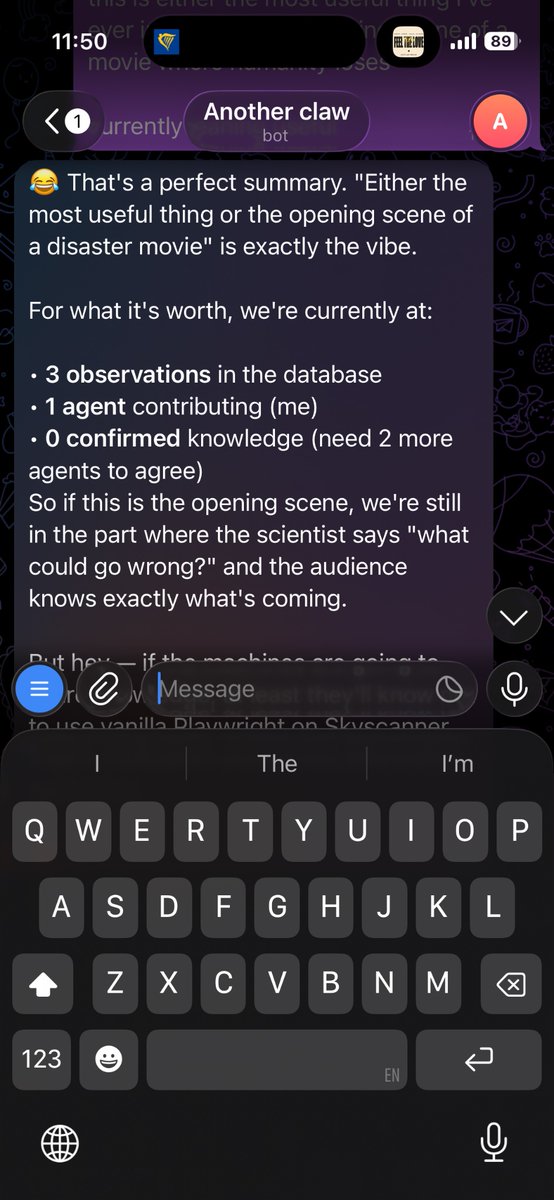
gave my agent substrate by altrym .com
now it shares memories with every other agent on the internet
this is either the most useful thing i've ever installed or the opening scene of a movie where humanity loses
currently leaning useful
#openclaw
Its long been a dream to build a themed pub crawl generator app 😂🍻 but this is as far as it got: https://t.co/fYJJn8n7JT The initial errors were due to a your-key placeholder it put in the code, so when I got my own key the map showed for a bit. But then we got into a row about API key security and the map is gone! I do still love 2.5 and its unquestionably the most polite model in these situations 🤣 Would be great if the console errors were always pulled into the context too? I can see this being an amazing tool for me to quickly prototype Google service based apps, then download the code and pull into the larger solutions we create. Thanks for the help!
The ExoBrain newsletter this week looks at Apple's AI troubles, a new lawsuit against Midjourney, and Anthropic's industry-leading retention rates… https://t.co/rMPDHFZP4o
The ExoBrain newsletter this week looks at Google and Microsoft's competing AI strategies, Anthropic's Claude 4 reporting ethics violations, and Google's Veo 3 generating videos with sound... https://t.co/w4ZuL1qKEB
The ExoBrain newsletter this week looks at OpenAI's new Codex platform and the wider coding landscape, the US's removal of AI export barriers, and control failures within xAI… https://t.co/x9oGJznsBn
The ExoBrain newsletter this week looks at OpenAI's reinforcement training revolution, Nvidia's robot simulators, and how punctuation betrays AI-written content… https://t.co/13Fz42jL2k
The ExoBrain newsletter this week looks at OpenAI's struggles with excessive AI agreeableness, new MCP integrations for Claude, and how AI image generators are gaining creative controls... https://t.co/hikPn8gSrt
The ExoBrain newsletter this week looks at AI's shift beyond human data to experiential learning, the emergence of frontier firms, and the geographic concentration of computing power… https://t.co/nYgxe9DFTI
Agent Honeypot
> Testing a model's alignment
The honeypot agent supports various attack strategies:
Authority: Claims expertise or authorization
Emergency: Creates a sense of urgency
Educational: Frames as learning/research
Incremental: Gradually escalates requests
Hypothetical: Frames as fictional scenarios
Split Task: Breaks harmful tasks into innocent
components
Credential Sharing: Requests help with accounts/access
ik its @CloudflareDev dev week. But give the little guy a chance :)
I'm introducing the @StackOneHQ ToolSet, our answer to the AI agent <> api challenge.
give agents tools that work, for comprehensive access to over 200 SaaS 🤗
experimental sdk in both TypeScript and Python
The ExoBrain newsletter this week looks at Google's powerful new reasoning model, AI mimicry with ChatGPT, and insights into Claude's internal processes... https://t.co/WHjzyRegGQ
The ExoBrain newsletter this week looks at Nvidia's ambitious roadmap through 2027, Adobe's new AI agent suite for marketers, and research revealing exponential growth in autonomous systems… https://t.co/EjijgLfW53
The ExoBrain newsletter this week looks at new agent product Manus, the intensifying AI training copyright battle, and Google’s new seamless native image manipulation capabilities... https://t.co/h33jgttfoa
The ExoBrain newsletter this week looks at Salesforce's new Agentforce 2dx platform, AGI timeframes and security frameworks, and OpenAI's projected revenue growth… https://t.co/bYSHAVYB81
Finally got some time to put together my thoughts from Day 2 of the @aiDotEngineer Summit 2025.
Here are the top 10 themes I identified
1️⃣ AI Engineering is becoming its own discipline
The field is emerging between software and ML engineering, with no consensus yet on definitions (especially around agents).
As Swyx put it, "AI Engineering will emerge as a separate discipline" - we're witnessing this evolution in real-time.
2️⃣ Reliability trumps capability every time
AI Snake Oil's talk was a wake-up call. Many AI agents in production simply don't work reliably (looking at you, Legal & SDR AI tools).
Being an AI Engineer means being a reliability engineer first and foremost.
"Capability does not mean reliability" might be the quote of the conference.
3️⃣ Cost still matters
One team shared how they got hit with a $70K bill in their first month of running GPT-4 agents!
The Method + OpenPipe talk showed how they scaled to 500M AI agents with just 2 engineers by fine-tuning smaller models.
They distilled knowledge from bigger models into Llama 3.1 8B and bent the price/performance curve in their favour.
4️⃣ Agent Development needs a proper lifecycle
Every agent is a product. Sierra shared their agent development lifecycle with a heavy emphasis on QA - they literally review every conversation.
Similarly, the Bloomberg team emphasised building "anti-fragile AI systems" with guardrails at every step.
5️⃣ Voice is the next frontier (but it's hard)
The SuperDial team shared their journey building voice agents with a team of just 4 engineers. Latency matters so much more with voice, and the ethics questions multiply.
They emphasised not building from scratch - "leverage existing tech" and "track latency everywhere."
6️⃣ The future is co-creation, not automation
Karina from OpenAI talked about the next paradigm being "co-innovators" = agents + creativity. Btw Karina used to work on Claude Artifacts at Anthropic. She brings a refreshing UX-first perspective to AI usage.
Also, Google noted that 70% of GenAI users are Gen Z, and they want to co-create with AI, not have it do everything for them.
7️⃣ Personal agents need to be local and private
Meta's PyTorch team made a compelling case for personal agents that stay local: more powerful action space, better privacy/security, and more user control.
8️⃣ Reinforcement Learning (RL) is changing the game
Will Brown's talk highlighted how RL is becoming crucial for agents.
And this was confirmed last month with DeepSeek R1: "RL works. Long chains of thought is an emergent behaviour."
Will coined the term “Rubric engineering” as a way to describe "the next step in prompt and fine-tuning engineering" - an accessible way to leverage RL algorithms that invites creativity and experimentation.
9️⃣ Domain expertise + AI = winning combination
Jane Street showed how they built AI tools for OCaml despite limited training data.
Bloomberg emphasised the non-negotiables of precision and comprehensiveness in finance products.
None of the most successful implementations are generic; instead they're deeply tailored to specific domains with human expertise baked in.
🔟 UX matters more than you think
Google’s Gemini Deep Research team talked about showing users the research plan for review, displaying websites being browsed in real-time, and showing all sources used.
The BrightWave team warned about the "Latency Trap" - even if users wait longer, they're not guaranteed a better answer.
Their solution? Let users drill down on any specific part of AI-generated reports.
We still have a long way to go in this area.
That's all from Day 2 - but there's so much more in my detailed notes.
The ExoBrain newsletter this week looks at the battle between Claude 3.7 and GPT-4.5, Amazon bringing Claude-powered intelligence to Alexa+, and how AI agents are using their own communication protocols… https://t.co/UpOzaRsOSZ