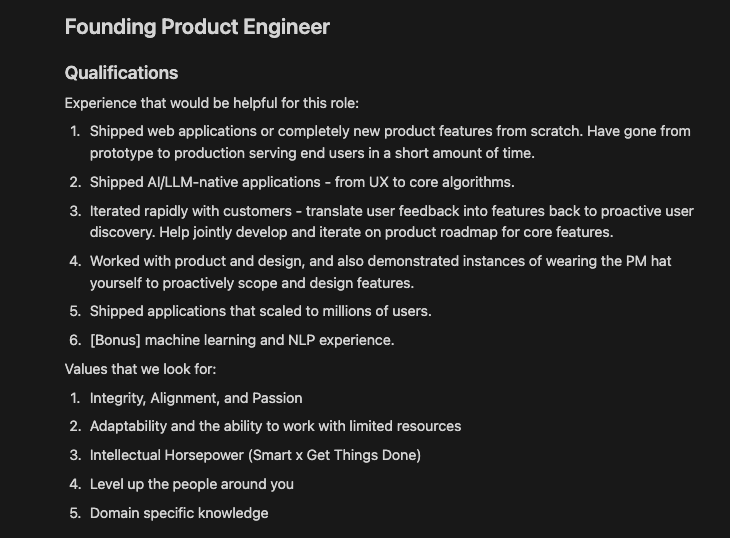
We're looking for senior full-stack product engineers to join @llama_index to build out the new data stack for AI software.
You'll be:
- Working on LlamaCloud - a platform to process and centralize all your knowledge, across any storage system, for production LLM applications
- Rapidly iterating with customers and interacting with our developer community
- Wear many engineering hats, and also product/design
- Shipping AI/LLM-powered applications yourself to our wide open-source community
We're seeking those with:
1. Track record of fast shipping velocity from prototype to production
2. Ability to lead technical and product directions
3. Passion for LLM application development
Apply now on our trusty google sheet! https://t.co/CSH1PrRuUH
Also wrote up an actual JD instead of having this tweet be the only source of truth 😉: https://t.co/oCWQAxpaUM
this ersatz analysis just got completely mogged by Karina who actually trained Claude Haiku and was also working on a similar chart - here she makes the point about industry trends and where cost of intelligence is likely to go in the next 2-5 years.
we are accelerating
# On the "hallucination problem"
I always struggle a bit with I'm asked about the "hallucination problem" in LLMs. Because, in some sense, hallucination is all LLMs do. They are dream machines.
We direct their dreams with prompts. The prompts start the dream, and based on the LLM's hazy recollection of its training documents, most of the time the result goes someplace useful.
It's only when the dreams go into deemed factually incorrect territory that we label it a "hallucination". It looks like a bug, but it's just the LLM doing what it always does.
At the other end of the extreme consider a search engine. It takes the prompt and just returns one of the most similar "training documents" it has in its database, verbatim. You could say that this search engine has a "creativity problem" - it will never respond with something new. An LLM is 100% dreaming and has the hallucination problem. A search engine is 0% dreaming and has the creativity problem.
All that said, I realize that what people *actually* mean is they don't want an LLM Assistant (a product like ChatGPT etc.) to hallucinate. An LLM Assistant is a lot more complex system than just the LLM itself, even if one is at the heart of it. There are many ways to mitigate hallcuinations in these systems - using Retrieval Augmented Generation (RAG) to more strongly anchor the dreams in real data through in-context learning is maybe the most common one. Disagreements between multiple samples, reflection, verification chains. Decoding uncertainty from activations. Tool use. All an active and very interesting areas of research.
TLDR I know I'm being super pedantic but the LLM has no "hallucination problem". Hallucination is not a bug, it is LLM's greatest feature. The LLM Assistant has a hallucination problem, and we should fix it.
</rant> Okay I feel much better now :)
Starting today, Bard is now available in many more countries and languages. We’re also rolling out Google Lens capabilities in Bard so you can use images in prompts, a new text-to-speech feature that lets you listen to responses, and much more. https://t.co/Lzw83K540L
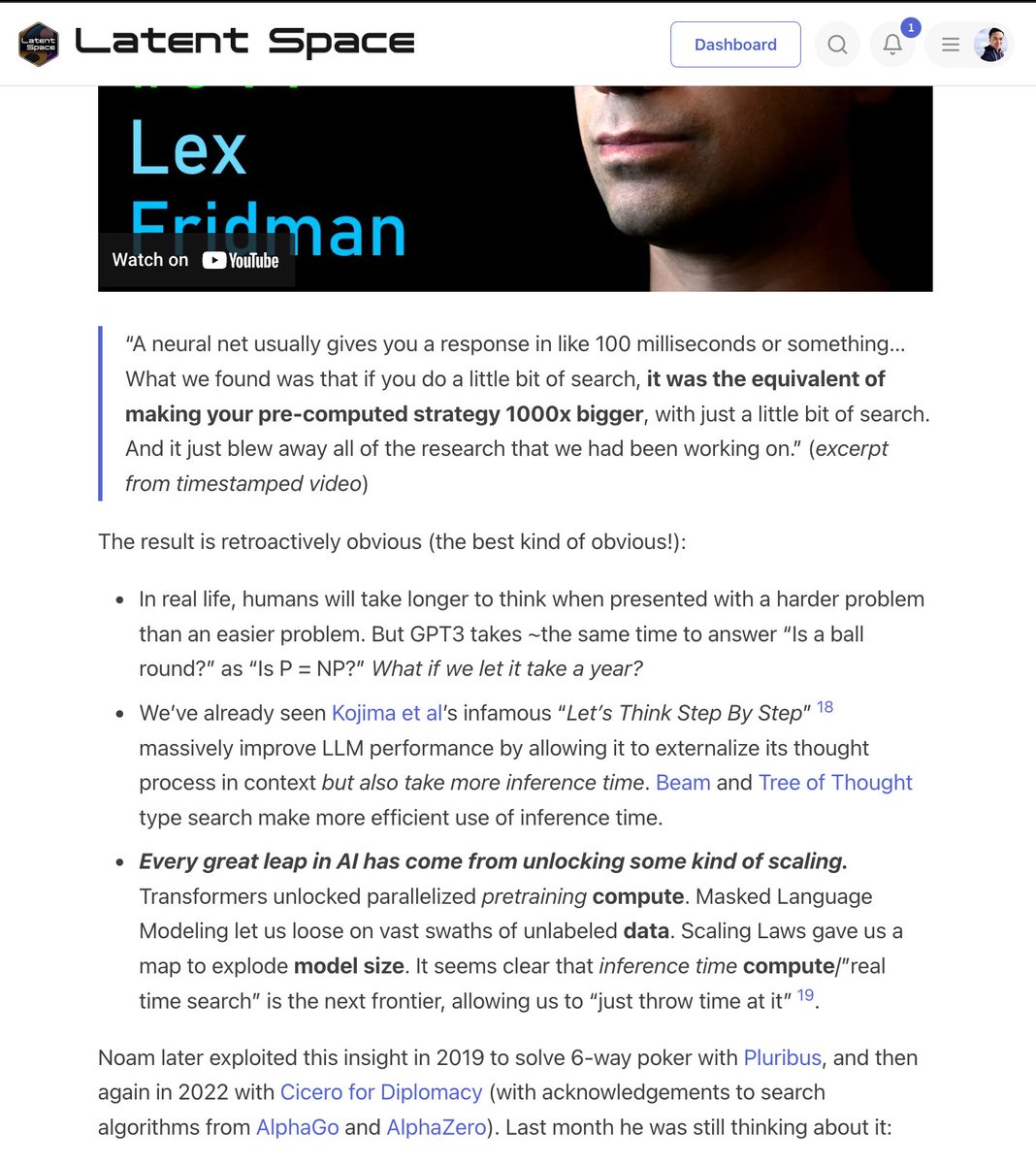
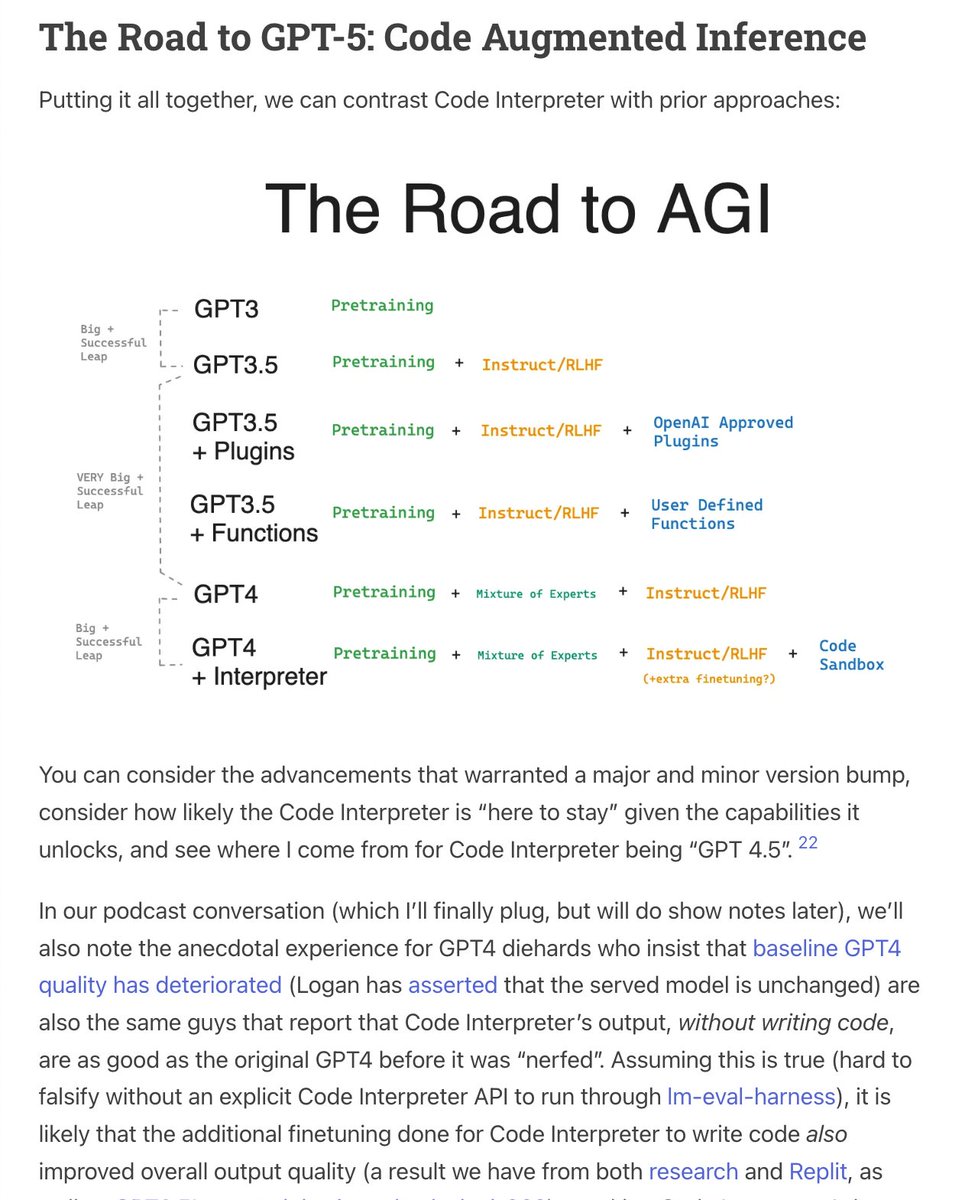
🆕 Code Interpreter == GPT 4.5
https://t.co/pfwVKibLu1
(or, making GPT4 1,000x better with One Weird Trick)
17,000 people tuned in to our emergency @latentspacepod with @simonw and @altryne!
I explain why Code Interpreter is a massive leap forward toward GPT5, why @polynoamial joining OpenAI is a glimpse of the future and why you're about to see a whole lot more Agent Cloud startups rise up!
GPT-4 and GPT-3.5 Turbo models in the API now support calling your custom functions, allowing the model to use tools you design for it. Also — reduced pricing & new model versions (including 16k context for 3.5 Turbo): https://t.co/dalfgEQ9k2