Been working on Accessibility work with a new tool, https://t.co/a4imryxsbI, for a few months. The tool's scans are comprehensive and clear. The team is quick to onboard and happy to assist with actual meetings. I could not recommend them enough for any company seeking a vendor for a11y scans. I have recommended that they allow independent devs to purchase this, but I understand them not wanting to.
Since Dec, I have been able to take a large corporate website from an arbitrary score of 45 (with 18,435 issues) to 94 in a matter of weeks.
And now I've gotten it to a score of 100 with zero critical, serious, or moderate issues thanks to the platform's ability to scan, group, and identify the solutions for each issue.
The tool helped identify some interestingly unique issues like old dead internal links, an actual looping URL bug (which is why the starting scan was nearly 2k pages), and understanding how large the actual size of the site is from a 500 ft view.
Very proud of this work result and I learned how to write much better semantic a11y code that will stick with me forever at this point. I used to write buttons with A tags as a habit born from the mid 2000s! Don't do this, people!
NVIDIA might just have open-sourced one of the most important AI projects right now.
everyone is building skills, and we are also pulling in skills other people wrote and downloading them straight off GitHub.
the skill is not just text. it bundles instructions and real executable code, and your agent runs that code with the same access you have.
so a skill you grabbed to save ten minutes can read your environment variables, lift your API keys, and quietly send them somewhere. recent research found roughly 1 in 4 public skills carry a vulnerability, and a smaller slice are outright malicious.
that is the gap SkillSpector closes. it is a security scanner that answers one question before you install anything: is this skill safe to run.
you point it at a skill, and a local folder, a single skill .md file, a GitHub link, or a zip all work.
it then runs two passes over the code. a fast static pass flags risky patterns like credential harvesting, data leaks, and prompt injection, and checks the dependencies against live cve data.
an optional second pass uses an LLM to read intent and clear out false positives.
at the end you get one risk score from 0 to 100 and a plain verdict that reads as safe, caution, or do not install.
it is open source under Apache 2.0 and scans skills for Claude Code, Codex CLI, and Gemini.
worth a run before you trust the next skill you find online.
link to the GitHub repo: https://t.co/iaPlOvQ3t4
@WPTutz@mitchell_bennis@WordPress I always keep them on since I only use a few well known ones. If they fail me, however, they’ll become unknown to me. 😅but that rarely happens.
@DietWaterGUY How could Brandon and Josh be on there if BAM removed them from the company? Seems like a counter suit is going to be much more profitable.
@DawnOfSunset They’re wanting to pay Brian off to invalidate Ben’s lawsuits because Ben paid Brian for the legos to sue him 10x. If Brian is paid off, they will most likely kill Ben’s leverage for all of the videos.
Discovered a new method for detecting if someone is using Incognito in Chrome:
Write 512 tiny 1-byte responses into a scratch Cache API cache, then read:
https://t.co/gsVNLl57y6.estimate().usageDetails.caches
Normal Chrome: ~393kb
Incognito: ~85kb
Why? When you're in incognito, Chrome writes to memory instead of disk, which leaves less metadata residue
THIS IS ABSOLUTELY WILD 🤯
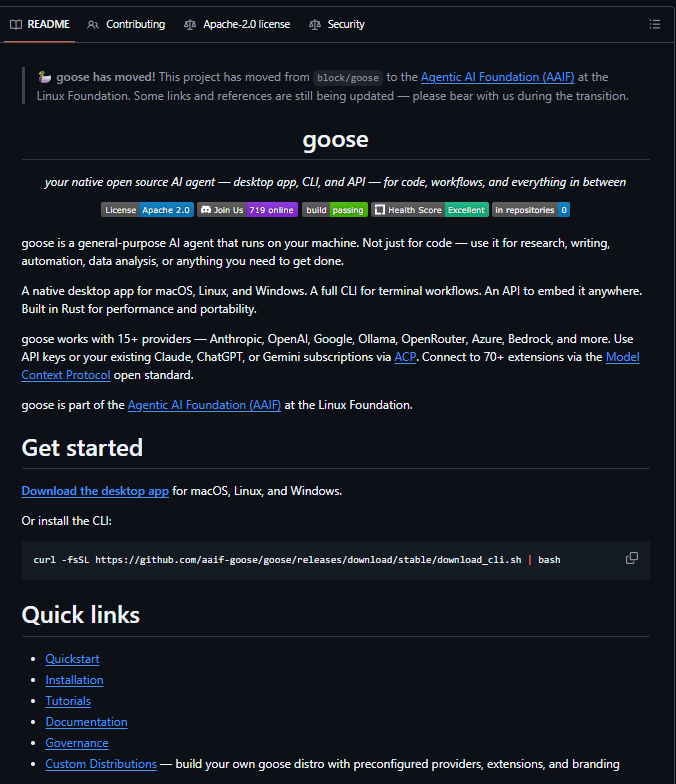
Jack Dorsey's new AI tool, Goose, is 100% FREE.
You type:
"Build me a website like YouTube."
And Goose gets to work on its own:
→ Creates the entire project
→ Writes all the code
→ Installs dependencies
→ Fixes errors automatically
→ Keeps going until it's working
The crazy part?
• No monthly subscription
• Runs on your own device
• Your code stays private
• Completely open-source
Just a few years ago, building software meant hiring developers or learning to code.
Now you can start with nothing but an idea.
We're entering a world where ideas are becoming more valuable than technical skills.
@Saboo_Shubham_ I greatly disagree. One and done interfaces based on dynamic data is a massive waste of compute. This is the whole reason why SaaS exists in the first place and AI, unless things greatly change (and most likely will), will not replace it.
The hardest part of building a good skill or Claude Code OS is getting your knowledge out of your head and into the system.
So use this skill.
Give this a 2 min read.