Lighter is quickly becoming the poster child for Ethereum’s rollup-centric roadmap, which was initially so heavily criticized.
All good things come last.
Building index-tracking assets on top of options instead of debt
https://t.co/gFNEvCbHct
What if the use options as the base of defi, instead of CDPs and liquidations? So instead of extreme price movements creating a sharp and global "you get liquidated" effect, instead your exposure to the index diverges quadratically from your preferred exposure in a smoother way?
A key benefit is getting rid of the need for instant oracles, and instead making everything work on top of "slow oracles" (ie. the type that prediction markets use)
This design has a significant downside - the need to do regular rebalancing - and an open question of whether and how this rebalancing can be made slippage-resistant enough. But it's worth considering and trying IMO. I would feel much safer holding algostables inside something like this, than in something that depends on an oracle that has to give real-time answers (and therefore could be tricked into giving wrong real-time answers with no time for human recourse).
"Blockchain users don't care about decentralization" is a take I've heard. What they actually care about are the things that meaningful decentralization offers:
- Censorship resistance
- Chain uptime / resilience
- Credible neutrality
- Exit rights
- Open source verification
The EU age verification app is presented as “completely anonymous”. But the risk is that member states (the countries are supposed to create their own versions of the open-source EU app) use it to introduce identity verification that makes it impossible to post anonymously on social media.
The idea behind “completely anonymous” is to use Zero-Knowledge Proof (ZKP) cryptography to break the link between the age credential issuer (EU governments) and the regulated services/sites. Currently, the EU app does not have ZKP functionality, contrasting Ursula von der Leyen’s claim that the app ”is technically ready to be used”. But more importantly, the app is designed to always function without ZKP technology; if ZKP is unavailable, the app falls back to a non-ZKP model. Even if fully developed ZKP technology could be implemented in the future, it would remain an optional extra feature that countries may choose to disable and that the EU could remove at any time.
This means that the EU could decide at any time that ZKP may no longer be used, and in one stroke the app would fall back to its default mode, meaning that every post on social media carries an ID tag. By that point, an infrastructure will already have been rolled out; people will have gotten used to it, and it will be harder to roll it back.
More details on https://t.co/wTVKHMS1zg
Rick Rubin’s House on the Mountain test:
Create according to your own taste, not for applause, critics, algorithms, or market demand.
“Imagine going to live on a mountaintop by yourself, forever. You build a home that no one will ever visit. Still, you invest the time and effort to shape the space in which you’ll spend your days. The wood, the plates, the pillows—all magnificent. Curated to your taste.”
“This is the essence of great art. We create our art so we may inhabit it ourselves.”
“I'm willing to go to extremes to make the thing that I want to inhabit and it's not for anyone else. it's just for me.”
my crypto investment thesis is rather simple:
Ethereum is the only smart contract platform that takes the blockchain trilemma seriously, aiming for security, decentralization, and scalability while upholding the cypherpunk ethos of neutrality and self sovereignty.
It was slacking on the scalability aspect for a while but that is now the primary focus without sacrificing security or decentralization. The current incremental steps have made transactions affordable now. The zk-rollup-ification of L1 in the roadmap will make it ultra scalable, too.
Dumbchains are not interesting as they have no on chain economies, and vc corposlop smart chains are cynical extraction machines.
Ethereum alone points to a brighter future that takes the masses some kind of power or agency back from the ever growing corpo fascist trend the world is moving to. When ETH does well, the entire industry does well, and vice versa.
No other blockchain ecosystem has people willing to fight for it like Ethereum, evidenced by the multitudes of devs and projects who choose to work on it without needing to be lured in by VCs and fat cheques.
These very qualities that make it appealing to cypherpunks also make it appealing to institutions as time after time, they prefer to work on open and neutral systems rather than closed/proprietary or biased ones.
Sure we all have nitpicks about the EF, myself included, but to their credit, they have cultivated an ecosystem that people care about beyond just pumping bags. It has a soul in an often soulless industry.
If ETH fails, then crypto has failed and the world will be a materially worse place. Call me naive or dumb, but I’d rather fight for something worthy of fighting for than succumb to a nihilistic stance focused solely on self-enrichment.
In short, it is the only chain/ecosystem in the space that isn’t garbage.
Congrats @Lighter_xyz ! This is one of the best reasons to build a financial app as an L2 on Ethereum:
1) An application-specific L2 can optimize for its own market design while still anchoring user rights to Ethereum.
2) The best onchain markets will have performance optimized at the app layer and user protection anchored in a settlement layer that the app does not control.
L2s can now have their own product experience while the final safety property lives somewhere more credible than any single application operator.
Users do not have to rely only on the team’s reputation as they can rely on a public verification process (L1 as a settlement layer, and a proven path back to Ethereum L1 if something goes wrong.)
The long term reliability of a venue is not measured only by who can trade during normal conditions. but by who can exit when conditions are abnormal.
I believe self custody of assets with private keys is legitimately one of the most powerful tools for sovereignty we have ever devised but the industry has completely bastardized this term to the point of uselessness. The original notion (in my mind at least) of self custody was having a string of letters and numbers or 12 words that unlock your assets. “Self-custody” when interacting with smart contracts and defi has become virtually meaningless at this point, encumbering coins with layers and layers of risks and dependencies, incredibly misleading
A lot of this narrative was ostensibly for regulatory reasons: “we don’t take custody of your assets, you deposit them in this pool or contract with self-executing code” but that’s so obviously not true at this point it’s an insult to our lived experience. Or, if it is “true” in the literal sense that the code technically always does what it is allowed to do, the “self-custody” component is very far down the list of what is actually important with these systems, a red herring really. Clearly Drift depositors didn’t (don’t) have “self-custody” of their funds. And the common retort is “well Drift doesn’t really either.” ok but North Korea does now.
At this point I liken self-custody in the context of defi to saying that you are the only one with the keys to the front door of a bank vault but there’s another door on the other side of the vault that criminals (or regulators, who knows) can enter with impunity and take your assets. Is it really that relevant that you’re the only one with a key to the front door?
The reason this is jading is because truly securing your wealth with private keys if you choose is a 0 to 1 unlock for some people (maybe the only real 0 to 1 unlock in this space) but that was conflated with all of these systems that have multisigs, upgrade keys, oracle dependencies, layers upon layers, turtles all the way down, often times with very obvious single points of failure. What is the value of self custody when a multisig can reorg your assets out of existence? The whole thing is very disillusioning
If you can't grasp the core concept of the freedom to transact uncensored without a middleman and how that is useful in an increasingly technocratic surveillance-centric world then you're woefully unprepared and ill-equipped for the future
The silver lining here is that when things like this happen, the market may finally begin to value cypherpunk approaches again, which should force more builders to go that route out of necessity of remaining competitive.
Some will come out and claim that we need more centralization to fix this, but we must seek to maximize user empowerment over paternalism when we think of security, otherwise we would just be pushing the problem further down the stack, not solving it.
Anyway.
CROPS will be vindicated. There will be a return to cypherpunk.
(PS: it’s a good time to read the EF mandate again, but deeply this time).
https://t.co/XJZlIgcedm
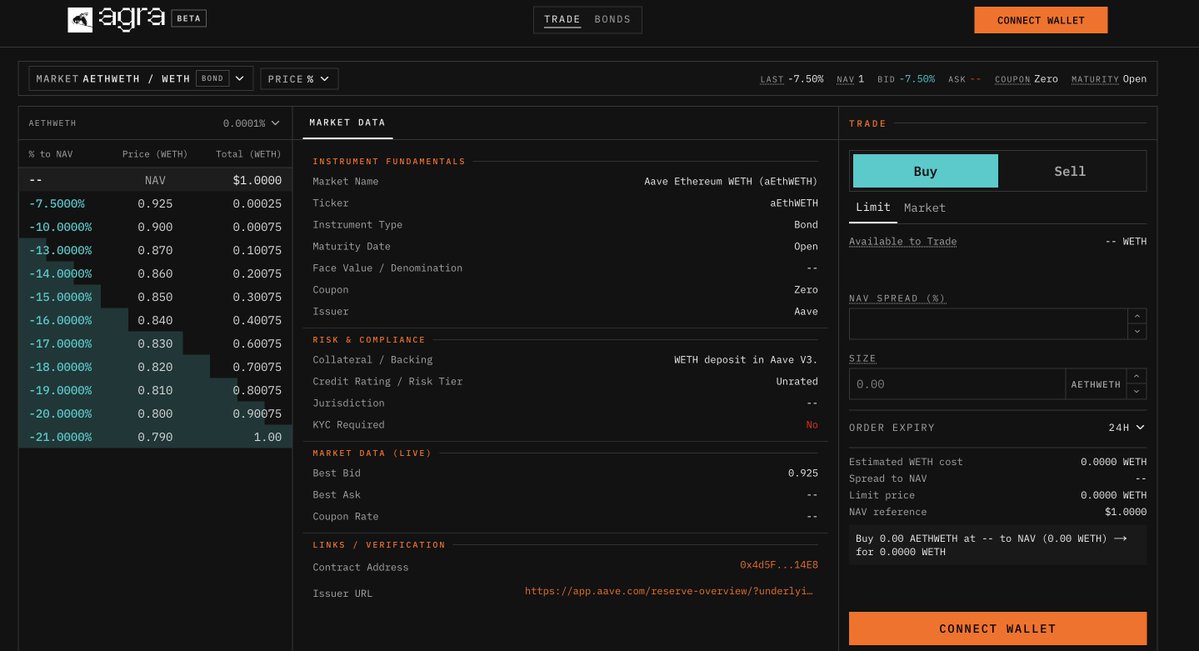
if you need some conviction in DeFi just look at this
within hours after the hack someone has spun up a marketplace for aEthWETH deposit tokens
if you can't withdraw right now, someone is willing to buy your illiquid deposit token from you
offers start at 7.5% discount