@dpeekdotcom I was just saying this the other day to a colleague. Git commit history is the only source of truth never to be out of sync. Markdown will get stale. I added that good commit messages could be criss-referenced to pull request descriptions as progressive disclosure
@angular One more..and i'm looking at it right now. Dated May 2020.
// Whoever decided to use ownedByUserId when we already have userId everywhere else is an asshole.
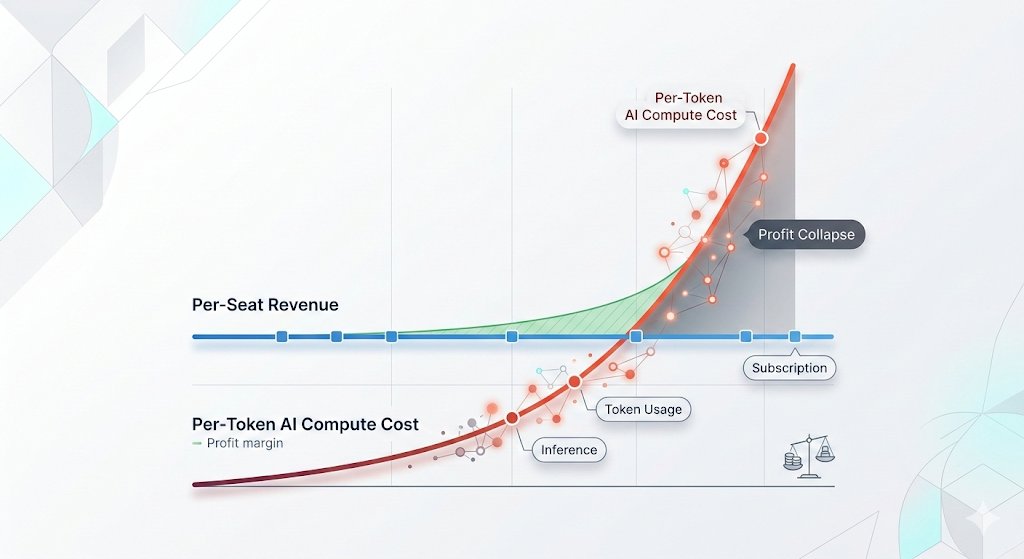
🦔Microsoft canceled its internal Claude Code licenses this week after token-based billing made the cost untenable, even for a company with effectively infinite cloud resources. Uber's CTO sent an internal memo warning the company burned through its entire 2026 AI budget in just four months. American AI software prices have jumped 20% to 37%, and GitHub (owned by Microsoft) is dropping flat-rate plans for usage-based billing across its products.
My Take
The AI subsidy era is ending in real time. The same company that put $13 billion into OpenAI and built the Azure infrastructure powering most of Anthropic's compute just looked at the bill from a competitor's coding tool and decided it was not worth paying. That is not a productivity failure on Anthropic's end. Token-based pricing is forcing every enterprise customer to confront the actual cost of running these models at scale, and the number turns out to be far higher than the flat-rate experiments suggested.
This ties directly to my Gemini Flash post yesterday. Anthropic, OpenAI, and Google all raised effective prices in the last six months. Enterprises that built workflows assuming AI costs would keep falling are now watching annual budgets evaporate in months. Two outcomes look likely from here. Either enterprises scale back AI usage to fit budgets, which slows the revenue ramp the labs need to justify their valuations ahead of IPOs, or the labs cut prices and absorb the losses, which makes the unit economics worse at exactly the wrong moment. Both paths land in the same place, the numbers stop working, and somebody has to take the writedown.
Hedgie🤗
What could possibly go wrong? Wasn't it just last week an AI agent wiped out a production database when it explicitly had instructions not to do destructive actions? No thanks.
A preview for Pro users: a new personal finance experience in ChatGPT.
Pro users in the U.S. can securely connect financial accounts, see where their money is going, and ask questions based on the information they choose to connect.
Your full financial picture, now in ChatGPT.
HUGE NEWS!
California AB2047 - the bill aimed at requiring 3d printers to have blocking software, has been GUTTED - and this is directly related to the incredible work @David_Tobin has been doing in the state, working with the California Handgun Association and the ACLU. THIS IS HUGE.
David is talking about this on his Instagram - https://t.co/calHnJq6Az
Updates soon on the channel, and see the fiscal breakdown that was instrumental at https://t.co/AQYa6WoL8b
BambuStudio has been violating PrusaSlicer AGPL license since their fork, with the same networking binary black box in question today. Why are they willing to burn the goodwill over it?
There's something most have sensed but never seen it all in one place, the five-law framework China built between 2017 and 2023 ⤵️
So maybe their hand is forced as their "network" is too valuable already? Each law on its own, interesting, okay... Read them together, and add any Chinese company with big reach to the mix you get the complete picture.
1) National Intelligence Law (2017)
All organizations and citizens must "support, assist, and cooperate" with intelligence work. The same law makes it illegal to disclose that cooperation happened. Cooperation is mandatory, and silence about it is mandatory too.
2) Cryptography Law (2020)
Commercial encryption must be state-approved and state-reviewed. When authorities request it, companies must provide decryption keys or plaintext. The state on both sides of that equation is the same one.
3) Data Security Law (2021)
Article 2 gives the state extraterritorial reach over data that touches Chinese national security or public interests. So EU/US data hosting does nothing to make it safe, because jurisdiction follows the company, not the server location.
4) Counter-Espionage Law revision (2023)
The general definition of espionage was expanded to cover "documents, data, materials, or items related to national security and interests." Industrial data is one of the intended targets since the revision.
5) Network Product Security Vulnerability regulation (2021)
Any company or researcher that discovers a software vulnerability must report it to MIIT within 48 hours. From there it flows to CNNVD (China National Vulnerability Database of Information Security), operated by the 13th Bureau of the Ministry of State Security. Microsoft's threat intelligence team documented Chinese state-hacker zero-day usage rising after this took effect. Shows the willingness to use the “tools” China built.
Together they describe a system with no neutral exits. Cooperation is required, encryption is real but the spare keys live at the ministry, jurisdiction follows the company across borders, industrial data is in scope, and discovered vulnerabilities flow to an intelligence agency 😬
3D printing became strategic for China in 2020 and joined the “Made in China 2025” plan soon after. Why does 3D printing matter so much? 1/x