Multiple best-selling author, pioneering online commentator. ~1 million readers turn to Mauldin for his view on market and history. 8 Kids. Luckily wed to Shane
Readers know my passion for longevity. There is now a therapy for aging issues like inflammation, muscle loss and reverses Alzheimer’s and dementia. See this powerful documentary and then read the serious in-depth research. https://t.co/frxDstB3QF DM questions about the business
Fareed’s @FareedZakaria piece in the Washington Post on why the tariffs aren’t working and how they are actually hurting us is well done. I might quibble with a few minor points, but his general point? Right on target. From the beginning of when I started writing my letter, I have said tariffs are a bad idea.
The result of President Trump’s tariffs has not been a manufacturing renaissance.
It has been higher prices, weaker investment, fewer manufacturing jobs — and a willingness to make falsehood official policy in order to defend a failed economic creed.
My latest column:
https://t.co/8MoZgoguBD
Narrative Bias
When the UK bond market went nuts, the press blamed Liz Truss tax cuts even though the Bank of England lifted interest rates, causing the problem.
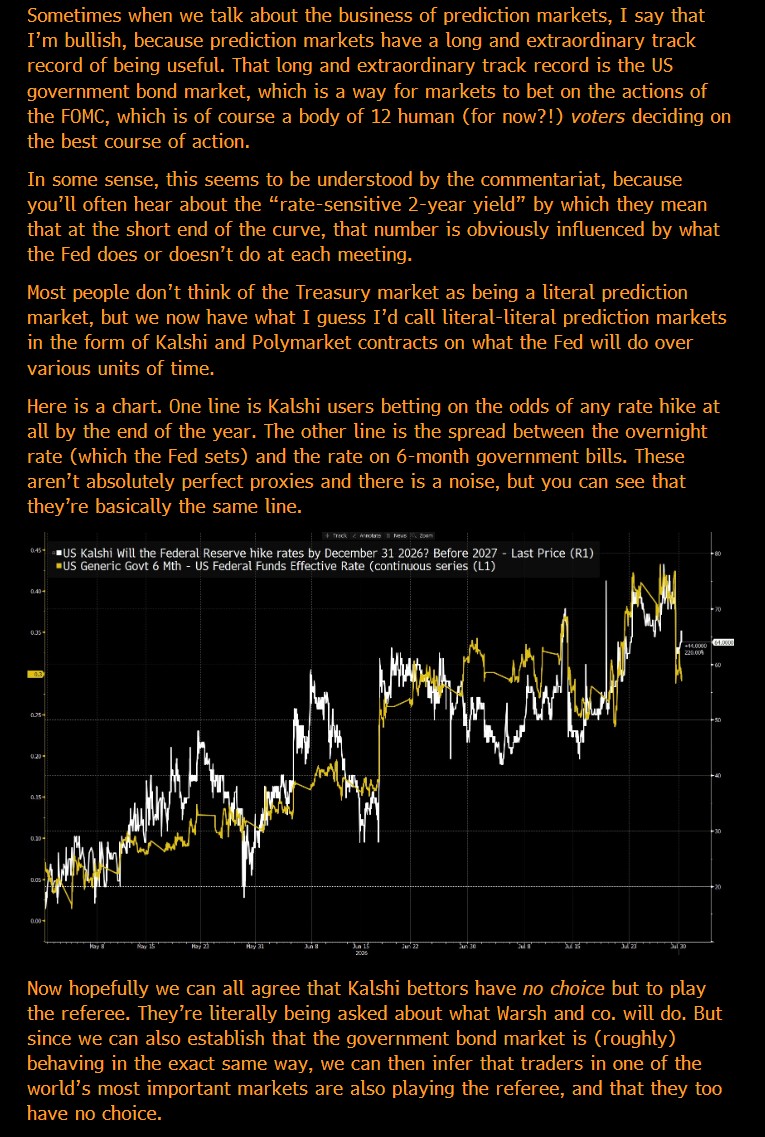
Now, with yields rising in the US, the press blames Kevin Warsh, not government deficits.
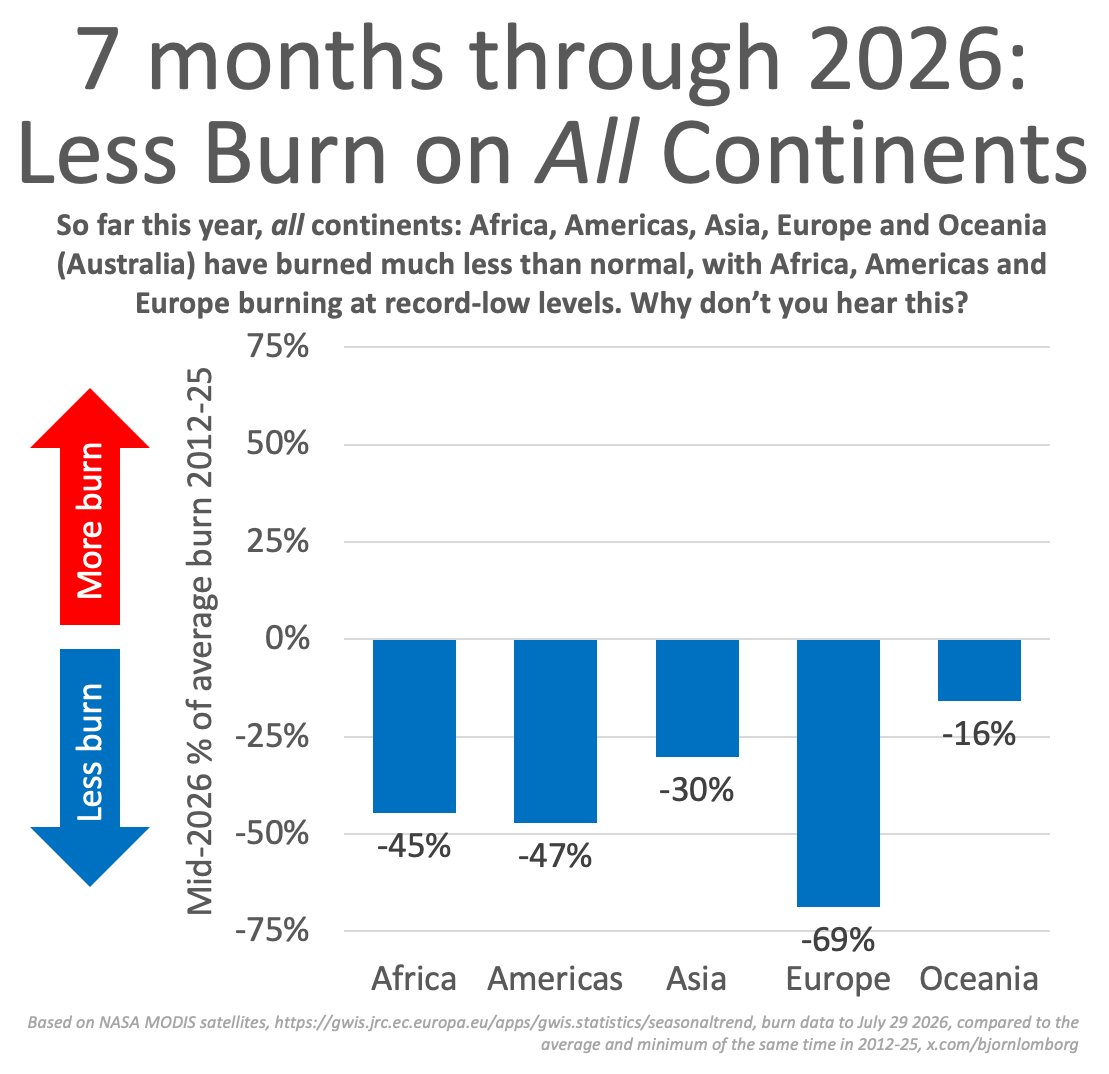
Less Global Fire
7 months through 2026:
Every continent is below average, and Africa, Americas, and Europe are at record lows
Yet, all you see is Canada (below average) and Europe (record-below average)
You are being badly informed on climate change
https://t.co/iDqlYckvRT
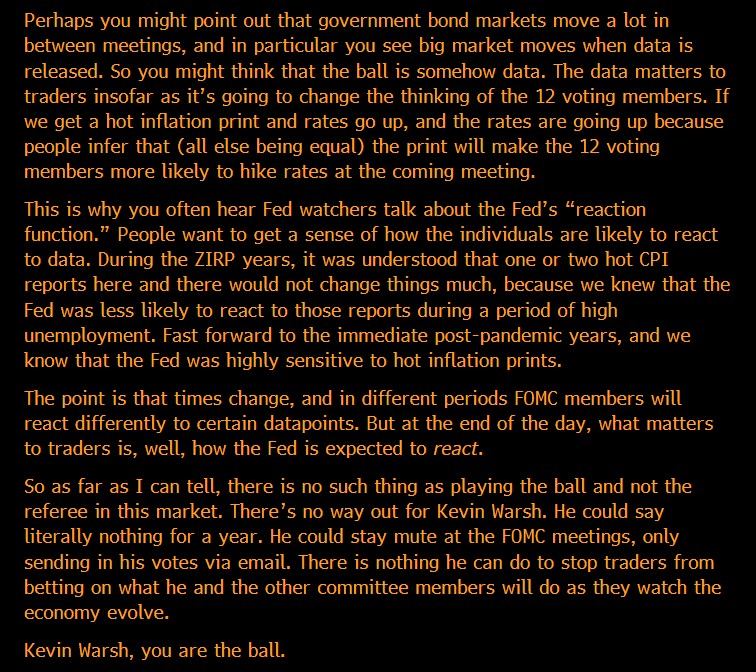
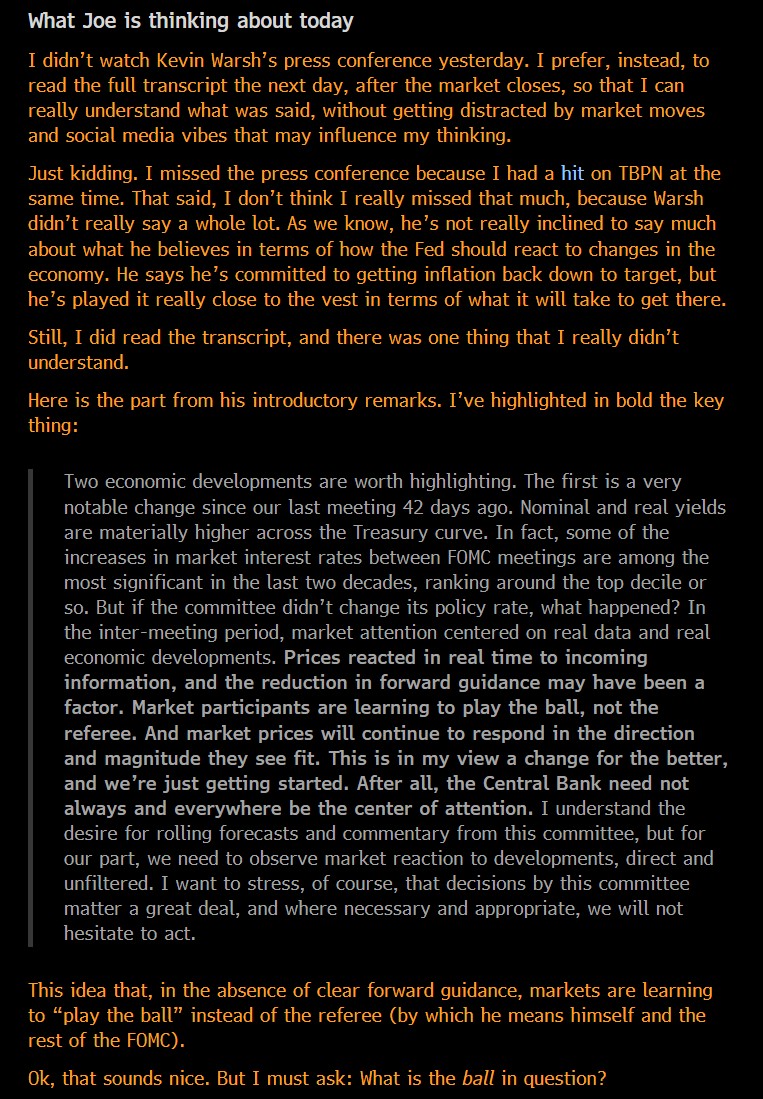
Kevin Warsh, YOU ARE THE BALL
In the newsletter, I wrote about yesterday's Fed press conference, and one thing in particular that I didn't understand.
Kevin Warsh says he wants the market to play the ball, not the referee. But I don't get how that's actually supposed to work.
Fed Gov Chris Waller voted to hold rates steady.
Waller said this on July 13:
"Sternly staring at inflation until it melts before our withering gaze is not an option."
I agree, as does the bond market.
So why did Waller vote to hold rates steady? Had he voted to hike, would the bond market's reaction today have been "calmer"
Our modern, high-speed information culture has become 'decoupled' from the slow-motion reality of our blue-green world.
This is the tragedy of a recent species that now lives its life in 'internet time' (seconds and hits) while the ancient world that sustains it operates in 'oceanic time' (over centuries and cycles).
Today's approach treats the atmosphere as if somehow it is the Earth's driving force. But the gauze thin film of the atmosphere is just a 'light breeze' compared with the might and power of ocean currents. We are obsessed with this one trace gas and the weather drama of the week, ignoring the measured, meaningful signals from the ocean deep.
The oceans are the true stakeholders of Earth's destiny, yet they are treated like a backdrop to a B-grade movie from the 1920s. When did we reinvent 'climate' as the world's latest ideological issue? When did we stop looking at the joyful storybook of the Earth or into its ocean depths?
Nature doesn't live in a global average anything. Even a tiny sparrow experiences the world through its local woodlands, seasonal rains and ancient territory.
By focusing on a climate spreadsheet we have lost connection with - or understanding of - the rich natural world. We have traded the joyful sights and songs of wild nature as click bait about some computer model.
We have become a 'now-focused' species. We inhabit a shallow world that demands instant answers for why it’s hot today. We forget that the deep journeys of the oceans might be responding to the sun and warmth from the 12th century.
To respect the ocean is to respect the relentless inertia of nature. The Earth cannot be broken or fixed by writing a new policy or a decade of data. Computer modelling has no place in nature. Earth is an ancient biological machine that created multicellular life and DNA all on its own. It doesn't care about human election cycles or social media trends.
We have seriously mistaken the airy breezes of the skies for the planet's engineroom. We count the air molecules in parts-per-million, while beneath us the oceans are the silent masters of time, circulating heat from a millennium ago.
We've traded our childlike wonder of a robin's song for globalised anxiety about spreadsheets. To truly love the world is to acknowledge its indifference to our fleeting, momentary ideological storms.
Stop Complaining
Wall St Keynesian establishment is in full panic mode, and for all the wrong reasons.
The moment markets begin functioning like markets again, the usual chorus returns, complaining about Kevin Warsh, fretting over higher rates, and mourning the end of central bank coddling. Their real grievance is not uncertainty. It is discipline. They want to be spoon fed.
For too long, the post-2008 consensus confused cheap money with growth and Fed intervention with wisdom. That game is over. What we are seeing now is an economy escaping secular stagnation and the liquidity trap, with capital finally being priced by risk rather than subsidized by policy.
Treasury Secretary Scott Bessent has been making this point for some time. The private sector, not technocrats, should set interest rates and allocate resources. Stop complaining.
The age of monetary paternalism produced distortions, dependency, and complacency. A more normal economy will offend the people who benefited from the abnormal one.
That is not a bug. It is the point.
🔥The PCE index, which the Fed targets cooled but not as much as the CPI in July and is still too hot!
As we warned, core services inflation, which is less sensitive to many of the external shocks we are enduring, remained remarkably stubborn, rising 3,8% from a year ago, only 0.1% cooler than the peak of May. The data are now stale and will show more inflation in July.
This was the data that the three dissenters were most focused on at the FOMC meeting yesterday.
GDP slowed, but most of that weakness was due to a widening trade deficit. Domestic demand accelerated, with consumers clocking in their best performance during the quarter since the third quarter of 2024, prior to the toll the six week government shutdown wreaked havoc on the economy.
Investment continued to rise, while a drop in federal spending took a toll on growth. Inventories were rebuilt modestly but are still lean.
In June:
Disposable incomes posted a small gain in June, rising at the fastest pace since early 2026. However, gains were driven by strong gains in Social Security and Medicare payments.
Spending outpaced those gains, buoying inflation. Gains were broad based as consumers spent what little they saved at the gas pump.
The saving rate dropped to 2.7%, it lowest level since the searing bout of inflation in mid 2022. Those losses understate the cushion affluent household have to keep spending going. A key issue will be the durability of equity market gains, which play an outsized role in supporting spending for affluent households with large stock portfolios.
🔥The PCE index, which the Fed targets cooled but not as much as the CPI in July and is still too hot!
As we warned, core services inflation, which is less sensitive to many of the external shocks we are enduring, remained remarkably stubborn, rising 3,8% from a year ago, only 0.1% cooler than the peak of May. The data are now stale and will show more inflation in July.
This was the data that the three dissenters were most focused on at the FOMC meeting yesterday.
GDP slowed, but most of that weakness was due to a widening trade deficit. Domestic demand accelerated, with consumers clocking in their best performance during the quarter since the third quarter of 2024, prior to the toll the six week government shutdown wreaked havoc on the economy.
Investment continued to rise, while a drop in federal spending took a toll on growth. Inventories were rebuilt modestly but are still lean.
In June:
Disposable incomes posted a small gain in June, rising at the fastest pace since early 2026. However, gains were driven by strong gains in Social Security and Medicare payments.
Spending outpaced those gains, buoying inflation. Gains were broad based as consumers spent what little they saved at the gas pump.
The saving rate dropped to 2.7%, it lowest level since the searing bout of inflation in mid 2022. Those losses understate the cushion affluent household have to keep spending going. A key issue will be the durability of equity market gains, which play an outsized role in supporting spending for affluent households with large stock portfolios.
It’s time for the Federal Reserve to issue M2 on a weekly basis. They stopped not long ago, and only issue the data once a month now. This suggests that the Fed doesn’t think money matters and they disagree with Milton Friedman. The Fed is wrong and we need more transparency.
This is jim Bianco’s @biancoresearch response to a question about the forward guidance process of the Fed. Worth at least two reads. I look forward to seeing Jim next week. I always learn a lot.
The Warsh press conferences aren't going to work in their current form, and it isn't because he's dodging.
The post-meeting press conference is a vehicle for forward guidance. Warsh has stopped it and restated that today at the top he is "steering clear of forecasting," and "market participants are learning to play the ball, not the referee."
Today he took 20 questions from 11 reporters, and by my count 14 asked for a future path or reaction function, 8 of them outright. That's not a lazy press corps. It's a room with no other established question, asking the only one it knows eight different ways and getting declined eight times. Everyone did their job, and the exercise still produced almost nothing.
The few reporters who asked him to characterize the committee rather than the path got real answers.
The missing half is the dissenters. Asked about them, Warsh said, "I'll let the dissenters speak for themselves." The problem is they have nowhere to do it. The statement names them and stops. Their reasoning arrives three weeks later in the minutes as "some participants," unattributed, unless they do it on their own after the blackout period ends two days later.
So the fix is mechanical. Publish two paragraphs from each dissenter with the statement. Then ask the chairman to characterize the majority he voted with, and to respond to what the dissenters actually wrote.
Stop asking him to steelman the side he voted against, as he was today; he said, "I guess I shouldn't give you their best arguments," which is a fair answer to an unfair question.
By the way, forward guidance hasn't disappeared. It has moved to the vote. See the increased dissents in recent months. The communications format needs to change.
Conveniently, Mervyn King co-chairs Warsh's communications task force. He ran the central bank that already publishes the vote split and the dissent's reasoning at the same moment as the decision. Findings are due by year-end.
Until then, expect awkwardness at the pressers.
Dear QE, the problem is if you are 55 and thinking about retirement. Why? Maybe switch careers or whatever, but retiring? Actual sit on then porch, golf or whatever? Your body will slow and age a lot faster in actual retirement.
I’ll die on this hill:
The hardest part of life is 55-60 years old.
You’re trying to get to the retirement finish line but you face age discrimination, DEI, and just general disrespect for being older.
It’s a total grind and you have to dig in.
I get that there are tech stocks in massive drawdowns right now
It's just kind of funny to see ppl talking about buying while there's blood in the streets when the S&P 500 is 1% off all-time highs
I mean, look, Fetterman's only opportunity to remain in the Senate past 2028 is if he switches parties or runs as an independent. He would get crushed in a D primary. Unlike Sinema, he's actually popular enough with Republicans that he could win a GOP primary.
OK, I shot off the posts without looking at the replies. There are some serious baseball aficionados who have replied to this post. It was a walk down memory lane. Of course you have to think about Barry Bonds and Hank Aaron and a host of others. What a pleasant way to spend the few moments before I go to sleep.
Although I might quibble with the choice of Johnny Bench as the greatest catcher of all time. Yogi Berra comes to mind, the greatest I ever got to watch personally was Pudge Rodriguez when he played for the Texas Rangers and I had an office in the right centerfield stands and got to watch him on a daily basis. Gods, he had the best arm ever. And I might want Mickey Mantle in the outfield.