Is the Phillips curve useful to make sense of inflation?
A.W.H. Phillips first postulated a negative empirical correlation between inflation and the level of economic activity. Looking at inflation in 2021-24---up and down---versus measures of unemployment---roughly unchanged---shows little correlation. Has the Phillips curve failed, yet again? No, it did not.
Friedman and Phelps, almost 50 years ago, clarified that this correlation should only hold keeping expected inflation fixed. Almost every account of how firms choose prices or bargain wages with their workers predicts that expectations would show up in a Philips curve. Moreover, those models of behavior further add that increases in marginal costs (supply shocks) would further shift out this relation. The empirical Phillips curve has for many decades meant a negative relation between inflation and real activity, controlling for expected inflation and supply shocks.
The left figure below shows on the vertical axis inflation, after controlling for expected inflation---mean and disagreement from a household survey---and for supply shocks---gas prices and global supply pressures. The horizontal axis shows a measure of slack in the labor market---the log of the ratio of unemployment to job vacancies. The Phillips curve held nicely and steadily throughout.
A criticism of that figure is that its is looking in the rear view mirror: the measure of supply shocks and the measure of slack were developed in the last few years and the data has been revised. The right figure does instead an out-of sample exercise. Estimate a regression of inflation on (i) expected inflation, (ii) the difference between the unemployment rate and the CBO estimate of its non-cyclical component, and (iii) the PCE energy price index. Do it on data pre-pandemic: 1984Q1-2020Q1. Using that estimated equation, predict inflation in real time from then onwards using the data releases available at the time of the forecast. The Phillips curve was a pretty good predictor of inflation throughout.
The Phillips curve was stable during the inflation surge, and it predicted well the movements in inflation, with expectations playing a key role in those predictions.
Notes: it is important to include the right measure of expectations to understand inflation-activity dynamics at a business-cycle frequency: the short-horizon expectations of households and firms. (For instance, the long-horizon expectations from professionals, or the expectations from models in policy institutions, as in my previous two posts, are the wrong measure.)
Sources:
(i) Section 3 in Reis "Why Did Inflation Rise and Fall in 2021-24? Channels and Evidence from Expectations"
(ii) The simple exercise on the left figure is inspired on the analysis of Bernanke and Blanchard “What Caused the US Pandemic-Era Inflation?”
(iii) The simple exercise on the right figure is inspired on @jadhazell "Comment" in the NBER macro annual 2025, which in turn built on Beaudry, Hou, and Portier "The Dominant Role of Expectations and Broad-Based Supply Shocks in Driving Inflation"
Using labor force surveys from 160 countries to build a new microdatabase on hours worked covering 97 percent of the world population to explore working hours determinants, from @amorygethin and Emmanuel Saez https://t.co/B720Hjqf7l
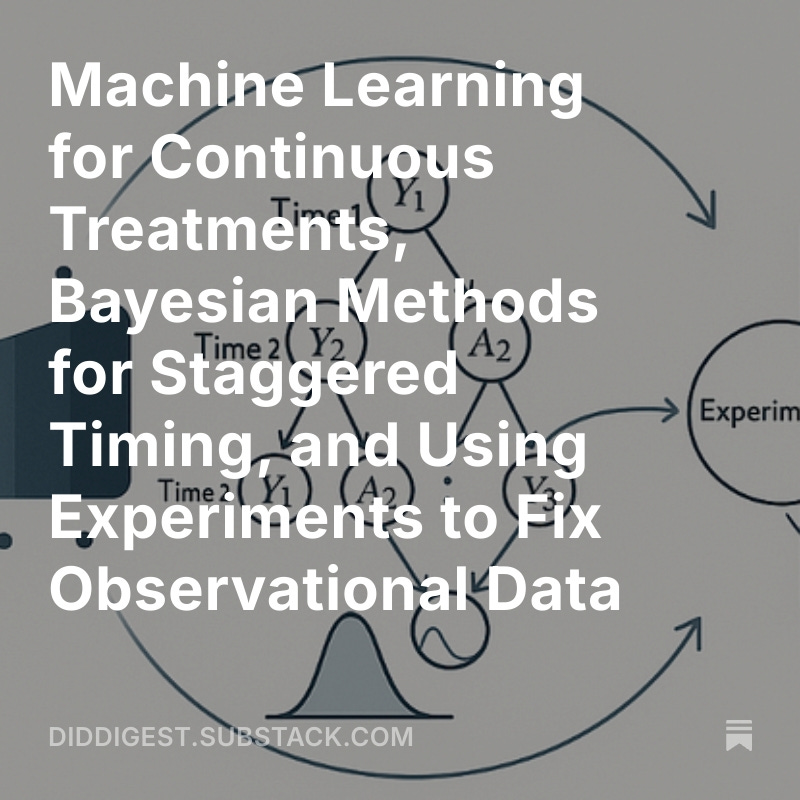
As promised, here's a new post :)
We’ve got 2 new DiD papers, 1 fantastic DiD guide, and a clever method from Athey–Chetty–Imbens on using experiments to fix observational bias
Link: https://t.co/UKrFl0xN4e
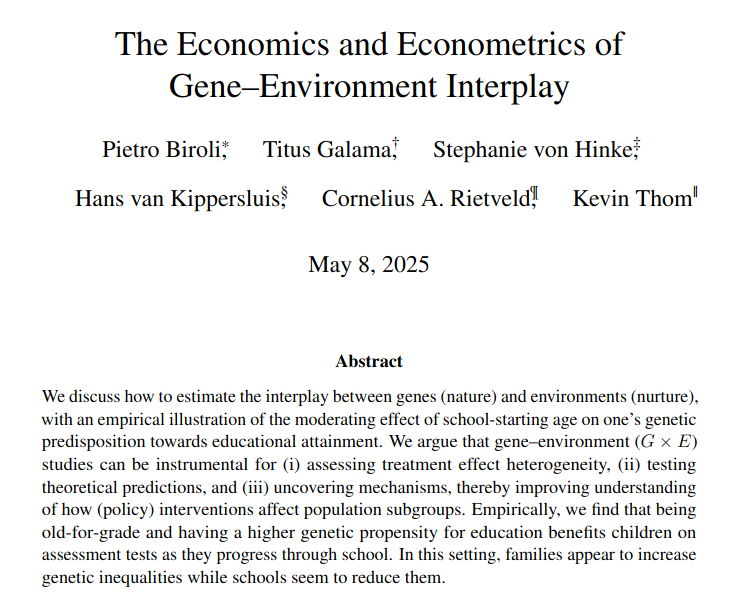
"We provide a guide for researchers on how to estimate gene-environment (GxE) interplay, using school-starting age as a case study. We argue that gene-environment (G x E) studies can help
(i) assess treatment effect heterogeneity,
(ii) test theoretical predictions, and 👇
1/
Our paper on "CBDC and the operational framework of monetary policy" with @NunoGalo and Carlos Thomas is now forthcoming in the Journal of Monetary Economics! https://t.co/qpcqCeL4fe
Happy to see this paper in print (joint with @zliu001 and @YajieWang_econ)-- thanks to the associate editor and referee. I'll write a short thread soon. Here is the link with free access (until March 5):
https://t.co/aiZAH2HOyV
“the intellectual shifts today is that we are returning to oikonomia. The political right wants to “manage” national security; the left wants to “manage” our ecology and social equity. Either way, it is Homo politicus, not Homo economicus, who dominates” https://t.co/8h42jUJwoY
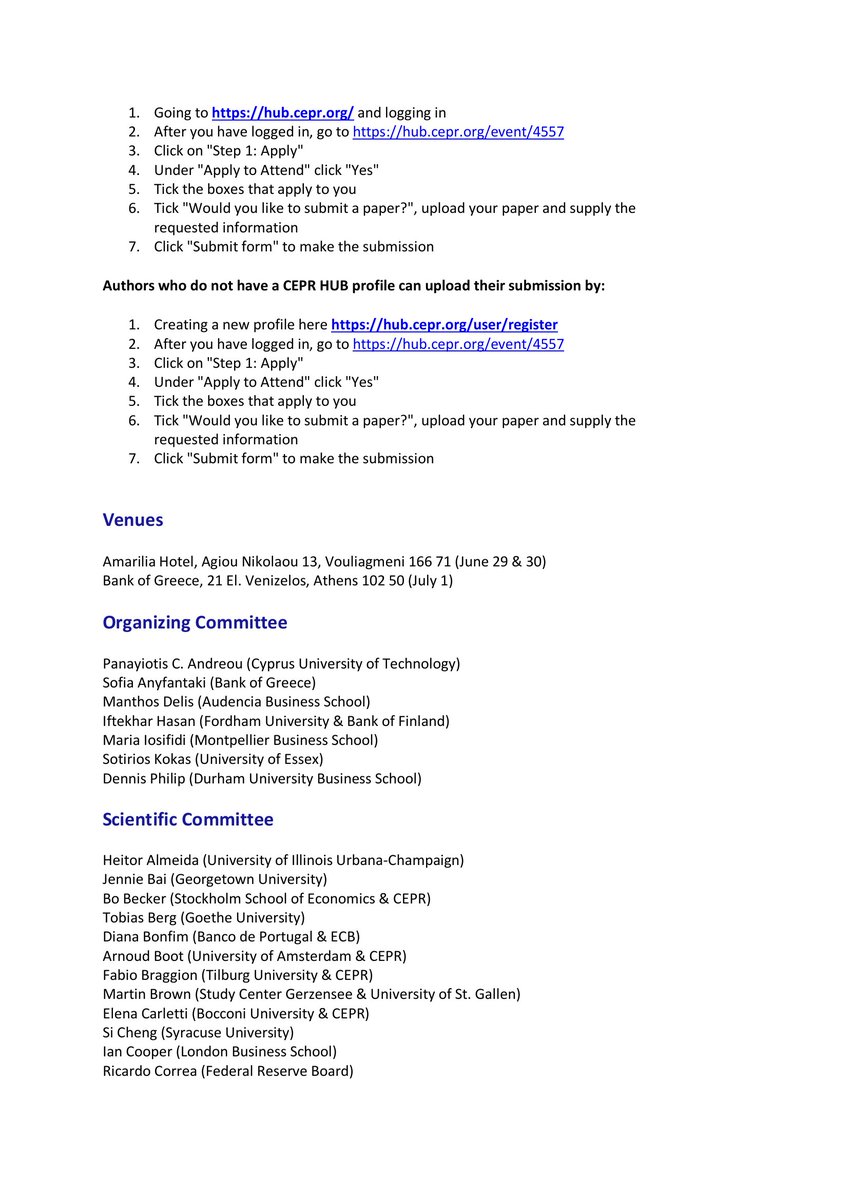
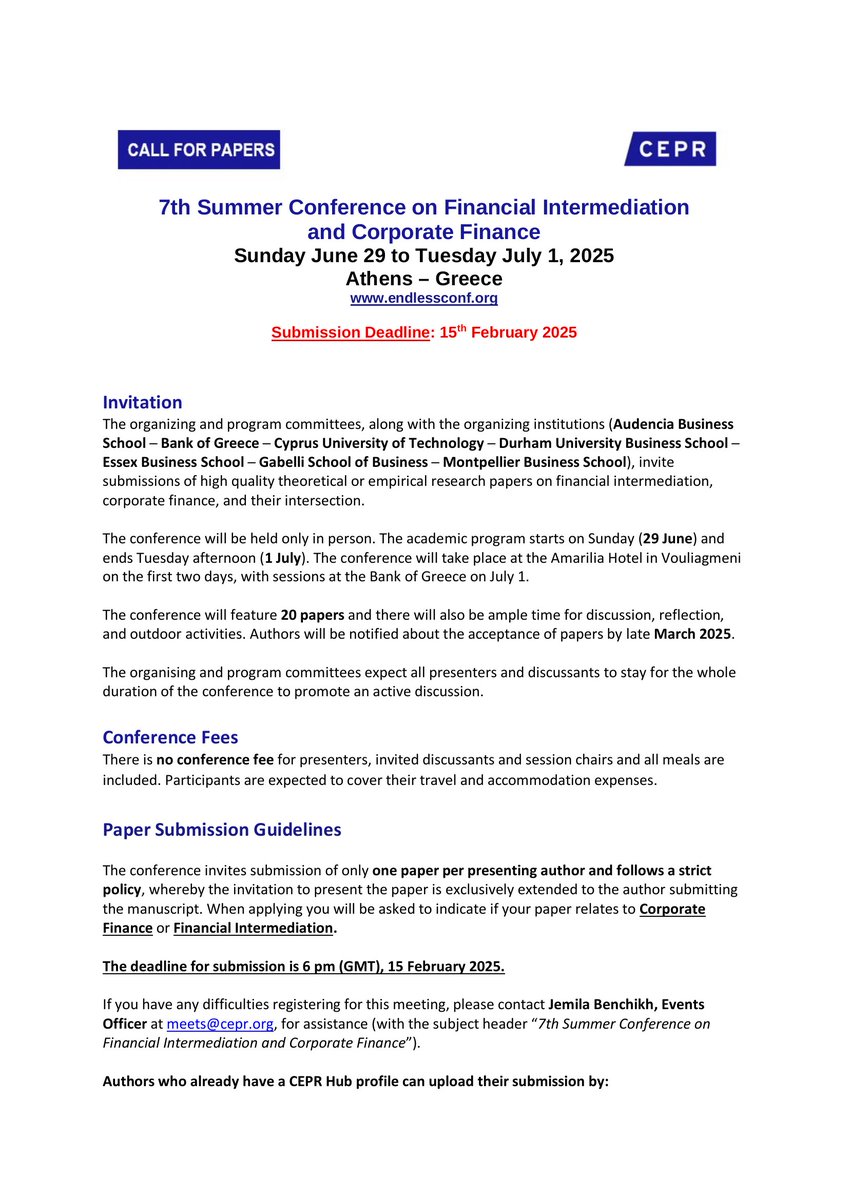
📢 Call for Papers 📢
Join us for the 7th @cepr_org Summer Conference on Financial Intermediation & Corporate Finance!
🗓 June 29 - July 1, 2025
📍 Athens, Greece 🇬🇷
🗓 Deadline: Feb 15, 2025
🔗 Submit here: https://t.co/YlxpvxVKGl
🌐 More info: https://t.co/Yq6oiOcYj1
I am pleased to share with you the Call for Papers for #SEHO 2025, scheduled to take place from June 10 to June 11 in Zaragoza. Please note that paper submissions will close on December 31, 2024. Full submission details can be found here:
https://t.co/F7VUwfOPGE
Our Center for Inflation Research and the @ecb will host the Inflation: Drivers and Dynamics 2024 conference Oct. 24–25. The event will bring together top researchers to present research related to inflation. Virtual registration is now available: https://t.co/BaQGITjorm
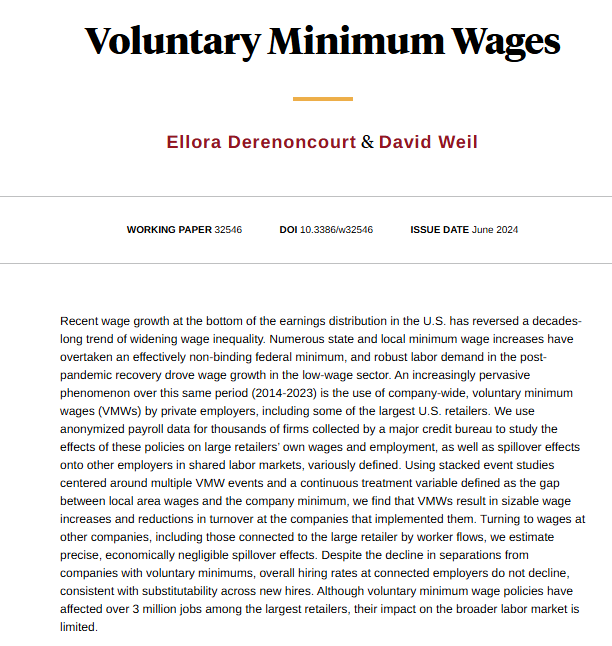
Company-wide voluntary minimum wages by private US employers have raised pay in millions of jobs in those firms, but their spillovers to the broader labor market are limited, from @EDerenoncourt and @profsheena https://t.co/S7WnD97ogl
``Successful performance of democratic regimes is critical for support for democracy."
From @DAcemogluMIT, Ajzenman, Aksoy, Fiszbein and Molina:
https://t.co/ky64gAzKQY
Authors find that intergenerational mobility declined sharply around 1980 when inequality rose sharply. Just Accepted new paper by JJonathan Davis, @jonmvdavis; Bhashkar Mazumder, @BhashMazumder. https://t.co/CZCo0xrQzq