@brian_armstrong Reminds me of what Steve Jobs said in his Stanford commencement speech "you can't connect the dots looking forward; you can only connect them looking backwards. So you have to trust that the dots will somehow connect in your future."
The older you get, the more you realize luck is just exposure.
If you sit in the same chair, same routine, talking to same people… nothing new happens.
You have to touch the world to win.
• Talk to strangers
• try a new coffee spot
• post on social
• Start a side hustle
The world rewards motion.
You don’t find opportunity sitting still.
You bump into it.
OpenAI published a repo with the code to orchestrate AI agents built primarily with Elixir (96.1%): https://t.co/D1CnU82OTS.
While explaining why they chose Elixir, they say that
- It is great for supervising long-running processes
- It has an active ecosystem of tools and libraries
- It supports hot code reloading without stopping
actively running subagents, which is very useful during development.
Amazing news for the Elixir community; I hope even more people will appreciate how amazing Elixir is for agentic AI systems.
#myelixirstatus
After hearing from developers building with AI agents, we expanded access to our API.
Since then, programmatic card creation on our platform has exploded.
You know what this needs? An event bus
You know what this needs? A hard boundary at the network layer between "services"
The footgun is almost always adding N+1 stateful services because someone says "it's more scalable"
everybody on your timeline is lying to you about OpenClaw
I started using it pretty much the first week it came out, and I was impressed and went deep into the rabbit hole
its not the 24/7 AI agent that everyone is making it seem like, not even close
if you need to build a website or code something, just use Claude Code or Codex directly. if you need to generate images, go straight to Nano Banana or Higgsfield.
Using OpenClaw for these things is like taking a detour through 5 cities to get to the house next door
the people telling you "just install OpenClaw and let it run your business" are either lying to you or havent actually used it for more than a demo
it breaks constantly. it forgets context. it takes 10x longer than just using the right tool for the job. the experience right now is clunky and inefficient for most real workflows
does that mean its useless? no. I still use it. I think once the context memory problem gets solved this thing is going to be legitimately powerful because the foundation is there
but we're not there yet and pretending we are just so you can get engagement is doing a disservice to people who actually want to learn how
to use AI properly
use it. practice with it. get familiar with it early. but dont throw away the tools that actually work right now just because some guy told you OpenClaw replaces everything
soon.
Figma shipped a silent patch specifically to kill figma-use — my open-source tool that did what they wouldn't: an MCP server that creates and modifies designs, JSX export, design linting. Then they scrambled to catch up with their own MCP server.
So I spent the weekend recreating @Figma from scratch.
OpenPencil: reads and writes .fig files, AI chat with full design tools, P2P collaboration with zero servers, ~7 MB app. No account, no subscription.
Three days, one developer, MIT license.
https://t.co/bPtP6JPbq0
It is hard to communicate how much programming has changed due to AI in the last 2 months: not gradually and over time in the "progress as usual" way, but specifically this last December. There are a number of asterisks but imo coding agents basically didn’t work before December and basically work since - the models have significantly higher quality, long-term coherence and tenacity and they can power through large and long tasks, well past enough that it is extremely disruptive to the default programming workflow.
Just to give an example, over the weekend I was building a local video analysis dashboard for the cameras of my home so I wrote: “Here is the local IP and username/password of my DGX Spark. Log in, set up ssh keys, set up vLLM, download and bench Qwen3-VL, set up a server endpoint to inference videos, a basic web ui dashboard, test everything, set it up with systemd, record memory notes for yourself and write up a markdown report for me”. The agent went off for ~30 minutes, ran into multiple issues, researched solutions online, resolved them one by one, wrote the code, tested it, debugged it, set up the services, and came back with the report and it was just done. I didn’t touch anything. All of this could easily have been a weekend project just 3 months ago but today it’s something you kick off and forget about for 30 minutes.
As a result, programming is becoming unrecognizable. You’re not typing computer code into an editor like the way things were since computers were invented, that era is over. You're spinning up AI agents, giving them tasks *in English* and managing and reviewing their work in parallel. The biggest prize is in figuring out how you can keep ascending the layers of abstraction to set up long-running orchestrator Claws with all of the right tools, memory and instructions that productively manage multiple parallel Code instances for you. The leverage achievable via top tier "agentic engineering" feels very high right now.
It’s not perfect, it needs high-level direction, judgement, taste, oversight, iteration and hints and ideas. It works a lot better in some scenarios than others (e.g. especially for tasks that are well-specified and where you can verify/test functionality). The key is to build intuition to decompose the task just right to hand off the parts that work and help out around the edges. But imo, this is nowhere near "business as usual" time in software.
@mattpocockuk been noticing this too. treating the AI like a junior dev you're reviewing makes way more sense than expecting it to just know what you want
the feedback loop thing is huge, same muscle as code reviews but faster iterations
@13_thirteenn Agreed. I'm reading C++ standards and design philosophy again because I have so much extra brainspace. I get to learn about the fun fiddly bits while claude does the boring stuff.
I worked in tech for almost 30 years but took over my family retail business. Marketing came to me and asked to buy some business card QR to contact page service for 150 per year. I built that on the same evening and it even creates the print-ready business cards. So, yes, if you know how it‘s done, AI is a super power. Marketing would not been able to do that on their own.
Building it, deploying it, hosting it. DNS, SSL CERTs, Firewall, database, Object Storage. Too many things that come natural to an experienced developer but are completely arcane to anyone else.
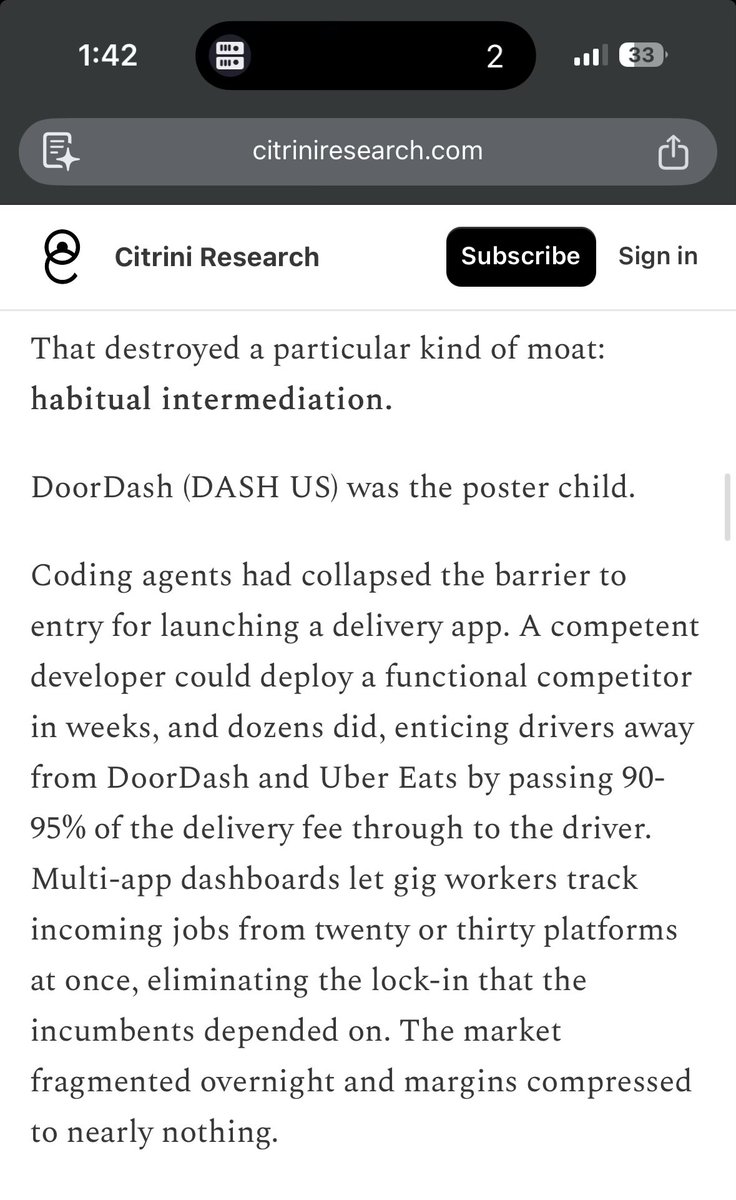
Out of every example they could’ve chosen, they went with DoorDash?
The barrier to entry for launching a delivery app is not and has never been software, it’s distribution, restaurant adoption, user adoption
Who is believing this stuff
I find it very funny when anyone feels confident that they've figured out agentic programming, even funnier when they're trying to teach others how to do it. I've been working on OpenCode since May of last year and I still have days (like yesterday) where I'm not even sure any of this is a good idea lol
I end up landing on "yes, these models are an incredible tool" but it's still all very confusing, lots of tangled thoughts and emotions and realities.
I badly miss the mundane coding tasks that broke up my days/weeks, the ones where you put on the headphones and just bang out 600 lines of code. But, no question, replacing those hours of my time with a few minutes of waiting on an agent is a boost and worth being excited about, despite the mixed emotions.
Then there's the distance that can creep in between you and the codebase if you start getting apathetic. I think it's pretty common at this point to make even small changes by prompting the models. It's less friction than finding the relevant code and making the change yourself. And less friction seems to win, must be some law of the universe or some shit. When most or all of your interactions with a codebase start flowing through the models, you start to lose track of where things live, which abstractions/components are carrying the weight, etc. It's a scary feeling to wake up and realizing you can't even reliably @<mention> a precise file for a change you want to make, and you have to get more vague, leaning harder on the model.
It all creeps up on you, there's an undeniable dopamine hit from using these things, and the resulting come down is predictable, like coming off a sugar high. On the positive side, it's really nice seeing other devs go through the same cycles, knowing we're all in this together and we'll ultimately figure it out.
Today I launched "Figures", a daily number puzzle game I made, inspired by the much-missed, short-lived NYT Digits game.
The idea came to me when I saw a video of a toddler watching the math game show “Countdown,” impressively solving problems right along with the contestants.
I decided to build a game around that concept, only to discover later that the New York Times had used that same concept for their (now discontinued) game Digits. So, I set out to bring it back to life with my own spin.
You can play it here: https://t.co/4Q4rIJx4dE