En 1979, un presentador de TV le preguntó a Milton Friedman si no le daba vergüenza defender un sistema basado en la codicia.
La respuesta se estudia hasta hoy:
«—Cuando ves la mala distribución de la riqueza, tan pocos que tienen tanto y tantos que no tienen nada… ¿nunca has dudado del capitalismo, de si la codicia es una buena idea?
—Primero dime: ¿conoces alguna sociedad que NO funcione con codicia? ¿Crees que Rusia no funciona con codicia? ¿Que China no?
¿Y qué es la codicia? Ninguno de nosotros es codicioso, claro. El codicioso siempre es el otro.
Los grandes logros de la civilización no salieron de despachos del gobierno. Einstein no construyó su teoría por orden de un burócrata. Ford no revolucionó el automóvil así.
Los únicos casos en la historia en los que las masas escaparon de la pobreza son aquellos donde hubo capitalismo y libre comercio.
—Pero parece premiar la habilidad de manipular el sistema, no la virtud.
—¿Y qué premia la virtud? ¿Crees que un comisario comunista premia la virtud? ¿Un Hitler? ¿Crees que los presidentes americanos eligen sus cargos por virtud… o por peso político?
Dime: ¿dónde están esos ángeles que van a organizar la sociedad por nosotros?
Yo ni siquiera confío en ti para hacerlo.»
It's kinda crazy how every headline is like "It's a win for builders" and "It's a win for investors" but never "It's a win for renters." And they're the people who actually live in these homes.
More supply = win for renters.
This is one of those "it's true but also misleading" narratives.
Make more than $75k as household (with roommates)? Median is <20% of income on rent.
Make less than $30k as household? Median is >80% of income on rent.
The K shape.
That is the real story.
I have changed my mind on how AI will impact jobs in America.
Previously, I believed AI would replace many entry level roles typically filled by young employees. The technology would then work its way up the organization and eventually reduce the total number of jobs in a company.
The data is saying something different, so when I get new information I am willing to change my mind.
The number of software engineers being hired has been increasing. The number of open software engineer roles is growing.
The number of new college grads who get hired has increased 5.6% over the last 12 months. The unemployment level for people aged 20-24 years old who have a college degree has fallen from nearly 9% to almost 5% as well.
The Wall Street Journal recently wrote “AI created 640,000 jobs between 2023 and 2025 in the U.S., according to an analysis by LinkedIn of job posting data, including new white-collar positions such as Head of AI and AI engineer.”
And I am starting to see companies throughout our portfolio aggressively hiring to keep up with the demand for their products and services.
If AI can make employees more productive, which is widely accepted as fact, then companies are going to want as many productive units of labor as possible. This is a key reason why I am changing my mind.
AI appears to be a magical technology that will make companies more productive and more profitable. The net result will be more corporations, more startups, and more jobs.
All three are big, positive wins for the American economy.
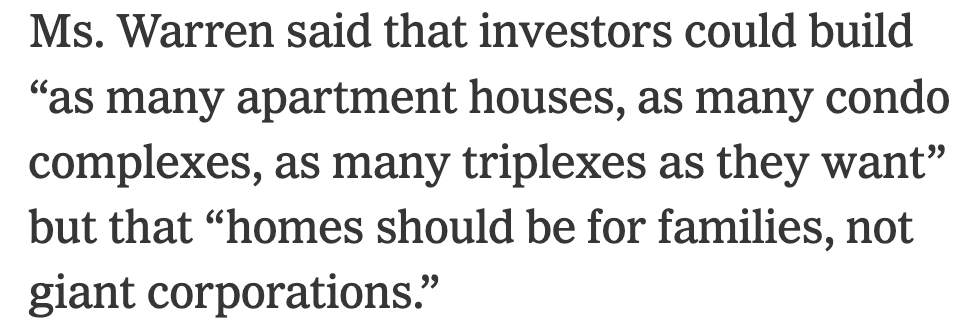
Why would any progressive say (effectively) that families don't deserve to live in a single-family house until they're wealthy enough to buy?
Truly bizarro-land, regressive stuff under guise of "investors are bad" mantra.
The Warren team seems to believe both that 1. investors are harming tenants by building new rental stock and 2. this is fine so long as the buildings are apartments
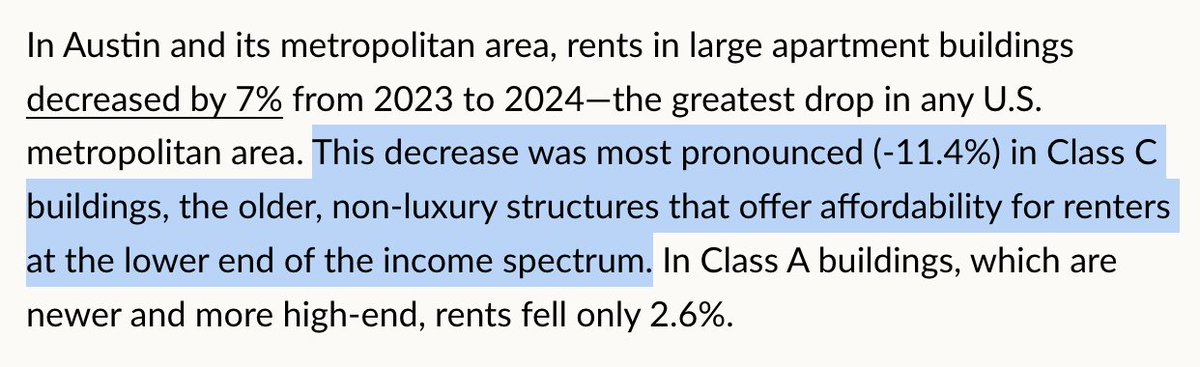
This is shaping up as the most consistent finding in housing studies: Building lots of luxury housing can reduce rents at the top of the market—but the people it helps most are renters struggling to afford even the least desirable units
Naval is right, and the math proves it in a way most people aren’t processing.
GPT-4 launched at $60 per million output tokens. Today, equivalent capability costs under $1. That’s a 98% price collapse in two years. Demand didn’t fall. It exploded. OpenAI went from $1B to $12B+ in ARR while slashing prices every quarter.
This is Jevons Paradox at civilizational scale. When coal got cheaper in the 1800s, England didn’t use less coal. They burned 10x more. Intelligence is following the same curve, except the adoption rate is compressing a century of energy economics into 36 months.
The part nobody’s thinking through: every previous commodity with “unlimited demand” eventually restructured the labor market around it. Electricity didn’t create unlimited demand for electricians. It eliminated most of the jobs that electricity replaced and created entirely new ones that didn’t exist before.
The 280x cost reduction Stanford measured between 2022 and 2024 means a task that cost $1,000 in AI compute now costs $3.57. At that price, companies don’t just automate what humans were doing. They start doing things that were never economically viable at human-labor pricing. Analysis that would have required a $200K analyst for a year now runs for $50 in an afternoon.
Unlimited demand for intelligence at near-zero marginal cost means intelligence stops being the scarce input. Taste, judgment, and the ability to ask the right question become the bottleneck. The returns flow to people who can direct intelligence, not people who provide it.
That’s the real trade: the value of raw intelligence is cratering while the value of knowing what to do with intelligence has never been higher. And that gap is only getting wider.
@jayparsons All as would be expected. And now there’s proof. The push to bar the most efficient capital from competition for housing supply is so short-sighted and sure to backfire. And I say this as a BTR developer that stands to personally benefit from these policies.
How's this for irony?
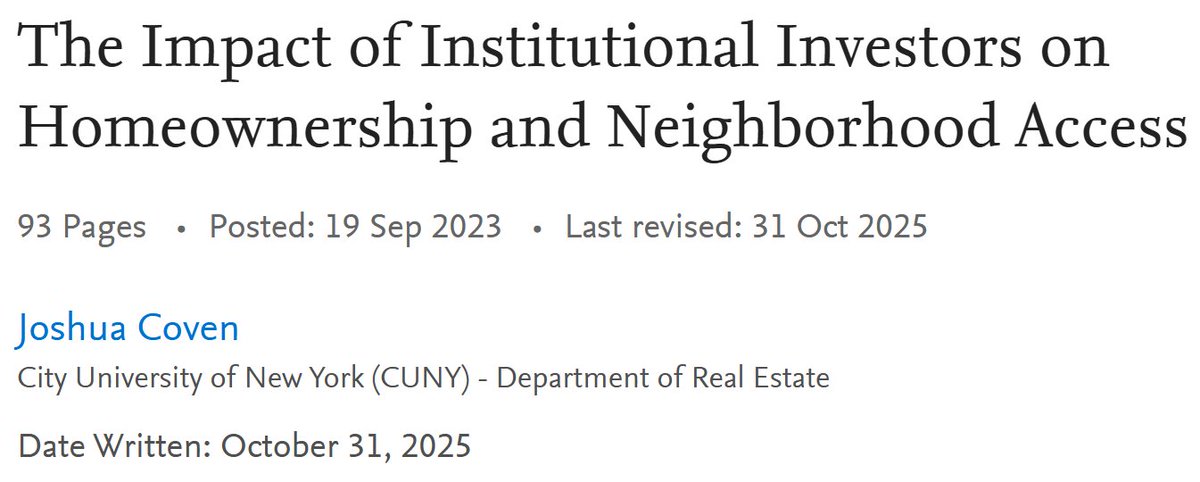
Just days before President Trump announced a ban on institutional investors buying homes, a bunch of academics in the American Real Estate & Urban Economics Association awarded its annual prize for best doctoral dissertation. The co-winner?
"The Impact of Institutional Investors on Homeownership and Neighborhood Access" by NYU’s Joshua Coven, who is now a professor of real estate at Baruch College in New York City.
So, what did Professor Coven conclude from his peer-reviewed and peer-honored study?
Three key conclusions, in his own words:
1) "I find that institutional investors increase the quantity of rentals and lower rents on net because their ability to operate large portfolios at scale outweighs the incentive to use market power to decrease the rental supply."
In other words: More scale = more supply = lower costs for operators (due to scale) + lower rents for renters (due to increased competition).
2) "Institutional investors decrease the quantity of homes available for homeownership and raised prices, however the homeownership impact is 1/5th of what it would be if there were no supply response and the price impact is far below the observed association between institutional investor purchases and actual price increases."
In other words: Yes, every sale impacts prices. But the impact is lower than generally assumed. Additionally: Coven found that if institutional buyers were removed, more than 60% of the homes they bought would have otherwise gone to small investors -- not individual homebuyers.
3) "I find that renters from regions with lower median incomes, worse school test scores, and lower historic economic mobility move into institutional investor rentals."
In other words: Single-family rentals help diversify neighborhoods with families who couldn't otherwise afford to buy homes there -- providing kids access to better schools and better upward mobility.
I’m learning today that there are whole segments of our technocratic class that think the central justification for opposing the russian invasion of ukraine is that putin didn’t have the proper permits
This will put it into sickening perspective:
The bipartisan Government Accountability Office (GAO) investigates fraud and improper payments in federal programs. It estimates that the U.S. government loses between $233 billion and $521 billion annually just to fraud.
Facts:
Personal taxpayers making under $94,440 cumulatively pay ~$236 billion in personal income taxes. This represents the bottom 75% of taxpayers.
Personal taxpayers making under $169,800 cumulatively pay ~$531 billion in personal income taxes. This represents the bottom 90% of total taxpayers.
So, the income taxes 75% to 90% of Americans are paying… are routed directly to fraud.
It’s not 1% a year for 5 years.
It’s a one time 5% tax on all assets and it will kill entrepreneurship in California.
Here is an example:
John Doe starts a company. He takes a nominal salary - say $150k for this example - and the rest in equity in the company. Let’s say he owns 20%. He raises VC capital in 2026 from someone that invests $100M into the company and values the company at $6B. This means his 20% is “worth” $1.2B.
I put it in quotes because he can’t actually sell. He has a paper value that putatively says he’s a billionaire. But he actually lives on $150k because that is what his income is. Just because someone decides to make a bet on the business does not mean some bank account in your name magically gets created with $1.2B in it.
Under the proposed tax, however, John Doe would now owe $60M in cash to California in 2027.
How will he pay it?
Is there some buyer you know of, that the rest of the market doesn’t, that will do a deal at the max value when there is a distressed seller like John Doe who needs money he doesn’t have to pay taxes on value he also doesn’t have!
Now imagine that after the tax is assessed, in early 2027, the company takes a write down to $200M. Now his share is $40M. But he still owes $60M. Again, there are no buyers for his shares per se.
He still only makes $150k/yr.
What is this person supposed to do? He now has a “worth” of $40M but owes California $60M.
Should he declare bankruptcy now because he tried to start a business but was retarded enough to do it in California?
So did you really get the billionaires??
No. Because the mega billionaires have already left or are tax structured to minimize the tax or will fight it.
You will, however, drag a bunch of young, energetic folks who want to make things and hire people into bankruptcy court.
Awesome work, Ro. You should be proud.
What you are saying is not true in any meaningful way.
You can say whatever you want as an untethered hypothetical, but here in reality, what you are actually advocating for is NOT a 1-2% wealth tax for established billionaires - it is a 5% tax calculated all in one year, payable (with interest!) over the subsequent five. That puts massive risk on founders with zero risk for you or Califorjia - as I just pointed out, one market correction (or worst case but sadly common, the company goes under) and I am homeless on the street with literally billions of dollars in debt that cannot be discharged even in bankruptcy.
Nor does this initiative you are pushing have ANY sort of provision for founders like me with illiquid shares in unprofitable companies - if I have to come up with billions of dollars, how can I possibly keep putting all our profit back into new R&D that keeps our warfighters safer? You are effectively forcing companies to immediately pivot into profit obsessesion over mission or long-term sustainability! Again, you say that isn't what you support, but that claim is not consistent with what you are actually doing.
This is all extraordinarily frustrating politician-speak that nobody in the industry is dumb enough to fall for. It is the same as saying you support reasonable speed limits with higher speeds for rural areas even as you explicitly push for a national 55mph speed limit, all the while claiming with a smile that you "support" a wide range of speeds. No, you don't, and no, you don't.
Something I've had to come to grips with:
Those pushing strict rent control don't actually care if rent control "works", in the sense of "accomplishes its aims in a net socially positive manner, after accounting for negative externalities and second- and third-order effects".
It's: "We want whatever we can get for ourselves, and f everyone else, including the future".
Socialism failed even in Venezuela, the country with the largest oil reserves in the world.
Venezuela used to be the richest country in Latin America. Its GDP was two and a half times bigger than the Latin American average.
Venezuela's GDP is now the poorest, with a whopping 80% poverty rate (50% extreme poverty).
From 1920 to 1980, Venezuela's GDP per capita grew at a 6.4% rate, the fastest growth rate in the world.
From 2013 up to today, Venezuela's GDP has collapsed by over 70%. The country is poorer now than two generations ago.
Things were not perfect before the revolution. That is clear.
Poverty was still an issue. Corruption was rampant. People's aspirations were not met for many years.
But socialism only exacerbated these issues. Corruption, poverty, inequality, you name it.
Venezuela is without a doubt the most visible example of the dangers of socialism.