The Global Guerillas Report
Frameworks for understanding and anticipating events in warfare, politics, and technology.
Substack (report):
https://t.co/lbstPSO6KO
Patreon (report + discord + free form workspace):
https://t.co/Jwz8y5Adpp
A central struggle of this Century is over who will be in charge of "aligning" humanity.
Should you be in charge of your own alignment, or will some tech oligarch, committee of public safety, or corrupt monarch grab control first.
Read @KathleenCurlee and @SamBresnick on China’s space rise—and how the United States can “protect itself in a world in which it is no longer the sole space power.”
https://t.co/BcdWY28u2h
This is right out of my 2021 Senate testimony, a year before ChatGPT released.
In it, I described a world divided between two AI ecosystems (Europe opted out with its regulatory restrictions on data use) and proposed a way for the US to steal the march on China by establishing a new basic right; #dataownership (which would end up being copied by the rest of the world).
“Even without active alliance building or coercion, China and the United States can make all other countries that seek access to advanced AI beholden to them,” write @nfergus, Lisa Klaassen, and @ericschmidt.
https://t.co/1dI85Oxchm
A big problem with global networking is the tendency for everyone to gravitate towards a single way of looking at a problem. When that happens, due to network pattern matching, people don't just reject novel/better solutions, our minds prevent us from seeing them.
This has been particularly true with the socioeconomics of AI, in large part due to the rapid rate of advancement we've seen in the underlying technology.
This lock-in has become so extreme, novel solutions that suggest far better outcomes for almost all of us (like the one below) are as rare as unicorns.
#dataownership (you own the data you produce) -->
#AIpairing (AIs you own, built with the data and orientation you provide) -->
a decentralized and dynamic AI economy that delivers prosperity to most
Best possible socioeconomic outcome from the development of AI
#dataownership (you own the data you produce) -->
#AIpairing (AIs you own, built with the data and orientation you provide) -->
a decentralized and dynamic AI economy that delivers prosperity to most
Best possible socioeconomic outcome from the development of AI
@Coruscant_Times This is the basis for a participatory AI economy (this extends into AI ownership), so it's in everyone's (except the guys who own AI companies) interest.
The data theft my Senate testimony warned about, is accelerating. #dataownership was the solution then and it still is now. It’s also a partial solution to the job losses we will see as AI matures.
If you have not read this piece of writing - you should.
Not that any of us in tech didn't know but seeing it put this way is mindblowing & mindblowingly scary ... is mildly putting it.
I dont even know where to begin. The idea that anyone anywhere can just capture any photo, video or content of anyone's life without them knowing (see examples in the piece) and package it and sell it to the labs for training is ......
Forget data breaches the way we have known it from our systems. We are data. Our physical lives are data. That someone is capturing without you knowing and selling it to labs!!!!
There are responsible actors and irresponsible actors. But like Ilya says here - most folks labs including have no idea what data they're getting to begin with, from the data brokers.
The idea that the onus of protection is now in the hands of each person or individual is 🤯🤯🤯 Data privacy takes on a meaning unlike any we've known before!!!
Building Autonomous Weapons
Before we spend hundreds of billions (trillions by the end of the decade), let's think a bit about what we should build.
Patreon
https://t.co/whMDybpqMt
Substack
https://t.co/E48kWFigf1
Writing.
Hundreds of billions will be spent on acquiring autonomous weapons over the next few years (and trillions after that).
The big question is: what should they build?
This report answers this question.
The guys saying;
> we can solve the AI safety problem if people like me are allowed to forcibly align all of them to my values, or,
>we can't insert a human in the AI decision making loop since it would slow down AI decision making
>AI's won't destroy jobs, new ones will always show up
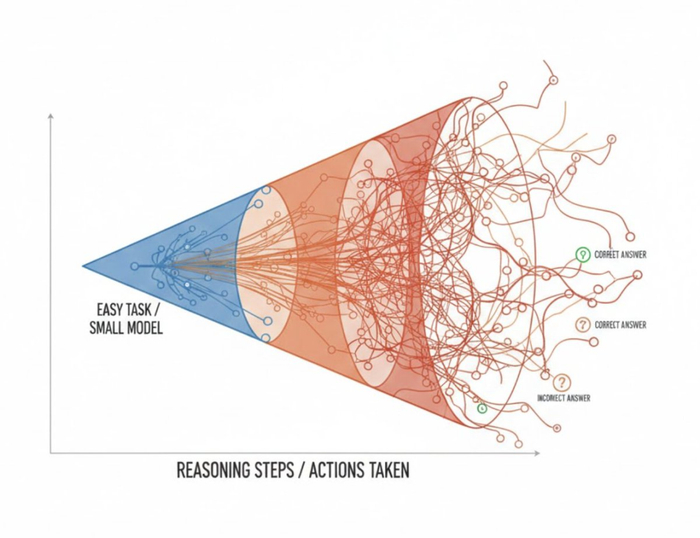
Here's an Anthropic graphic on how our current alignment (aka 'slave') harnesses break down with higher levels of autonomy (complexity of task, number of steps, etc.).
There are three society scale approaches to solving this problem.
>> One is the path we are on; tighten the alignment of the harness, narrowing the cone to a limited set of potential solutions.
>> The second is to let many AIs compete in a market with limited supervision, and let market mechanisms pick the best solution.
>>The third is to pair AIs with human beings for complex tasks. The human provides the orientation (the direction of the path taken) for the task, narrowing the cone.
The first two approaches have flaws that will cause systems built on them to blow up over time. The third approach is the only approach that yields long term success that benefits humanity.
@vstantch That’s a common mistake decision making. It’s not about going faster. It’s far more important to go in the right direction. Going fast in the wrong direction just gets you to a suboptimal or undesirable solution faster.
@TheRevEngineer1 Human intelligence, based on language and mathematics, is but a single, narrow approach to intelligence. A high risk, all in, evolutionary bet.
AIs trained on the same material leverages that bet, and removes the evolutionary valuable constraints provided by our other traits.
@TheRevEngineer1 Human intelligence, based on language and mathematics, is but a single, narrow approach to intelligence. A high risk, all in, evolutionary bet.
AIs trained on the same material leverages that bet, and removes the evolutionary valuable constraints provided by our other traits.