From a 1BR apartment to $10.7M Seed Round lead by @generalcatalyst
What was GeoSpy is now Raven. We are turning the physical world into real-time search.
🇺🇸
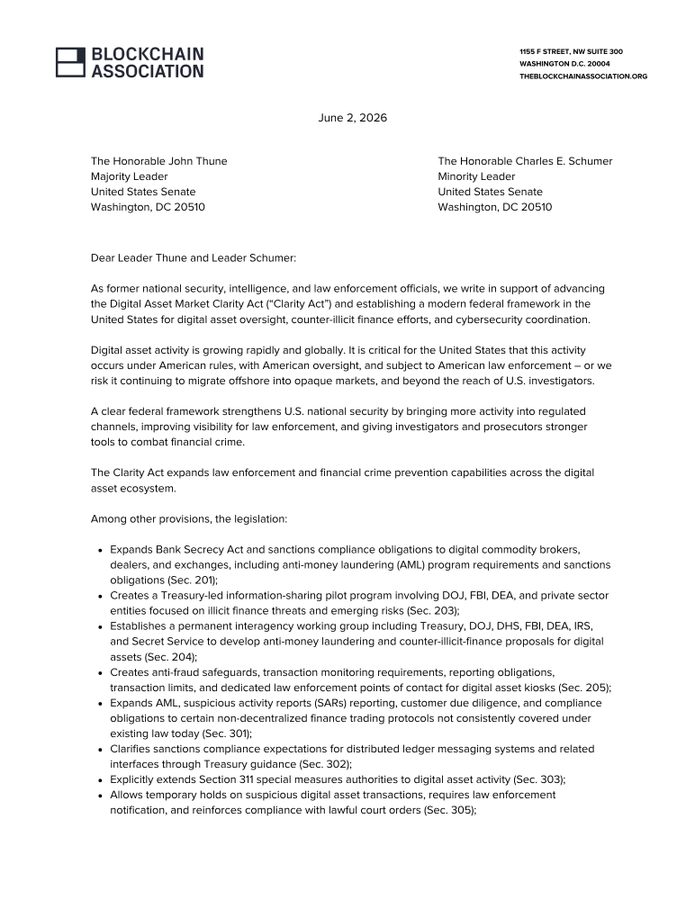
160 former national security, intelligence, and law enforcement officials have signed a letter urging Senate leaders to advance the CLARITY Act.
The group argues that digital asset market structure is a national security and law enforcement priority, saying “regulatory clarity is an enforcement advantage.”
The letter highlights provisions that expand anti-money laundering and sanctions compliance, strengthen coordination between Treasury, DOJ, FBI, and DEA, create a permanent digital asset illicit finance task force, and add new consumer protections for crypto kiosks.
Supporters say clear rules bring more activity under US oversight, improve visibility for investigators, and make it easier to combat fraud, money laundering, sanctions evasion, terrorism financing, and trafficking.
The push comes as industry advocates head to Washington this week for meetings across 18 Senate offices to rally support for the bill.
We're partnering with @ethena to support their security and operations across more than $5 billion in assets.
Coinbase is now their primary custodian, wallet provider and perpetuals venue.
With USDe coming to @base and our wider ecosystem.
Rand Hindi reveals how just 5% of one RWA protocol could make Zama the largest privacy protocol in crypto:
“T-REX already has $100 billion committed to its protocol. If just 5% of those existing commitments get shielded with Zama, it would make Zama the largest privacy protocol by total value shielded.”
“Privacy is still tiny today compared to the enormity of finance moving onchain. We talk about billions in DeFi today, but we’re going to be talking about trillions.”
Hyperliquid, a decentralized crypto platform, is open 24 hours a day, seven days a week. The exchange has emerged this year as a go-to spot for Wall Street’s weekend warriors. https://t.co/3VCVCnxToh
Are we in a Zombie VC era?
I came across a post by @endowment_eddie that really stuck with me. He pointed out that growing DPI dispersion, combined with increasing concentration in top portfolio assets and slow exit activity, is creating perfect conditions for "Zombie VCs".
The core issue is that IRR hides the problem. GPs can show double-digit returns for years simply by marking up positions and extending fund life and everything looks fine on paper until you check actual DPI.
So I decided to dig into the data and pulled the @cartainc dataset from Q4 2025 (all fund sizes) to see how many Zombie VCs are actually on the market. Here’s what stands out:
1/ ~85% of 2017–2018 vintage funds have still not returned capital - their DPI is below 1× after 7–8 years
2/ The median 2017 fund has returned only $0.34 on $1. At the same time, the median IRR for that cohort is 11.6%
3/ Only the top 10% of funds from that vintage have crossed 1x DPI
4/ For 2019–2022 vintages, even the 90th percentile hasn’t fully returned capital yet
5/ The gap between paper IRR and actual DPI continues to widen with every year that liquidity stays limited
To make sense of this, I split the funds by IRR and DPI percentiles and grouped them into 4 buckets:
- Winners (high IRR + high DPI). These are the funds that actually converted paper marks into cash. Only the top ~10% of 2017–2018 vintages landed here. This is what a successful VC fund is supposed to look like.
- Conservatives (low IRR + high DPI). Capital has been returned, but without meaningful upside. Usually the result of early exits at modest valuations. Rare in classic VC.
- Underperformers (low IRR + low DPI). These look weak both on paper and in terms of actual distributions, but for more recent vintages it could simply mean they are still too early. Either way, there is no false paper narrative.
- Zombie zone (high IRR + low DPI). Strong on paper, almost nothing returned. This is where most 2017–2022 funds actually sit.
In reality, buckets 3 and 4 look almost identical from the outside – both have low DPI and can say “we’re still early.”
The dangerous difference is underperformers are either “weak” or actually too early, but their low IRR is transparent. Instead zombies remain “alive” thanks to high paper IRR. They can raise new funds while distributing almost nothing to LPs from the current one.
My take: If your 2017–2021 fund is sitting in the Zombie zone with a respectable IRR but DPI still below 0.4-0.5x after this many years, it’s time to be honest with yourself and your LPs.
I expect a significant catalyst in the form of a stronger IPO window (especially larger, quality deals), which together with continued strength in secondaries should finally reopen primary liquidity channels. This will be make-or-break for funds sitting in the Zombie zone.
And from an LP perspective, it is often less damaging to long-term relationships when a fund is mentally written off early, rather than seeing high mark-ups for years followed by little to no DPI.
Jito Foundation is hiring a Growth Lead for Korea & APAC.
Join the team that built Solana’s Market Layer—the execution, capital, and incentives protocols that allow the onchain economy to function.
Ideal candidate:
• Based in South Korea/native Korean speaker
• Deep existing network in Korean crypto across media, creators, etc.
• Self-directed, owning outcomes and operating autonomously
Apply below:
Brian Armstrong: Crypto started like HTTP - totally transparent, everything on a public ledger.
Now it needs to become HTTPS (private).
His solution: optional private transaction types on default-open chains.
Coinbase acquired a company called Iron Fish in 2025 to build exactly this for Base.
FT @Brian_Armstrong@KevinWSHPod@Coinbase.
Holy cow… this is basically an ad for @Zcash, @Zama and any other privacy-preserving protocol; Seizure-resistance is now increasingly topical and important, no longer a hypothetical.
I will soon be introducing a bill to give the public a 50% ownership stake in the largest AI companies in America.
This would guarantee that the trillions created by AI are used to improve the lives of all of us — and block oligarch decisions that harm the American people.
Solana needs to increase SOL burn and reduce SOL inflation. These two proposals should be voted on when the new Solana governance system is live in prod. I support both of these proposals.
https://t.co/PqzODiSVwa
https://t.co/LEenYKn4Bl
The next generation of decentralized, onchain, trustless perps will be built on @solana and we are here to make it happen
If you are building anything to help accelerate the adoption of onchain perps reach out now
DMs are always open
The future of onchain trading demands a new market structure. Come build it with us
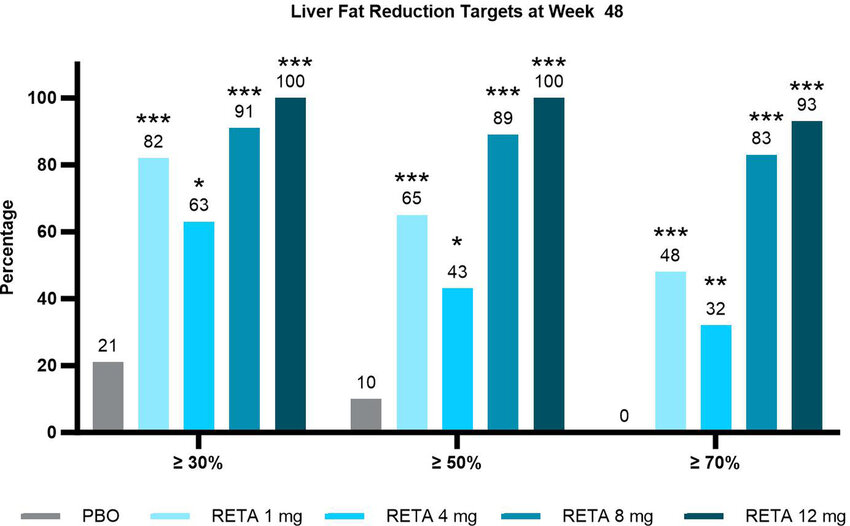
Retatrutide's liver data is unlike anything we've seen from a weight loss drug:
- 86% liver fat reduction at 48 weeks, most of it within the first 24 weeks
- 93% of patients achieved completely normal liver fat levels
For context, tirzepatide reduces liver fat by 45–57%.
One in three adults has fatty liver disease and most don't know it.
The reason for this is retatrutide's glucagon receptor. It tells the liver directly to burn its stored fat, not just reduce calories coming in.