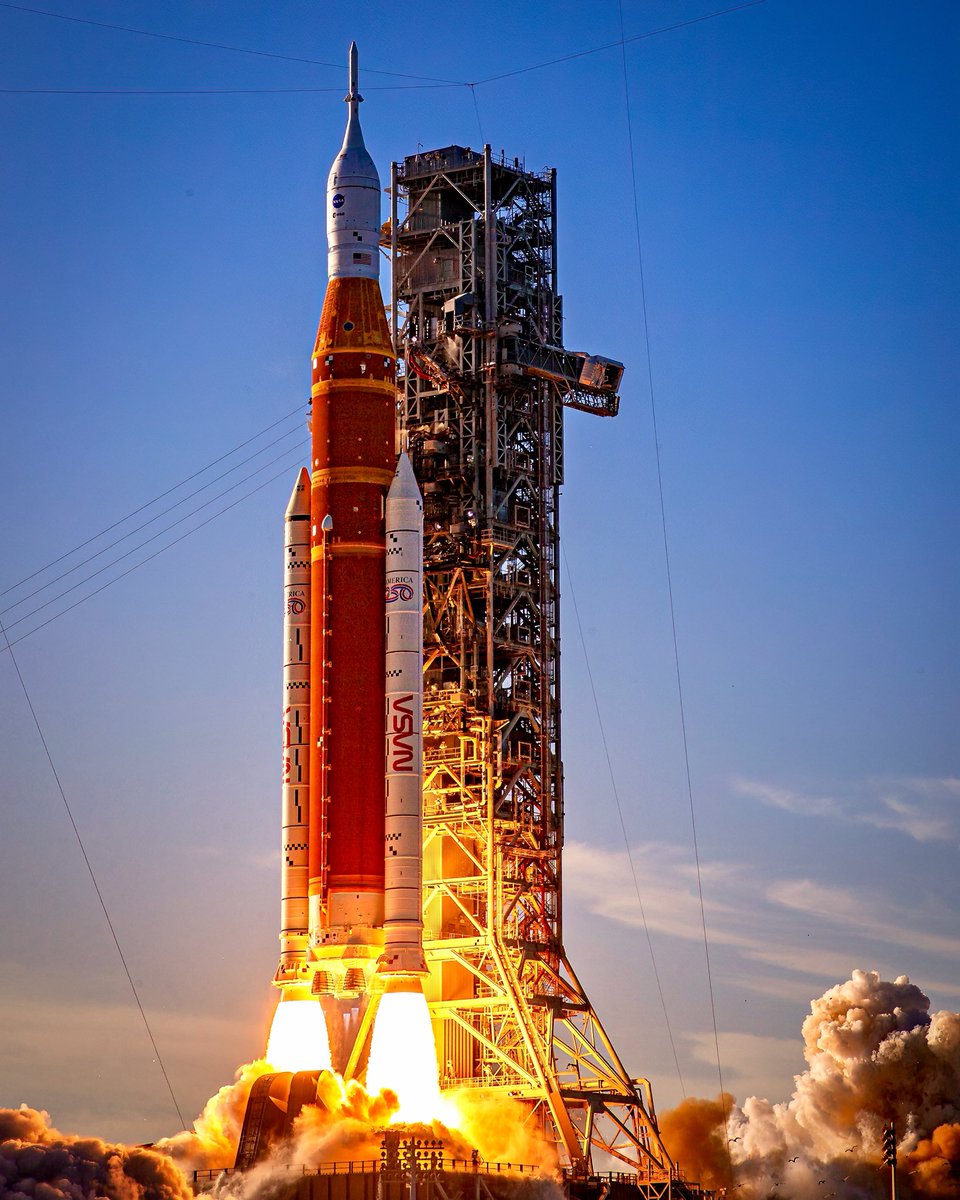
This is the shot you can’t get from the press site. This camera was sitting a few football fields from the SLS rocket at Pad 39B for days before launch, baking in the Florida sun, surviving rain, humidity, and whatever else the Cape threw at it. No photographer behind the viewfinder. Just a camera, a sound trigger, and a bet.
The way pad remotes work: you set your camera up days in advance, dial in your composition, lock everything down, and walk away. You don’t touch it again until after the launch. The shutter fires on sound activation
with a @MiopsTrigger smart+ trigger. With SLS, the four RS-25 engines ignite six seconds before the solid rocket boosters, so the camera is already firing before the vehicle even leaves the pad. You get home, pull the card, and find out if you nailed it or if a bird landed on your lens two days ago and left your a present and you got 400 photos of soemthing crappy.
There’s no formula for protecting your gear this close. Some photographers build wooden boxes with doors that pop open. Some use plastic bags and tape. Some do plastic or metal barn door rigs on hinges. I tend to leave mine open just in plastic rain covers because boxes limit my composition and setup time, but that means your cameras are more exposed to the elements and whatever energy and debris comes off the pad. You’re basically gambling a camera body every time you set one.
That’s what I love about this genre. There’s no playbook. You make it up as you go. Every time is an adventure.
📸 credit: me for @SuperclusterHQ - Artemis II pad remote | ~1,000 ft from Pad 39B | Kennedy Space Center
BREAKING 🚨: NASA dropped a new James Webb telescope deep space image
All the eight-sided features are stars in the Milky Way, everything else is a galaxy 🤯
In praise of mystery ✨
After a successful launch aboard a @SpaceX Falcon Heavy rocket from @NASAKennedy, @EuropaClipper is on its way from our ocean world to another to see if Jupiter's moon Europa has conditions suitable for life: https://t.co/nfI8RjiAuQ
Since your handle is “Whole Mars”, perhaps this lengthy reply is apropos:
Getting the cost per ton to the surface of Mars low enough that humanity has the resources to make life multiplanetary requires a roughly 1000X improvement in rocket & spacecraft technology.
Recent US Mars missions have had a cost per ton of useful load to the surface of Mars of about $1B. Moreover, it has become more, not less, expensive over time!
To build a city on Mars that can grow by itself likely requires at least a million tons of equipment, which would therefore require >$1000 trillion, an obviously impossible number, given that US GDP is only $29T.
However, if rocket technology can be improved by 1000X, then the cost of becoming sustainably multiplanetary would drop to ~$1T, which could be spread out over 40 or more years, so <$25B/year.
At that cost, it becomes possible to make life multiplanetary, ensuring the long-term survival of life as we know it, without materially affecting people’s standard of living on Earth.
Starship is designed to achieve a >1000X improvement over existing systems and, especially after yesterday’s booster catch and precise ocean landing of the ship, I am now convinced that it can work.