In 1 year, $AMKR spiked from $18 to $90 so 500% but it can easily hit $300-$500.
Here's 8 reasons why it hasn't ran like $AVGO $AMD $NVDA $MRVL $GOOG $AMZN:
1. Advanced packaging sits directly on the critical path of AI infrastructure growth and is becoming more important as Moore's Law slows.
2. Management expects revenue to grow from $6.7B in 2025 to approximately $11B+ by 2030.
3. EPS is projected to increase from $1.50 to roughly $5.00+, implying more than 3x earnings growth.
4. AI servers, GPUs, ASICs, HBM memory, and chiplets all require increasingly complex packaging solutions.
5. $AMKR has 18 active 2.5D engagements and multiple HDFO programs already entering production.
6. The Arizona facility creates a strategic U.S. packaging monopoly-like position among scaled OSAT providers.
7. Deep relationships with $NVDA, $AAPL, $AMD, $AVGO, $QCOM, $TSM and other semiconductor leaders reduce customer risk.
Higher-value advanced packaging should drive gross margins from 14% toward 22%+ by 2030.
♻️ RESHARE this post and write 1 comment, I'll DM you 2 more plays that hasn't exploded under $10 still.
JTX might be the most important Solana launch of the year.
Jito, the team that built half of Solana's infrastructure, is now building a trading platform.
1. Roadmap:
Spot trading first → perps (with a PhoenixTrade integration) → prediction markets.
→ Spot trading will access all the DEXes on Solana, using DFlow for aggregation, pulling from Meteora, Orca, and the prop AMMs on Solana.
2. Goal of JTX:
→ To attract traders who trade stocks, bridged assets, memecoins, RWAs, whatever you want, with best in class liquidity and UX.
→ To give traders the best possible trading experience and lots of assets that also trade on weekends.
→ And the timing isn't an accident. Last week Solana processed $11.6B in spot DEX volume, above NYSE American's $10.5B. It's already passed Coinbase and Kraken. The long term benchmark isn't bigger CEXs. It's the Nasdaq itself. With global distribution, 24/7 markets, and tokenized equities entering the stack, that now feels increasingly possible.
That's the opening JTX is built for.
3. Early access is open now:
→ Join the waitlist → private beta in the next ~2 weeks
https://t.co/CCwtl8dwUw
4. The edge is the infra. JTX runs on Jito's own BAM plugins. BAM (Block Assembly Marketplace) moves transaction sequencing into trusted execution environments, bringing proposer builder separation to Solana. Translation: private, verifiable ordering, tighter spreads, far less toxic MEV. It's the closest thing Solana has to a real block building layer, and JTX builds directly on top of it.
5. JTX will direct 80% of all fees toward $JTO buybacks, and Jito already runs a lot of Solana's core infra. Could be a solid alt to spot buy and hold long term. NFA.
$NOW --- $NOW has forged an in-depth strategic alliance with Google Cloud to roll out a brand-new suite of AI solutions spanning 5G networks, retail operations and enterprise IT workflows. Google Cloud formally honored the firm with its Annual Global Partner Award for Commercial Applications & Agent Innovation this June, further cementing its impenetrable ecosystem moat.
Mid-to-late May, Bank of America flagged $NOW as a top AI beneficiary stock, stressing its market leadership is virtually unassailable. Then in mid-June, Benchmark analysts lifted the stock’s price target counter-trend from $125 to $130, reaffirming it as their large-cap value top pick across the software sector.
1.The Ultimate AI Control Tower for Agentic AI
Investors previously feared AI would render legacy enterprise software obsolete. However, NVIDIA CEO Jensen Huang made a definitive statement at this year’s Knowledge 2026 conference: “Agentic AI is entirely additive for software vendors.”
Enterprises of the future won’t only employ human staff—they’ll run countless autonomous AI agents handling day-to-day operations. Who orchestrates, coordinates and governs all these AI agents? The ServiceNow Now Platform.
$NOW is evolving into the enterprise-wide AI Control Tower for digital transformation, embedding native AI capabilities seamlessly into core business workflows including IT management, HR and customer support.
2.Unrivaled Stickiness & Defensive Profile (97% Customer Retention Rate)
Once ServiceNow’s workflows are embedded into day-to-day operations of Fortune 500 firms (over 85% of the Fortune 500 are active clients today), switching costs become prohibitively steep. Since late 2019, $NOW has maintained a consistent 97% quarterly customer retention rate. This unparalleled competitive moat delivers the sector’s most predictable cash flow through all macroeconomic volatility cycles.
3.High Certainty on Long-Term $30B+ Revenue Target
At its 2026 Investor Day, management laid out crystal-clear long-term financial guidance: a 19.4% compound annual growth rate (CAGR) projected between 2026 and 2030, with a revenue target of $30–32 billion by 2030, alongside sustained ultra-high operating margins north of 33%.
Space Force has issued new orbit data for the @AST_SpaceMobile sats launched yesterday, showing all three in their expected 525 x 530 km x 53.0 deg orbits, independently confirming successful launch.
$RBRK plans to integrate Agent Cloud with $AMZN Bedrock AgentCore to strengthen security and governance for AI agents.
The integration will add agent discovery, risk visibility and the ability to reverse destructive agent actions.
DECISION IMMINENT: US energy regulator FERC is poised to rule by end of June on how data centers connect to the grid. Former FERC Chairman Neil Chatterjee calls it "the most significant FERC action in decades."
Two tracks to watch:
1) PJM co-location rules: clarifying whether hyperscalers can buy power directly from on-site generators without triggering tariff violations
2) A broader DOE-directed federal rulemaking that would standardize large load interconnection nationwide and may require hyperscalers to foot the full bill for grid upgrades
Existing grid interconnects become more valuable if hyperscalers must self-fund upgrades, but even more importantly, regulatory certainty alone is likely enough to kick off a new investment cycle in PJM, where new capacity has badly lagged demand. For context, PJM fell 6.6 GW short in its December 2025 capacity auction, with capacity prices hitting a record $333/MW-day.
Could be good catalyst for PJM-exposed names: $TLN $CEG $WULF $KEEL $MARA
🤖Physical AI is the next trillion-dollar buildout, and the market is still pricing it like a demo reel.
It's also just one layer.
Here's the whole map of what the next decade actually runs on, and the names building each piece 👇
In 2023, the AI trade was $NVDA and the hyperscalers. The brains. In 2026, the body went into production. Figure's factory is reportedly turning out a robot an hour. Boston Dynamics has its entire 2026 Atlas output pre-committed to Hyundai and DeepMind. Unitree shipped more than 5,500 humanoids last year and is targeting five figures this year.
Demos don't need supply chains. Production lines do. Every robot that ships is a bill of materials, and every line on that bill is a company. The market pays full price for cash flow after it arrives. The asymmetry is owning the chokepoints before it does.
Robots can't run on vibes. Here's the stack that builds them, asymmetric setups up top, anchors at the base.
THE ASYMMETRIC SETUPS💫
Small-cap chokepoints. Multiple-X potential if the theme delivers.
🧠 BRAIN: Edge Compute
$AMBA: edge-AI vision SoCs with a 46M-unit installed base, and a fresh Hanwha LTA worth $800M+ over a decade spanning robotics, industrial automation, and security. One of the first deals of its kind in edge AI.
$CEVA: the IP royalty toll on edge silicon. Every device that thinks locally pays someone for the architecture.
$AIP: the on-chip highway. Network-on-chip IP licensed into the SoCs the robots run on.
👁 EYES: Perception
$OUST: digital lidar plus cameras after the Stereolabs deal. Q1 revenue +49%, the 13th straight quarter of product revenue growth, and Rev8, the first native-color lidar. The company calls itself sensing and perception for Physical AI, and the numbers back the name.
$AEVA: FMCW 4D lidar that reads velocity, not just distance. Exclusive long-range lidar supplier for Daimler Truck's autonomous program.
💪 MUSCLE: Magnets
$USAR: commercial NdFeB magnet production live in Oklahoma, ramping toward 1,200 tonnes by early 2027, with a new South Carolina plant targeting 10,000 tonnes of domestic capacity. China still makes roughly 90% of the world's magnets. Every robot joint needs one.
⛏ FEEDSTOCK: Upstream Supply
$MP: the domestic mine-to-magnet chain. The raw input the chokepoint runs on.
🦾 BODY: Embodiment
$KRKNF: subsea autonomy, the rare robotics name already adjusted-EBITDA positive. Q1 revenue +35%, and the C$615M Covelya deal closes within weeks, taking the combined company to roughly C$365M of revenue at a 24% EBITDA margin. The ocean is a robotics theater too.
$RR: service humanoids built on NVIDIA's robotics stack.
$SERV: autonomous sidewalk delivery, spun out of Uber, NVIDIA-backed.
$PDYN: embodied-AI software for industrial robots and drone swarms.
🛸 AUTONOMY: Air & Ground
$ONDS: Q1 revenue up 10x to $50M, full-year guidance raised to $390M+, backlog at $457M, and $1.48B in cash to keep consolidating. The Mistral deal brought U.S. prime contractor status, including participation in a $982M Army loitering-munitions program.
$RCAT: tactical defense drones, built for the NDAA-compliant procurement lane.
$AUR: driverless freight, commercially live in Texas. The first robot most of America will share a road with is a truck.
⚡ POWER: The Nervous System
$NVTS: GaN and SiC power semis, working with NVIDIA on the 800-volt architecture the next datacenter and robot generation runs on. Efficiency is the constraint as fleets scale.
🎒 FIELD COMPUTE: Edge AI Deployed
$OSS: datacenter-class AI compute ruggedized for drones, vehicles, and defense platforms. The brain has to survive the field.
🏛 THE ANCHORS
Own the theme durably. Not asymmetric, but they cannot lose the war.
$NVDA: Isaac GR00T and Jetson Thor. The OS every robot trains on, and the checkbook funding the whole stack.
$TSLA: Optimus. The only player with the manufacturing base to brute-force mass production.
$TER: industrial automation and cobots. Universal Robots already on factory floors.
$QCOM: the Dragonwing edge platform. The fleet's connectivity layer.
$ARM: the IP tax inside nearly every edge chip.
$POWI: the established, profitable high-voltage power anchor.
$ISRG: surgical robotics. Proof the category can print money, decades ahead of the rest.
The asymmetric upside lives in chokepoints capital can't easily replicate: IP, perception, magnets. The anchors are how you own the theme while you wait.
The counter-thesis, because every map needs one. Most of the asymmetric layer is pre-profit, and the real revenue inflection is 2027 and beyond. China is the other side of this trade: Unitree and AgiBot are shipping volume at price points Western names can't yet touch, and if embodiment commoditizes the way solar did, the hardware layer gets squeezed while the IP and feedstock layers keep the margin. Several of these names have already re-rated hard this year. This is a patient, multi-year allocation. Size accordingly.
The robots stopped being demos this year. They became purchase orders.
Own the parts inside them.
Bookmark this one. It will still be the map when the cash flow shows up. Then tag the investor still pricing robots as science fiction.
$USAR, $MP, and $LYSCF are incredibly important.
Probably the biggest national security priority for the government at the moment.
$USAR specifically has:
-> Acquired Sierra Verde which has signed a 15-year supply agreement with US Gov & private investors.
-> Expiring contracts with Chinese buyer at the end of the year.
-> First large scale producer of light & heavy rare earths outside Asia.
-> Defense contractors have a hard January 1, 2027 deadline to source outside of China.
-> First investor day planned for Q3
-> Blue chips, OEMs, and Tier 1 defense all actively engaging.
Unprofitable, slightly risky, but very very important.
The S&P 500 quarterly rebalance announcement is expected after the close tonight, and $MRVL is the name everyone is watching.
If it gets the nod, this is the least surprising index addition in years. The only real question is how much is already in the price.
The case for inclusion:
→ Size: Marvell is sitting north of $275B market cap. The next largest eligible candidate, $BE, is around $82B. It does not just qualify, it dwarfs the field.
→ Profitability: it clears the earnings screen cleanly. Record Q1 FY27 revenue of $2.418B, up 28% YoY, with data center now ~76% of the mix.
→ Narrative: Jensen called it “essential” at Computex and floated the trillion dollar club. Nvidia put $2B in. NVLink Fusion wires it straight into the rack.
Here is the part most people skip. Index inclusion is not a story, it is a forced buyer.
Every fund benchmarked to the S&P 500 has to own it at its index weight, on the effective date, regardless of price or valuation. That is mechanical demand that does not care about your DCF. The index effect is real, and for a name this size the weight is not trivial.
The reshuffle goes effective prior to the open around June 19. That window, announcement tonight into the effective date, is where the index-effect flows actually land. That is the part to watch, not the headline.
$KEEL - Moses Lake is go. 🟢
Turner Construction just received the Coverage Letter from the Washington Department of Ecology.
That’s the official legal authorization to discharge stormwater. The final permit.
Every. Single. Gate. Is. Open.
Here’s the full checklist:
✅ Zoning approved
✅ Demolition permit issued March 19
✅ Public notice expired May 29
✅ NOI administratively complete June 1
✅ Soil contamination cleared May 27
✅ Coverage Letter issued - Turner Construction ✅
There are no more permits to clear at Moses Lake.
Turner Construction is on site. Staffed. Ready.
Notice to Proceed is next.
Then shovels in the ground.
The original construction target was October 2026.
They’re months ahead of schedule.
One site fully permitted and construction ready. Two more in progress. Three leases promised by year end.
This is what execution looks like.
$KEEL 🏗️⚡
DYOR. NFA.
$RDW catalyst list
1.SpaceX goes public
2.Own engineering/business breakthrough: RDW is expected to simultaneously announce the key business progress of its space manufacturing (such as ZBLAN optical fiber or bioprinting),
3.large follow-up orders from the Pentagon and NASA.
$RDW
Moving exactly as scripted, and this pullback is not a warning. It is an invitation.
$32 is the next stop, followed by $45 after that.
Members received the exact adding plan this morning.
If you need context for how significant this opportunity is, think about what it felt like to miss $ASTS at $40 and $RKLB at $30. This is that moment.
$NOW is 1000$ stock trading 115$
$CRWD is a 2000$ stock trading 660$
$SMCI is a 250$ stock trading 45$
$OKTA is 500$ stock trading 122$
$AAOI is a 900$ stock trading 180$
$ZETA is 200$ stock trading 22$
$OCTV is a 150$ stock trading 18$
$EOSE is a 110$ stock trading 8$
$RDW is a 150$ stock trading 18$
$INFQ is 175$ stock trading 17$
$UMAC is a 200$ stock trading 28$
$SATL is a 80$ stock trading 8$
$HIVE is a 50$ stock trading 4$
$IMSR is a 85$ stock trading 8$
$SMR is 120$ stock trading 12$
$LAES is a 45$ stock trading 3.50$
$CGNT is a 135$ stock trading 9$
$ELMT is a 100$ stock trading 19$
$VELO is a 150$ stock trading 18$
$DDD is a 35$ stock trading 3$
$GRRR is a 90$ stock trading 18$
$TSSI is a 165$ stock trading 13$
$SAIL is a 130$ stock trading 17$
$NTSK is a 120$ stock trading 10$
$FLNC is 155$ stock trading 140$
$RZLV is a 35$ stock trading 2.50$
$ASPI is a 90$ stock trading 8$
$RR is a 30$ stock trading 2.60$
$CPSH is a 85$ stock trading 8$
$OCC is a 160$ stock trading 14$
$VIVO is a 45$ stock trading 5$
$CRDO is a 600$ stock trading 200$
$QBTS is a 200$ stock trading 27$
$USAR is a 150$ stock trading 27$
$NNE is a 120$ stock trading 26$
Don’t miss these x fam.
These are the dips.
They were all down 9/10% today.
Bookmark. Repost. Subscribe 1$
Check back in 5 years.
Take risks.
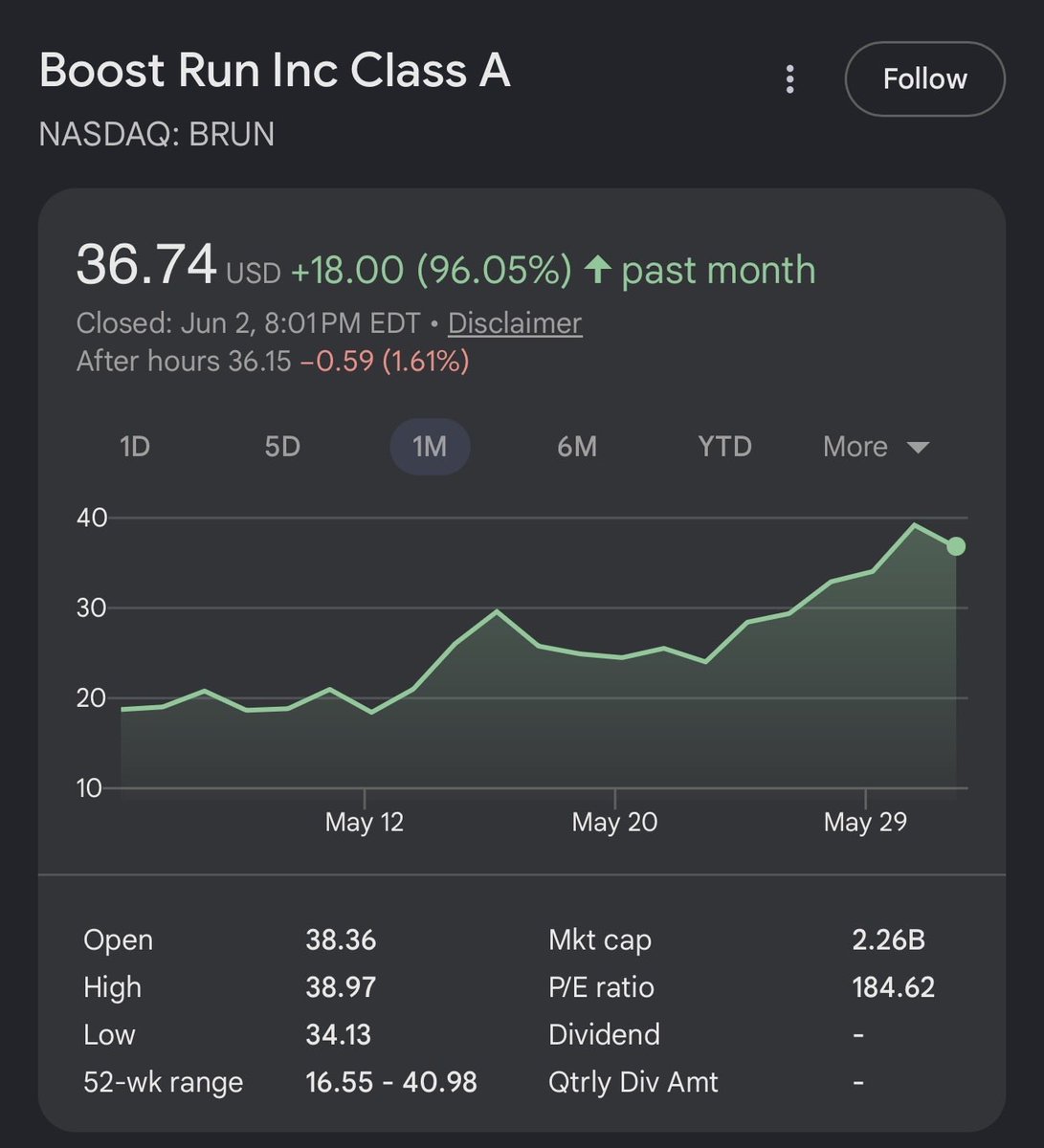
There is a brand new AI infrastructure company that just hit the public market and only a few people on X are talking about it.
$BRUN.
I think this is one of the most overlooked opportunities in the entire AI buildout right now.
Here is what Boost Run actually is.
They deliver scalable AI and high performance computing infrastructure. GPU compute, CPU nodes, managed Kubernetes, and storage for enterprises that need control, speed, reliability, and compliance.
They just began trading on Nasdaq in May after coming public through a SPAC. And the relationships they have already locked in are what make this so compelling.
Start with NVIDIA. $BRUN is an NVIDIA Preferred Cloud Service Provider and just achieved NVIDIA Exemplar Cloud validation.
In a supply constrained market where everyone is fighting for GPU allocation, being a preferred NVIDIA partner means you get access to next generation chips that competitors cannot easily get.
That is a massive structural advantage for a company this size.
Then look at Dell. $BRUN entered into a $1.44 billion purchase agreement with Dell Technologies for AI compute and storage infrastructure.
They also expanded their relationship with Dell Financial Services to align flexible capital with customer contracts.
Dell just posted one of the best quarters in its history with AI server revenue up 757% year over year. $BRUN is plugged directly into that supply chain.
And the contracts are already coming. They signed orders for 5,000 NVIDIA B300 GPUs across their facilities with a combined contract value of roughly $471.7 million over 36 months.
Take or pay structure. The customer pays for the full term regardless of usage. That is locked in recurring revenue.
A newly public AI infrastructure company. NVIDIA preferred partner status. A $1.44 billion Dell agreement. $471 million in contracted GPU revenue already signed.
And a market cap that almost nobody has discovered yet because it just came public.
This is exactly the kind of early stage gem that gets found before it runs.
$TE agreed to acquire KORE Power for ~$32M giving T1 Energy direct exposure to battery storage and AI data center infrastructure.
The deal adds KORE’s utility-scale battery storage platform with ~1,100 global projects and is expected to contribute ~$20M of EBITDA in 2027.
BREAKING: The CLARITY Act, the most important crypto regulation bill in U.S. history has officially been placed on the Senate Legislative Calendar.
The bill cleared the Senate Banking Committee on May 14 with a 15 to 9 bipartisan vote. It is now formally in the queue for a full Senate floor vote.
If passed, the CLARITY Act would for the first time establish clear legal boundaries between the SEC and CFTC over crypto, ending years of regulatory uncertainty that has allowed manipulation and fraud to operate freely across the industry.
I think Jito has the potential to be one of the first true crypto economies.
JTO is the central value accrual and economic alignment asset. Buybacks coming from not a single app, but fees across several revenue lines including including JTX, JitoSOL and BAM.
People who refer people to JTX earn JTO, which has been bought back from the market, which will radically expand the distribution. Not inflationary incentives, backed by value.
The governance token era is dead, this is what tokens should be.